
The president of the United States is using the Department of Justice, the FBI, and the Department of Homeland Security to coerce states into changing their election rules to favor his party. He is not hiding this. He gave a twenty-five-minute televised speech about it on July 16.
The specifics are not in dispute. The DOJ has demanded unredacted voter lists from thirty states, containing the personal information of every registered voter. Federal judges have rejected half of those demands. The Department of Homeland Security has promulgated new rules conditioning counter-terrorism funding on states changing how they conduct elections. The FBI has sent two hundred agents to Fulton County, Georgia, to investigate an election that happened six years ago and has already been audited, recounted, litigated, and certified. The director of Homeland Security has threatened local election officials with jail time if they fail to comply with the administration’s election directives.
These are the actions of a government turning its law-enforcement apparatus against the democratic process. The mechanism is not complicated. When you control the DOJ, you can threaten state election officials with criminal prosecution for allowing noncitizens to register to vote — a problem that multiple studies have shown is vanishingly rare — and then use those threats to pressure them into adopting voting restrictions that disproportionately affect your opponent’s voters. When you control the FBI, you can reopen investigations into elections you lost, seizing hundreds of boxes of ballots and interrogating election workers, and the message to every election official in America is: defy us and we will do this to you next. When you control DHS, you can tie funding for counter-terrorism to election-rule compliance, and suddenly the fight against domestic extremism becomes a lever for vote suppression. This is not governance. This is a protection racket, with the franchise as the hostage.
I have watched this movie since Nixon. The names change but the script does not: an administration facing electoral accountability turns the machinery of justice into a shield. Nixon sent the FBI after his political enemies and tried to use the CIA to shut down the Watergate investigation. The Bush administration fired nine U.S. Attorneys in 2006, several of whom had refused to pursue politically timed prosecutions against Democrats, in what the Justice Department’s own Inspector General later described as an unprecedented politicization of the department. And now a president who has never accepted a loss converts the FBI into his personal recount committee, the DOJ into his campaign’s legal arm, and DHS into his elections-enforcement squad. The fourth time in my lifetime. The machine is the same. Only the audacity grows.
What makes this iteration distinct is the volume. Previous administrations at least maintained the pretense that law enforcement was independent. Nixon’s abuses were exposed precisely because the system still had enough integrity to investigate itself — the Saturday Night Massacre failed because his own attorney general and deputy attorney general resigned rather than fire the special prosecutor. The 2006 firings resulted in congressional investigations, an Inspector General report, and the resignation of Attorney General Alberto Gonzales. Accountability, however slow, arrived.
This time, the pretense has been discarded. The letters went out to state election officials on DOJ letterhead, written by a top department official, explicitly threatening criminal prosecution. The FBI director, a presidential appointee, has remained silent while his agency is deployed to re-litigate a settled election. The DHS secretary stood at a press briefing and repeated the president’s unsubstantiated claims about election fraud while threatening local officials with jail. There is no independent figure inside the administration applying the brakes, because independence has been systematically removed. The president has already fired the non-partisan members of the Election Assistance Commission. He has suggested he is open to sending ICE agents and National Guard troops to polling places. The old constraints — norms, career officials, institutional loyalty to the law rather than the man — have been dismantled or cowed into silence. What remains is a president who lost an election six years ago, who now commands the full force of the federal law-enforcement apparatus, and who has made unmistakably clear that he intends to use it to ensure he does not lose again.
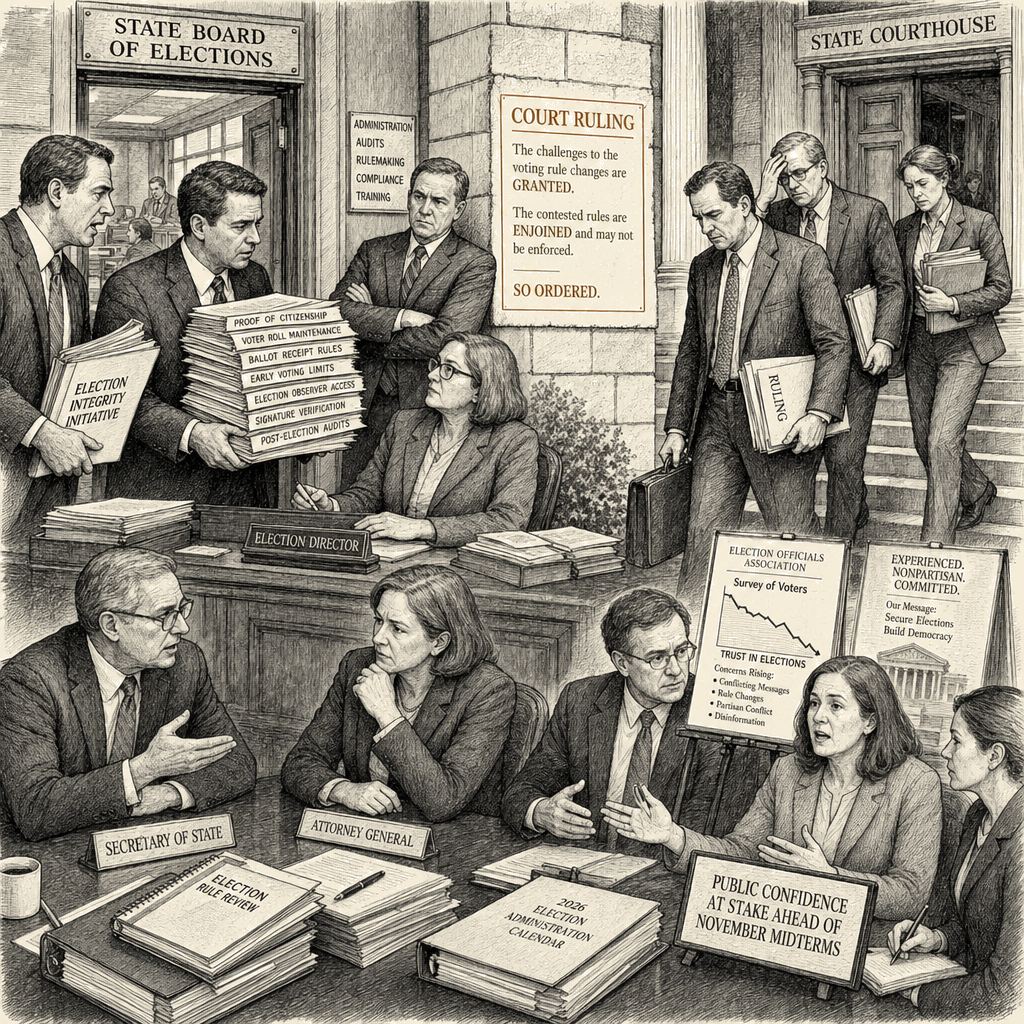
The courts have pushed back. Fifteen of the thirty DOJ demands for unredacted voter rolls have been rejected by judges. One judge openly excoriated the department, calling its subpoena for every election worker’s information in Fulton County an arbitrary fishing expedition. The Democratic governors released a joint statement calling the president’s actions deeply alarming. A few former Republican officeholders have warned that the president’s obsession with the 2020 election will backfire. But the administration is not relying on winning in court. It is relying on winning through chaos — injecting enough uncertainty, enough fear, enough threat of investigation that election officials hesitate, that voters stay home, that the machinery of democracy seizes up in ways that benefit the party in power. The point is not to prevail on the legal merits. The point is that a state election official in Michigan or Pennsylvania, reading about FBI agents seizing ballots in Georgia and a DOJ official threatening criminal prosecution, will think twice before mailing out ballots or certifying a result the administration dislikes. The chaos is the weapon.
There is a particular category of American political scandal that follows a fixed architecture: a president, facing the loss of power, deploys the instruments of the state to prevent that loss. The scandal is never that the scheme was clever — it never is. It is that the scheme was attempted at all, by people who had sworn an oath to the Constitution. Nixon resigned. Gonzales resigned. The accountable figures eventually faced consequences, however partial. The question now is whether the architecture that produced those consequences still exists well enough to produce them again, or whether the machine has finally been built strong enough to protect the man who built it — the man who, six years and zero evidence later, has two hundred FBI agents in Georgia, a threatened DOJ letter on every state election director’s desk, and a midterm election in November he has already begun to rig.
Six years. Zero proof. Two hundred agents. The arithmetic speaks for itself.