
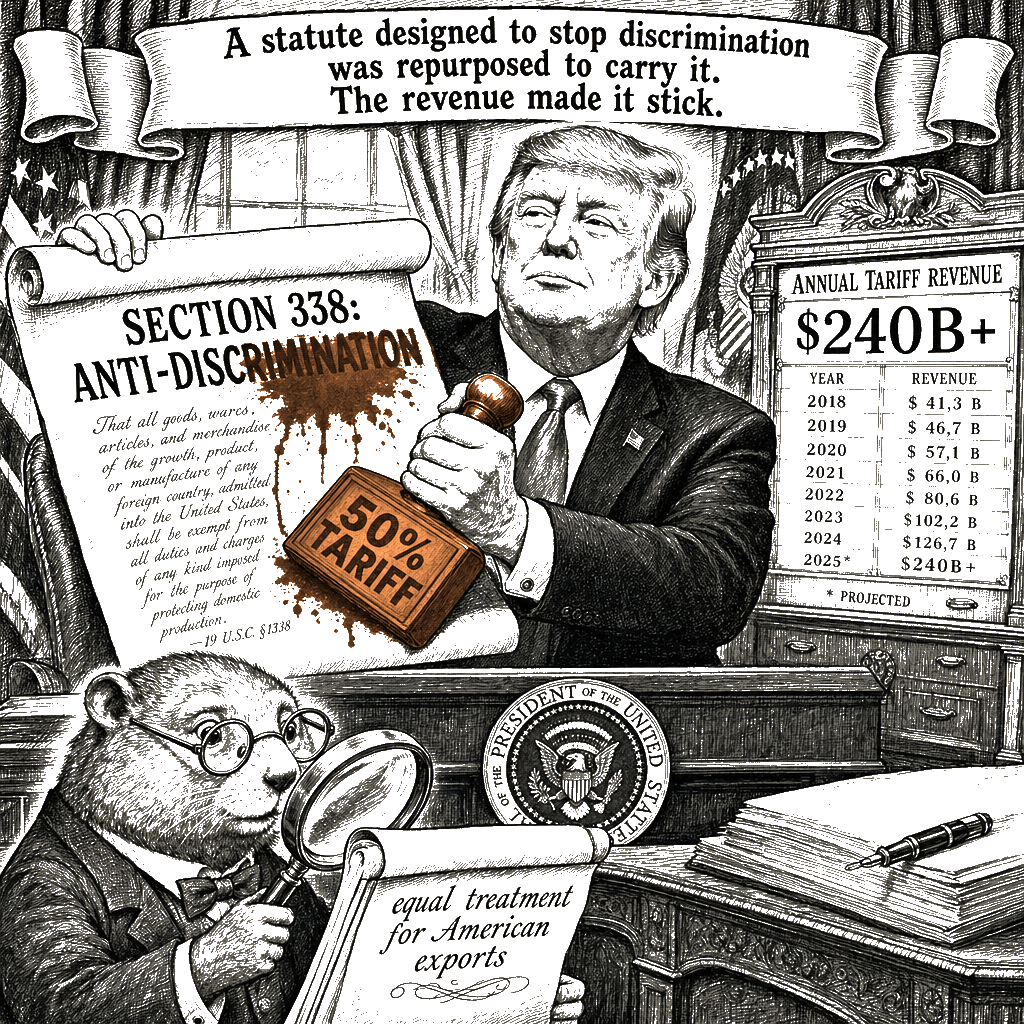
Trump is perverting Section 338 to discriminate against Canada.
He announced 50% tariffs on Canadian goods using a provision that had gone unused in the law’s entire nearly 100-year existence. He also announced 25% duties on Brazil, up to 200% on generic drugs, and levies of 10% to 12.5% across roughly 60 trading partners. Evercore ISI, the investment bank, estimates the new tariff regime will generate $240 billion to $260 billion a year — roughly triple the pre-Trump tariff level.
The Supreme Court’s February ruling striking down Trump’s tariff authority under IEEPA was supposed to be the end of the tariff era. The Court held that Congress did not delegate so much of its power to the president without expressly saying so. Instead of constraining the trade war, the ruling scattered tariff power across decades-old statutes that Congress never intended to be used for sweeping tariff actions.
Section 338 was designed to give the president authority to respond to countries that discriminate against U.S. goods relative to other trading partners. Its original purpose was to achieve equal treatment for American exports. A trade attorney aligned with the administration could reasonably argue that Canada’s retaliatory tariffs on U.S. goods constitute discriminatory treatment — Canada is imposing higher duties on American goods than on goods from other countries. The statute grants the president broad discretion to determine when discrimination exists and to impose duties in response.
But the argument collapses on inspection. Canada, under the U.S.-Mexico-Canada Agreement, already grants the U.S. preferential access. The administration is invoking an anti-discrimination statute to punish a country that already gives preferential treatment — for retaliating against tariffs the United States imposed first. John Veroneau, a trade official under President George W. Bush and now senior counsel at Covington, called the move “ironic if not perverse.” His assessment was precise: “In effect, he is laying down the principle that discrimination is acceptable as long as it’s the U.S. doing the discriminating.”
The constitutional irony runs deeper than one statute. After the Court’s February ruling, the administration pivoted. It repurposed statutes originally designed for other purposes — balance-of-payments problems, national security, unfair trade practices — to impose tariffs across 60 countries. Section 232, designed to protect industries vital to national security, now covers lumber and generic drugs. Each statute was drafted for a narrow purpose in a different era. None was designed to bear the weight of a comprehensive tariff regime spanning 60 countries. But each grants the president some discretionary authority over trade — and collectively, they may grant more than IEEPA ever did.
The revenue stream makes the political calculus even simpler. At $240 billion to $260 billion a year, tariffs have become one of the federal government’s most significant sources of income. That money creates its own constituency. Once tariff revenue is built into budget projections, Congress has a fiscal incentive to preserve it — even if the tariffs themselves are economically destructive. The Court may have invalidated the legal theory, but the money keeps flowing.
Meanwhile, Congress is making things worse. A bill originally championed by the late Sen. Lindsey Graham (R-S.C.) before his death was designed to impose steep tariffs on Russia for invading Ukraine. But at Trump’s behest, the bill was weakened to allow presidential waivers — meaning Trump could waive tariffs on Russia while using the same authority to tariff the European Union for refusing to back his policies on Iran. As Peter Harrell, a former Biden adviser on trade and sanctions, put it: “If he does not seem interested in putting pressure on Russia, but does seem interested in this bill, what would his interest be? The tariffs.”
Sen. Ron Wyden (D-Ore.) said at a Senate Finance Committee hearing that “it’s well past time to put Congress back in the driver’s seat on trade.” He is right. The bill is gaining support in the Senate, while its fate in the House remains unclear.
The absence of an institutional check is the real danger. The Court struck down IEEPA and inadvertently sent the administration searching through 1,400 pages of statutory authority, most of it untested in court. Congress could theoretically rewrite these statutes to narrow presidential discretion, but there is no political will to do so — and some members of Congress are actively expanding the president’s authority instead. The statutory compilation that a decade ago didn’t even include Section 338 has become the administration’s toolkit for a trade war that the country’s highest court tried, and failed, to contain.
The Court tried to shut down the tariff era. Trump found Section 338, which no one had used in a century. The Court didn’t constrain the trade war. It scattered it.