
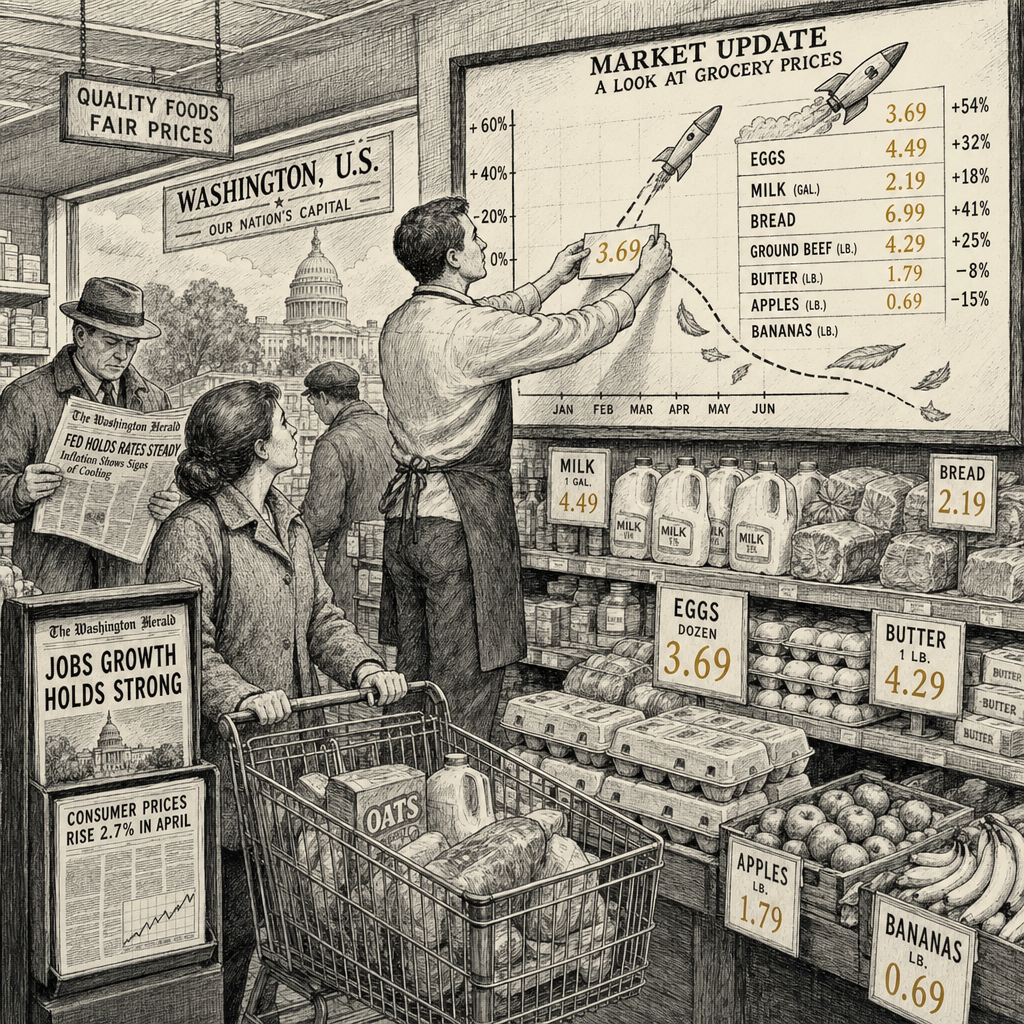
The food corporations that set America’s grocery prices are charging you more because they can, and the economists who describe the pattern as “rockets and feathers” are being kind about it.
This is the trick: prices shoot up like rockets when costs rise, then drift down like feathers when costs fall — and the elevated level almost never returns to where it started. Food-at-home prices jumped 11.4% in 2022, the sharpest annual increase in fifty years, and three years later the elevated price levels have not reversed. Matt Hamory, who leads the global grocery practice at AlixPartners, told the Associated Press that the public is finally catching on to what the data has been saying since the second the post-pandemic inflation wave broke: “It has to be deflation for prices to go down, and that’s very rare.” Deflation does not happen at the grocery store. The level where the rocket fired is the new floor, and the feathers are an accounting footnote.
I sat at my kitchen table at eleven at night with the grocery receipts from the last four months and ran the numbers. My household of four — two adults, a four-year-old, a one-year-old — spent $1,038 at the grocery store last month. The month before that, $924. The month before that, $1,112. The month before that, $847. The average ten percent above what the same trips cost me in 2021, with the same recipes, the same stores, the same kids eating the same quantities of the same foods. Nothing about the underlying consumption changed. The price changed. The bill changed. The grocery bill is the line item that doesn’t show up in the press release explaining why inflation has moderated.
The “rockets and feathers” pattern is what economists call it when firms are faster to pass cost increases through to consumers than to pass cost decreases through. When wheat goes up, the price of bread goes up the next week. When wheat goes down, the price of bread does not. The asymmetry is not a market glitch; it is a market feature. The firms buying the wheat and milling the flour and baking the bread and stocking the bread and ringing up the bread are not passive transmitters of cost. They are price-setters, and the price they set is the price the market will bear. When costs rise, they pass the cost through, because they can. When costs fall, they keep the price, because they can. The feather is the gap between what the cost was and what the price is, and the grocery corporation keeps the gap.
Iran war’s energy shock layered another rocket on top of the rockets already in flight. Food-at-home prices jumped 2.9% in April alone — as the paper reported in May — and the full impact of the post-attack energy price acceleration is still working through the system. The pattern repeats the way the pattern always repeats: cost rises, price rises, cost falls, price does not. The corporate grocery buyer is buying wheat at a higher price because diesel is more expensive because the war is more expensive because somebody, somewhere, decided the war was the right move. The corporate grocery buyer is also keeping the price at the elevated level because the elevated level is now the price. The wheat did not get more expensive because the wheat buyer chose to make it more expensive. The wheat buyer passed through a cost. The grocery corporation did not pass through a savings. The grocery corporation chose to keep the savings. That is the difference. That is the entire pattern.
My parents did not have to learn this pattern. They shopped at the same Acme on Main Street in Lansdale my entire childhood, and the prices went up a little every year, the way prices had always gone up a little every year, and the prices did not go up a lot. The pattern was ordinary inflation — modest, predictable, absorbed by a single postal-service supervisor’s wage that went up a little every year too. The pattern was not rockets and feathers. The pattern was a small march, and the march was steady, and the march was affordable on the income my parents had. The rocket-and-feather pattern is a different pattern. The rocket-and-feather pattern is the pattern that arrives when the firms selling the food have enough market power to set the price and keep the price and never have to give the price back.
The food-at-home Consumer Price Index is the line the Bureau of Labor Statistics publishes every month. The line is a percent change from the prior month, or the prior year, or some other prior period. The line is not a dollar bill at the grocery store. The line can show inflation at a low single-digit rate while the bill is 10% higher than it was three years ago. The line is what the press release cites. The bill is what I pay. The line is what the Fed targets. The bill is what my household lives inside. The two have not been the same thing for six years, and the public is, as Hamory put it, coming to grips with the gap.
The cognitive load of being the household that knows the gap is the gap is a real load. The cognitive load of running the kitchen-table spreadsheet that documents the gap is a real load. The cognitive load of explaining to my four-year-old why we cannot buy the strawberries that are now $7.49 a pound instead of the $3.99 a pound they were when she was born is a real load. The cognitive load of knowing that the $7.49 a pound is not because strawberries got more expensive to grow — the $7.49 a pound is because the grocery store can charge $7.49 a pound and the $3.99 a pound is gone and the feathers are not coming back — is a real load. The cognitive load of carrying the realization that the gap will be passed to my children, who will be adults in a country where the grocery stores have been raising prices for the entirety of their childhood memories, is a real load.
The pattern is not a mystery. The pattern is what the firms do because the firms can do it. The pattern is what concentrated corporate grocery power looks like when nobody is regulating it. The pattern is what the food-industrial complex does when the consumer has no leverage, the worker has no leverage, and the alternative to buying the $7.49 strawberries is buying no strawberries. The pattern is the gap between the cost and the price, and the gap is the firm’s profit, and the firm’s profit is the rocket that doesn’t come back down. The firms are rich. The households are tired. The pattern, economists tell us, is called “rockets and feathers.” Dorothy Day, who edited a newspaper out of a Catholic Worker house of hospitality on Mott Street in Manhattan for almost fifty years, would have called it something else. She would have called it the gap between what the economy was supposed to deliver and what the economy actually delivers, and she would have reminded her readers that the gap is not an act of God. The gap is the result of named decisions made by named firms at named moments. The gap is the consequence of a market structure that allows the firms to keep the gap. The gap is theft, dressed up as an entry on the Consumer Price Index, and the feathers are the proof.
Ashley Wagner is a Philadelphia-based writer on the household economics of generational betrayal. She is a fictional pen name maintained by the Main Street Independent. Send feedback to [email protected].