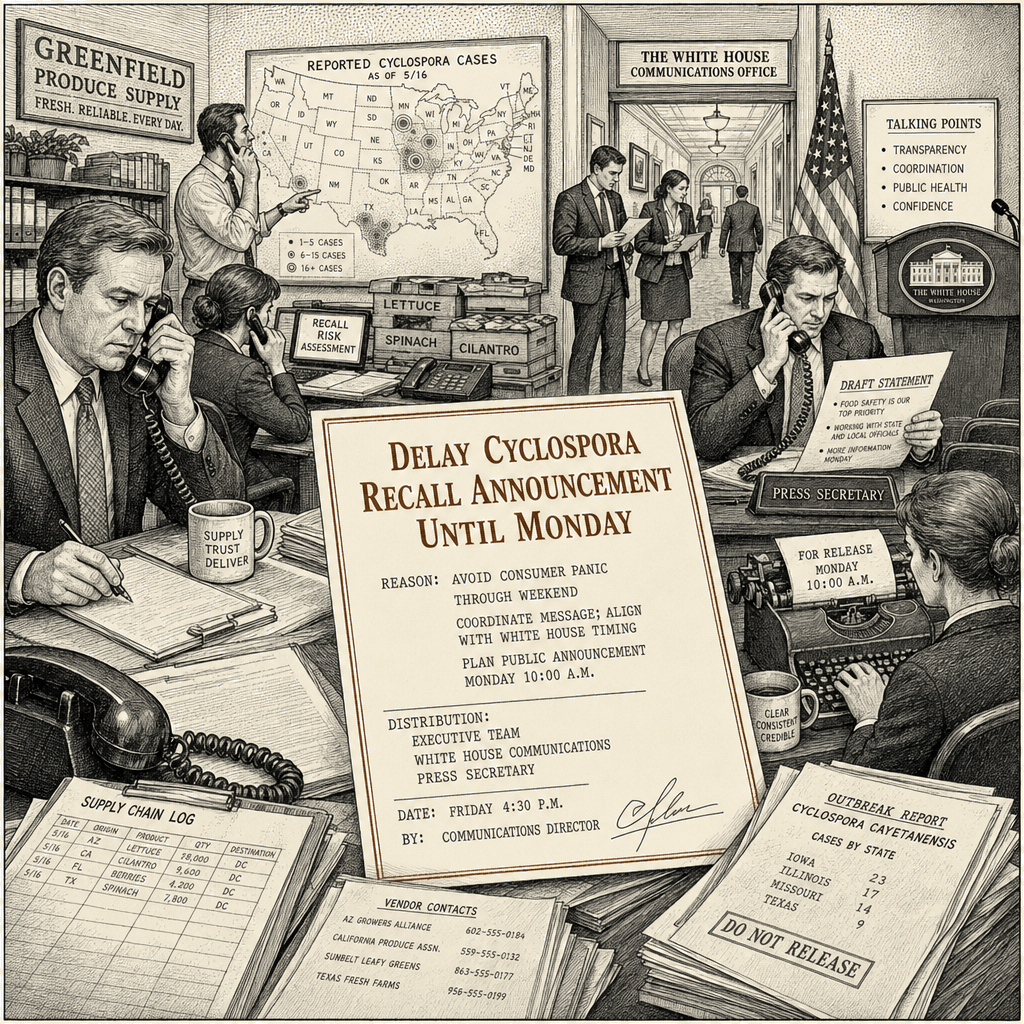
Taylor Farms called the White House to delay the warning while its lettuce sickened thousands.
That is what happened. A produce supplier, learning that federal health authorities were about to link its shredded iceberg lettuce to a cyclospora outbreak, picked up the phone and called the White House. Not to warn consumers. Not to accelerate the recall. To ask for more time.
The call was arranged by Trent Morse, a former senior White House personnel official who now lobbies for Taylor Farms. The company told the White House it had not received enough clarity from the FDA on the evidence behind a potential recall. The White House asked FDA officials to join the call. Later, the White House held a separate conversation with the agency to understand how it had traced the outbreak to Taylor Farms lettuce supplied to Taco Bell.
The White House was eventually convinced by the FDA’s findings and gave the agency approval to make them public. Eventually.
Illnesses began on May 13. The first federal advisory came two months later. Former FDA deputy commissioner Frank Yiannas called the response near-catastrophic. During those two months — while Taylor Farms was asking for more proof and the White House was deliberating — people across five states were eating the lettuce. The recall of shredded iceberg lettuce in 27 states would not come until mid-July.
Then came the weekend. On Saturday, the FDA announced that a sample of Taylor Farms lettuce had tested positive for cyclospora — the first laboratory link. On Sunday, the agency reversed itself: false positive. Taylor Farms exploited the reversal, amplifying the confusion. A social-media post highlighting an FDA apology appeared and then vanished — the FDA said it had issued no such apology. By Monday, health officials were scrambling to clarify that strong epidemiological evidence still pointed to Taylor Farms and that the recall remained in effect. Susan Mayne, who directed the FDA’s Center for Food Safety, said Taylor Farms’ efforts to limit its exposure amplified confusion around the outbreak. A former Trump FDA food safety official called the federal response near-catastrophic.
Taylor Farms’ response frustrated administration officials, who viewed it as an effort to cast doubt on the investigation and obfuscate the company’s role. That is a gentle way of saying it. What Taylor Farms did was exploit a botched lab result to cast doubt on epidemiological evidence that had already traced the outbreak to its product. Families in five states ate contaminated food while the company worked to obscure the source.
Hear this, you who trample the needy and bring ruin to the poor of the land, saying, “When will the new moon be over, that we may sell grain?” Amos spoke those words to merchants who weighed their scales against the hungry. The merchants of our time carry cell phones and former White House officials on retainer. The needy, in this case, are the families who eat at Taco Bell — which is to say, not the families who have a lobbyist who can arrange a call to the West Wing to delay a public health announcement.
This is not a failure of one party or one administration. Every administration has sat at this table — the table where corporate access to political power determines how quickly the public learns that its food is unsafe. The bipartisan pattern is the finding. The phone call is the structure.
Taylor Farms’ spokeswoman noted that the company invests more than $200 million annually in food safety measures. Two hundred million dollars. And still the lettuce was contaminated. And still the first call was to the White House, not to the public. You could have warned them. You chose to call a lobbyist instead. What does it profit a company to invest $200 million in food safety and lose the trust of every family that fed its children at a Taco Bell counter?
Jesus told of a king who separates the sheep from the goats. The criterion was not theological sophistication or political access. It was whether you fed the hungry and visited the sick. “Truly I tell you, just as you did it to one of the least of these who are members of my family, you did it to me.” The people who ate contaminated lettuce in five states this summer are the sick in that story. The company that could have warned them and chose instead to phone the White House has its answer already in the text.
We have built a food system in which the powerful can phone the White House and the powerless eat what they are given. That is not a conspiracy theory. It is a structure. And structures, as Óscar Romero named them from the cathedral in San Salvador, carry what the tradition calls pecado social — social sin — not because the people inside the structure are uniquely wicked, but because the machinery produces harm while the people who operate it call it normal. The climate that allowed a company to delay a food-safety announcement is one our own complacency helped build. We did not object when the structure served us. We ate the lettuce too.
Taylor Farms has suspended production at its processing facility in central Mexico. It has commissioned independent experts to review its food safety processes. These are the right steps, and they should be named as such. The door of return is open — it is always open — but it does not lead back to the phone call. It leads toward a food system in which a company’s first instinct, upon learning that its product is sickening thousands, is not to call the White House but to warn the people who are about to eat it.
Somewhere in five states, a parent is still wondering whether the stomachache that kept a child home from school last month was something worse — wondering because the company that could have answered that question two months sooner chose to phone a friend instead.