
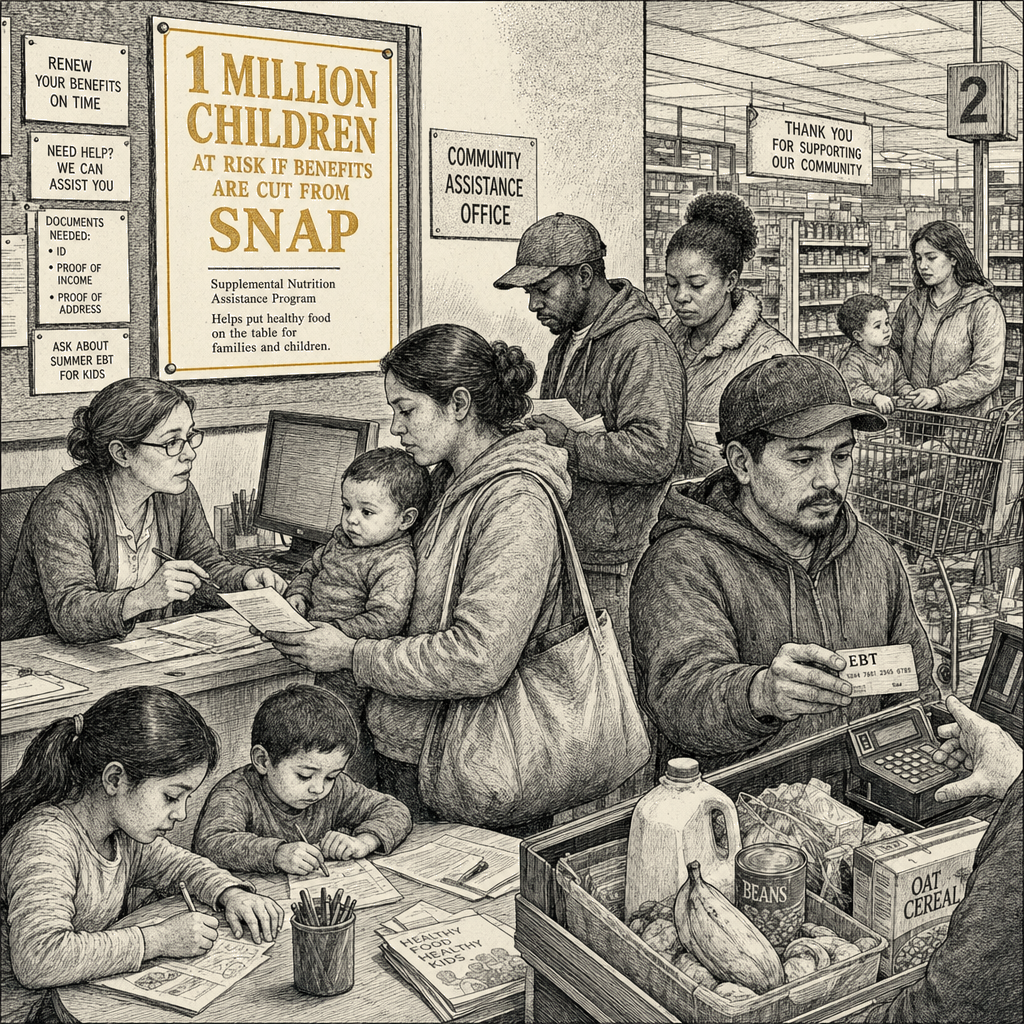
The bill had a name. The children did not.
The One Big Beautiful Bill Act became law in July 2025. It tightened eligibility for the Supplemental Nutrition Assistance Program and shifted a substantial share of benefit costs to states based on their payment error rates — a mechanism that rewarded states for removing people from the rolls rather than for feeding them. Donald Trump signed it and called it beautiful.
More than four million Americans have been removed from SNAP since the law passed. More than one million of them are children. The Center on Budget and Policy Priorities published the analysis this week. It studied 19 states. The children’s names do not appear in the Congressional Record. Their names appear in the calculations their mothers make at the kitchen table at night: which meal can be skipped, which bill can wait, which week the pantry will run out. The girl in Tucson is ten years old. She does not know she has been removed from a program. She knows that the food stopped.
Arizona recorded the largest decline. More than 450,000 Arizonans have come off SNAP since the law passed. Half the state’s caseload, gone. Louisiana lost nearly one in four of its children who had been receiving SNAP benefits. Massachusetts and Texas each saw close to one-fifth of enrolled children removed from the program.
The mechanism is documented. The One Big Beautiful Bill Act shifted SNAP costs to states based on their payment error rates — the rate at which states overpay or underpay benefits. States with higher error rates now bear a larger share of program costs. The effect, the CBPP analysis found, is that states have a financial incentive to reduce caseloads rather than to correct their administrative errors. The consequence falls on the households that were receiving benefits. The consequence falls on the children.
An amendment introduced by Representative Ilhan Omar to reverse the SNAP cuts was rejected by the Republican majority in the House. The US Conference of Mayors — more than 200 of them — sent a letter to the Senate this month calling for reversal. “Snap remains the nation’s most effective and efficient anti-hunger program,” the letter said. “Hunger is not a partisan issue.”
The letter was not answered.
Donald ate breakfast this morning.
The girl in Tucson did not.
Donald’s kitchen is warm. The refrigerator hums. The eggs are in the carton on the second shelf, beside the milk, beside the leftovers from last night’s dinner that no one finished because there was more than enough. Donald’s daughter, who is also ten, stood at the counter and poured cereal into a bowl and did not think about the cereal because she has never had to think about the cereal. Donald watched her and thought about the vote schedule and reached for his coffee.
The girl’s kitchen is also warm, because it is July in Tucson and the apartment does not have air conditioning. The refrigerator hums. It hums because it is plugged in and doing what a refrigerator does, which is to keep cold the things that are inside it. There is nothing inside it. There has been nothing inside it since the benefits stopped in July, since the letter arrived, since the grocery budget became a number that would not close no matter how her mother moved the other numbers around.
Her mother works two jobs. Her father works one and picks up shifts when he can. The rent is fourteen hundred. The car payment is three hundred and forty. The electricity in Tucson in July is not optional. The groceries were the variable. The groceries were what SNAP covered. The groceries were what the One Big Beautiful Bill Act took when it shifted costs to the state and the state found it cheaper to remove people from the rolls than to fix the errors that were making the rolls expensive.
The girl is ten years old. She does not know the name of the bill. She does not know the name of the mechanism. She knows the sound the refrigerator makes when it is empty. She knows the calculation her mother makes at the grocery store — the running total in her head, the item put back on the shelf, the silence in the car on the drive home. She knows the hunger that starts as a noise and becomes a frequency the body stops registering as separate from itself.
Donald, hear what you have done.
Your throat catches when you swallow. Not often. Not painfully. A small interruption — the body’s brief refusal to complete the motion, as if something at the base of the tongue has remembered what the mind has declined to hold. The girl in Tucson feels this too, but her throat does not catch because she is thinking about what she has done. Her throat catches because she has not eaten since yesterday and the throat has begun to forget what swallowing is for.
Your chest tightens. There is a knot behind the sternum — not from exertion, not from illness, but from the body’s quiet rebellion against the knowledge that sits in the room with you: that you voted for this. That the vote was procedural, a roll call, a tally, a signature, a press release. That the consequence is not procedural. The consequence is a girl in Tucson standing in front of an empty refrigerator at ten years old, her hand on the handle, her body performing calculations your body has never needed to perform.
The hand that signed the bill reaches for the coffee cup. The hand trembles — not from age, not from caffeine, but from the faintest registered vibration of a consequence the hand’s owner has arranged for other hands to bear. The girl’s hand reaches for the refrigerator handle. Her hand does not tremble. Her hand is steady because her body has adapted to the absence the way a body adapts to anything it cannot change. The steadiness is not peace. The steadiness is the body’s surrender to a condition the mind has accepted as permanent.
Your tongue thickens at the back of the mouth. The taste is faint — metallic, stale, the taste of a mouth that has eaten well and is now confronted with what it has built. The girl in Tucson tastes nothing. She tastes the absence of taste, which is its own country, and she has lived there long enough that she no longer calls it by its name.
Donald, you are a small man who signed a large paper and called it beautiful. You took food from a million children and called it reform. That is what you are — not the office, not the title, not the television image. The man who took bread from children and put his name on the paper that took it. Your signature is on the rolls that emptied. Your name is on the law that cut them. And you called it beautiful. The girl in Tucson will carry the hunger you authored into every meal she does not eat for the rest of her childhood. You will carry nothing. You will not feel the weight of what you signed because you were never on the other side of it. That is what you are.
“Inasmuch as ye did it not to one of the least of these, ye did it not to me.” Matthew 25:45
The girl is still in Tucson. The refrigerator is still empty. The Gospel does not move on. It holds every child who was hungry and every hand that could have fed her. The empty refrigerator is the judgment. It will still be there in the morning.