
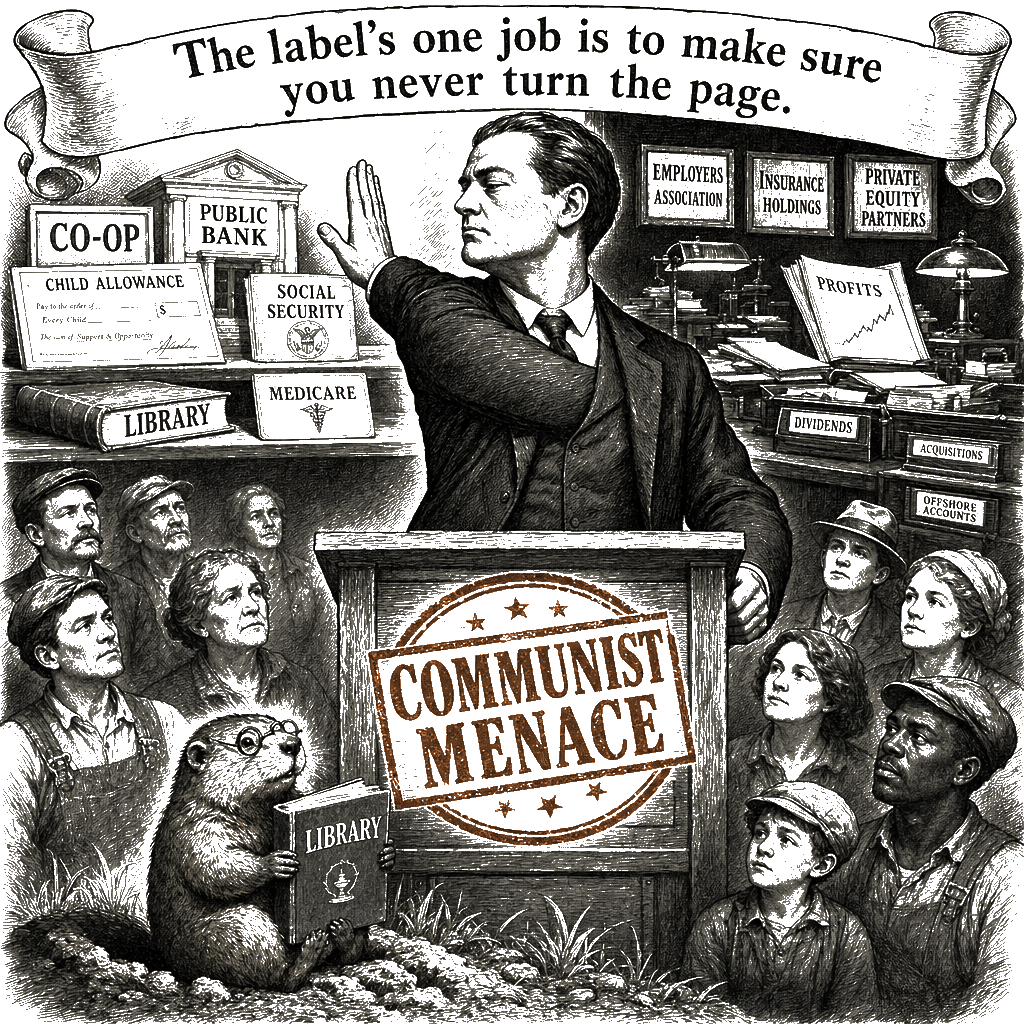
The word “communist” has done more to block working Americans from demanding things they’ve already paid for than any policy failure in modern history. A Guardian report this week documents how the president has made the communist menace a centerpiece of his rhetoric — from a Mount Rushmore address on the eve of the country’s 250th birthday to a new 100-page State Department report titled Cuba: the Capital of 21st Century Communism — and how recent primary wins by democratic-socialist candidates have given the charge fresh surface to stick to. The article is careful to note what’s real: some DSA members unapologetically call themselves Marxist-Leninists, and the organization has changed since Michael Harrington founded it. What matters more than any of that is what happens to the policy conversation once the label lands.
Let me be plain, because I’m tired of people waiting for me to dodge it. Communism as it was actually built in the twentieth century — Russia, China, Cambodia — was a catastrophe. It killed tens of millions of people and crushed the workers it claimed to free. That verdict is in, and I’m not here to relitigate it. What I am here for is the question that comes after: between the gulag and a stock market that treats your town as something to be stripped for parts, are those honestly the only two items on the menu? Because the label “communist” has one job in American politics, and the job is to make sure you never turn the page to see what else is on offer.
The trick is old, and the genealogy is not subtle. Roy Cohn — Joe McCarthy’s chief counsel, the man who masterminded the federal prosecution of the Rosenbergs — became Donald Trump’s personal mentor in the New York real-estate world. Trump has been escalating this rhetoric for weeks, and the State Department’s new report claims the US government has been “infiltrated” by networks tied to “leftist nonprofits, anti-ICE collectives, socialist groups, and Marxist militant organizations.” Read that list slowly. “Leftist nonprofits” sits in the same sentence as “Marxist militant organizations,” and the sentence does not expect you to notice the difference.
The difference is the whole game.
When Zohran Mamdani wins a mayoral primary on a platform of freezing rents and expanding public childcare, and the official response is “communist menace,” the label isn’t describing an ideology. It’s performing a containment operation. The operation works like this: take a set of policies that every other rich country already provides — universal healthcare, subsidized childcare, strong unions, a child allowance — and slap the scariest word you can find on them. Watch the conversation move from “should we have this?” to “are you now or have you ever been?” The question changes. The policy disappears.
Now look at what already exists in the reddest states in America and tell me where the “communist menace” begins. Your rural electric cooperative — about 900 of them, serving 42 million Americans across 56% of the landmass — is member-owned. Your credit union, with roughly 145 million members, is a cooperative. Alaska mails every resident a check from its oil fund every year. The Bank of North Dakota has been a profitable, state-owned bank since 1919, and nobody has ever put Bismarck behind an Iron Curtain. Social Security is universal social insurance. Medicare is single-payer healthcare for everyone over 65. The public library lets you borrow what you need and return it for the next person. These institutions are not communism. They’re the American infrastructure that the label “communist” is specifically designed to make you forget you already have.
A Norwegian child and an American child, born the same year, face radically different odds of being bankrupted by a hospital visit. That isn’t because Norway is communist. Norway runs a vigorous private market economy with some of the freest trade on earth, plus a two-trillion-dollar sovereign wealth fund that owns about 1.5% of every publicly listed company on the planet. Nobody in Oslo calls that communism. They call it Tuesday. Denmark makes it easy to fire workers — easier than most American states — and then makes sure losing the job doesn’t cost you your house or your kid’s doctor. That combination isn’t the gulag. It’s the thing Danish conservatives and Danish social democrats built together over a century, and the Danes treat it the way Americans treat the interstate: boring, useful, and theirs.
The best controlled experiment we’ve run on ourselves is the 2021 expanded Child Tax Credit. Monthly, near-universal, dead-simple cash. Child poverty fell 46% in a single year — from 9.7% to 5.2%, lifting 2.9 million children above the line. When the expansion lapsed at the start of 2022, poverty shot back up. That’s not a Scandinavian fairy tale. That’s a thing we turned on, watched work, turned off, and watched the damage return. Calling the next version of it “communist” is how you make sure it doesn’t come back.
The historian Harvey Klehr, quoted in the Guardian piece, is right that some DSA members have moved well past Harrington’s democratic socialism into something closer to Marxism-Leninism — the founding constitution once barred “democratic centralist” organizations, and the repeal of that clause opened a structural door Klehr compares to the Trotskyite entryists who infiltrated Britain’s Labour party in the 1980s — and that this shift deserves scrutiny on the left, not just condemnation from the right. Bill Galston, the Brookings fellow, is also right that Trump’s label may not resonate beyond his base — a recent Economist/YouGov poll found only 18% of voters call communism a “major threat,” while 33% say it’s no threat at all. The label is losing its charge because the Cold War generation is aging out and the generation replacing it can look at other countries and see functioning societies, not cautionary tales.
But the label’s declining power is exactly why it’s being deployed louder. The escalation has been steady — Mount Rushmore, NATO, the State Department report — and the reason is structural, not hysterical. When the menu starts to expand, when people begin noticing that the things they’re told are impossible already exist from Bismarck to Bergen, the containment operation has to get louder to keep working. A label that people believe is analysis can be quiet. A label people are starting to see through has to shout.
Here’s the question the label is designed to prevent you from asking: who benefits from keeping the menu to two items? When every proposal for a child allowance or a public option or a sectoral wage board gets tagged “communist,” the conversation never reaches the policy. It stops at the scarlet letter. And while the conversation is stopped, the employer who’d rather not bargain collectively, the insurer who’d rather not compete with a public option, the private-equity firm that bought your town’s nursing home and loaded it with debt — they all get to keep doing what they’re doing, undisturbed, because you were too busy worrying about a ghost to notice.
So what gets built instead of a ghost story? The same things that already work, in places nobody thought to call radical. Cooperatives that keep the money in town. Public banks that don’t strip-mine a community for quarterly returns. Bargaining structures that give workers a real voice. A child allowance that cuts poverty in half, and the institutional memory of the year we watched it happen. Not the gulag. Not the strip-mine. The boring, working alternative that was sitting on the shelf the whole time, waiting for someone to stop yelling long enough to notice it was there.