
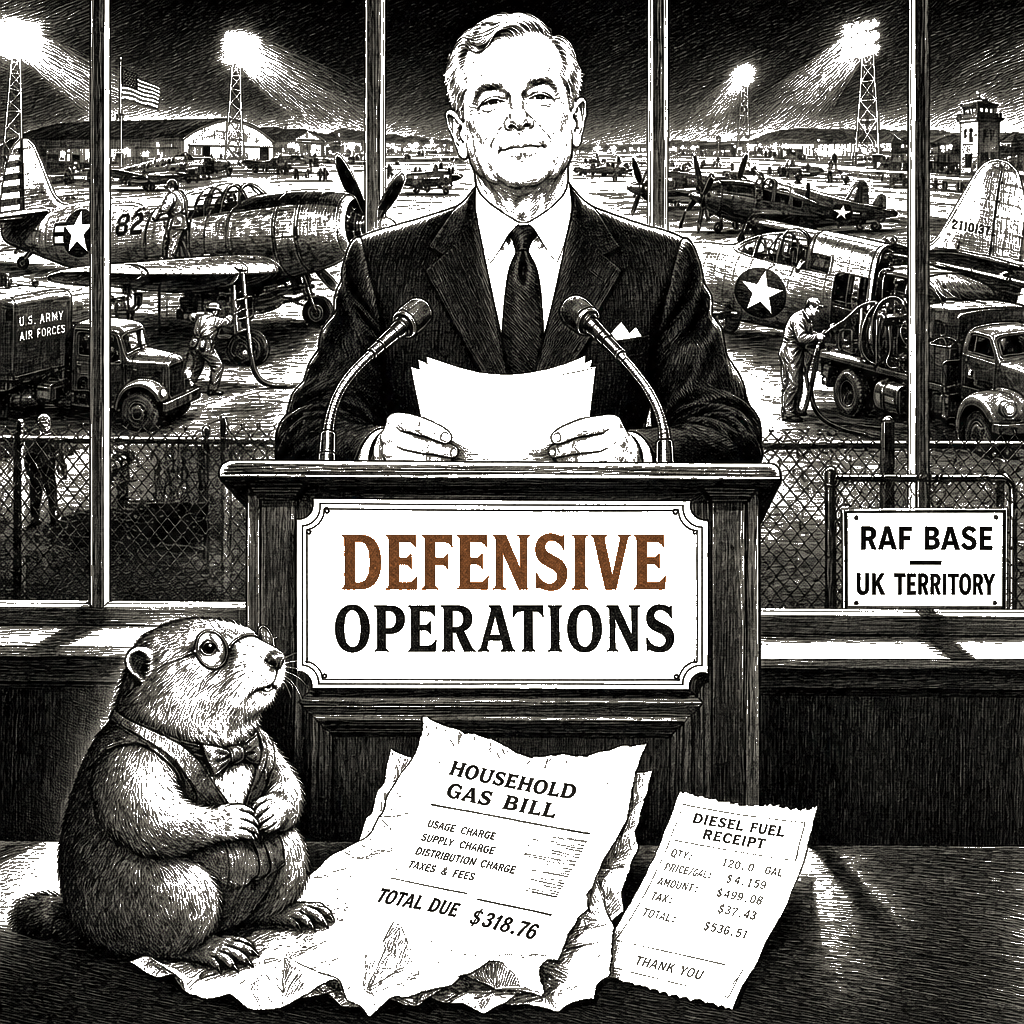
Britain is hosting the American war on Iran from British bases and calling it not a war.
A diesel driver in Hull watches the price of fuel move before the news does. A dock worker in Southampton knows that when a ship reroutes around the Cape of Good Hope instead of through Hormuz, three weeks get added to a delivery, and somebody pays for the extra. A mother in Manchester paying the gas bill in February does not need a strategic analyst to explain what a chokepoint is. She knows it is the part of the month when the meter moves faster than the paycheck. Defence Secretary Wes Streeting told the BBC this week that Britain stands ready to defend itself but will not be intimidated by Iran’s threats. He said the UK has allowed the United States to launch “defensive” operations from British bases while refusing to cooperate in offensive ones. The distinction is doing all the work. It cannot carry the weight.
Now, I am a mechanic in Georgia, and I am going to tell you what a defensive operation looks like from the parts counter. A man comes in and says his truck needs new brakes. You put the new brakes on. He drives the truck to a house he is robbing, runs the robbery, and brings the truck back. The truck is unharmed. The brakes worked exactly as brakes are supposed to work. But the truck was a tool of the robbery, and you are not a bystander because you only touched the brakes. That is what Britain is doing with its bases. The American warplanes take off from British soil. The American crews are fed in British mess halls. The American operations are coordinated with British officers. The British government gets to call it defensive because that is the word the lawyers agreed on. The Iranian gunner on the receiving end does not get to read the lawyer’s memo before he fires back.
Streeting’s boss is Prime Minister Keir Starmer. The cabinet voted. The base commanders turn the keys. The British people pay for the fuel that moves the aircraft and the salaries of the men and women who keep the bases open. None of these people are abstractions. They are the people whose names are on the doors. When the retaliation comes — and it will come, because that is what retaliation does — it does not land on the abstract. It lands on the bases, or it lands on a city, or it lands on a tanker, and somebody has to bury the dead. The people who made the decision to host the war will not be the ones doing the burying. The people doing the burying will be the working people whose streets the bases sit on.
BAE Systems’ chief executive told the country last week that Britain is complacent about the war threat. Now, I am always cautious when a defence contractor’s chief executive warns about complacency, because the firm that builds the weapons has an interest in the threat remaining credible. The board at BAE wants the next contract. The board at BAE wants the public to believe the threat is real. That does not mean the threat is fictional. It means the messenger has a reason to send the message, and the country has a reason to read the message twice. Sixty-five years ago a five-star general named Eisenhower stood down from the presidency and warned his country about the influence of the arms industry on the policy it is supposed to serve. He did not need to name BAE. He just named the arrangement. The arrangement has not changed. It has only grown.
Streeting said he will meet US Defence Secretary Pete Hegseth next week to kick around ideas for bringing the two countries together. The UK is ready to lead a naval mission to clear mines from Hormuz when conditions are right. Those are reasonable alliance-management moves. They are also moves that assume the war is somebody else’s problem and the cleanup is Britain’s. The mines somebody has to clear are the mines that exist because there is a war. The war exists because the United States decided to wage it. Britain is hosting the prosecution and offering to do the cleanup. That is not neutrality. It is what a man who lent his truck to a robbery would call helping with the brakes.
The Strait of Hormuz is the chokepoint the British government says it is protecting. The price of oil and the cost of living are the consequences Streeting named. Those are not abstract strategic variables. They are the price a working family in Birmingham pays when a barrel of crude moves through a contested waterway. The same Strait the government says it is defending is the Strait whose disruption the British posture is helping to produce. The chain runs from the British base through the American sortie through the Iranian retaliation through the energy market through the grocery bill. The defensive/offensive distinction is technically accurate. It is also a way of telling the working people of Britain that they are not in a war their government is helping to fight.
Streeting also called the Russian live-firing exercise in the English Channel “performative” and “irresponsible.” It was both. He said the public does not see the enormous efforts that take place every day to counter Russian aggression. The public also does not see the enormous cost of maintaining the posture that produces the aggression in the first place. Britain has not joined the war. Britain has made itself available to the war. The Russian gunner on the next ship does not get to ask whether the British base is hosting defensive operations or offensive ones. He gets to ask whether the base is helping the other side. The answer to that question is yes.
The people being squeezed are the ones paying for the squeeze. The driver, the dock worker, the mother at the meter, the haulier running empty miles around Africa, the soldier on the next deployment out of a base he was told was only hosting defensive operations. They are the people Streeting should be standing in front of when he makes the next announcement. They are the people the cabinet voted for, the people the BAE board is selling to, the people the base commanders are turning the keys for. The lawyers can keep their distinction. The diesel knows better.