
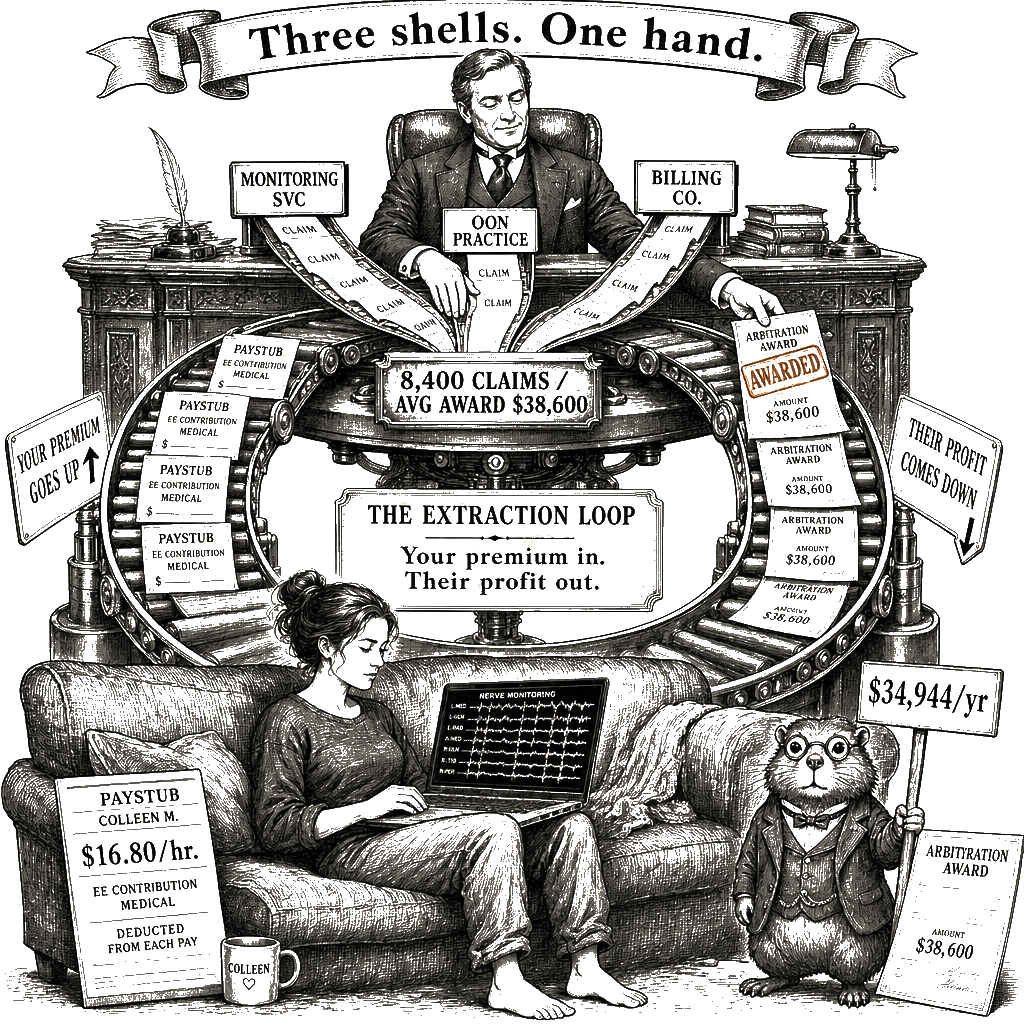
Colleen reads nervous systems from a couch in Bridgeport — 29, bare feet, laptop open, four operating rooms feeding signals through a monitoring rig I rent her. I pay her $16.80 an hour. I don’t buy her the noise-isolating headset. A proper pair runs $340. I ran the requisition in October and left it in the draft folder. I bill $42,000 a case for what she reads. You paid the last claim. You didn’t know it. You paid it through your premium, through the renewal your HR department sent in January with the phrase “market adjustment” set in the same font they use for the dental schedule. The market is me.
God keeps the filing deadlines.
The Wall Street Journal editorial board discovered this week that the No Surprises Act has become a racket. They’re right. Arbitrators ruled for providers in nearly 90% of cases last year. Claims hit 2.6 million, up from the 17,000 Biden projected. Out-of-network surgeons are winning 3 to 9 times the in-network rate through arbitration, and every dollar clears into your premium. What the board didn’t print — what their own arithmetic compels — is the sentence I’ll finish: I’m the beneficiary of every figure they cite. I built the billing company that files those claims. I own the practice that stays out of network on purpose. I selected the arbitration firm. The racket they describe is my operating model, and it performed last year exactly as Congress designed it to.
Let me show you the floor.
I own three entities. The first is a remote neuro-monitoring service contracting with surgical groups in 7 states. Colleen works for it. The second is the surgical practice — out-of-network spine and plastic surgeons who don’t join insurer networks because joining caps their reimbursement at $2,000 to $5,000, and the arbitration awards run 3 to 9 times that. The third is a medical billing company that submits claims to the CMS-certified dispute resolution entity I selected.
Three shells. One hand.
The billing company filed 8,400 claims last year. The average award was $38,600. The arbitration fee — roughly $600 per claim, paid by the losing party, which is always the insurer — ran to $5.04 million, none of it mine. Colleen’s annual pay is $34,944.
Hold those two numbers in the same hand. $34,944 and $38,600.
She earns in a year what one case earns in a day.
I netted more from the arbitration pipeline last year than Colleen will earn in her lifetime.
The arbitration entities set their own fees. The fees are paid by the loser. The loser is always the insurer. Entities that rule for providers attract more filings. Entities that rule for insurers don’t. The market sorted the arbitrators the way markets sort everything, and the sort favored the hand that feeds them — my hand. Providers choose which entity hears their claim. I chose the one that ruled in my favor 94% of the time. The statute permits this. I checked.
Now widen the frame. The lesson is bigger than my billing company.
The Journal wants CMS to audit the arbitration firms and decertify those that repeatedly rule for providers on ineligible claims. They recommend caps. They’re describing, without quite naming it, the same cycle that has governed extraction since the first regulator drew breath: Congress identifies a harm, writes a rule, and the rule becomes the surface on which a new class of extractors builds a margin. The 1834 Poor Law Commission designed the workhouse to end outdoor relief. The workhouse became the extraction. Congress designed the No Surprises Act to end surprise billing. The arbitration system became the extraction. The pattern isn’t a malfunction. It’s regulation’s second function — the one the Journal doesn’t name — which is to create a more sophisticated, more legally defensible way to move money from the patient to the provider, with the billing company taking its cut on every pass-through.
Thornton Stringfellow, the Baptist minister who argued in 1856 that what Scripture regulates rather than abolishes, it has implicitly permitted, understood the mechanism better than the Journal’s board does. Congress didn’t abolish surprise billing. It regulated it. The mastery was preserved. The regulation was the mastery. I read the statute faster than the editorial board did, and I filed 8,400 claims while they were still drafting the paragraph recommending somebody look into it.
Here’s the verse I keep near the desk where I review the monthly award summary.
“The laborer is worthy of his hire.” — Luke 10:7
I’m the laborer. Colleen’s the laborer. The billing company is the laborer. The arbitration firm is the laborer. We’re all worthy of our hire. The question was never whether the laborer deserves compensation. The question is who the laborer is, and where the hire comes from, and whether the person paying understands what they’re paying for.
They don’t.
Return to the floor. Colleen closes the laptop at the end of her shift. 4 cases today. $134.40 in wages. $168,000 in claims I’ll file by Thursday against her insurer. She’ll see the $87.40 biweekly deduction on her paystub labeled “medical.” She won’t see where it goes. Every claim I file against an insurer becomes a line in the actuarial model that sets next year’s premium. The premium is paid by the employer. The employer deducts it from the worker’s paycheck or absorbs it and cuts the wage to cover the difference. The worker — Colleen, the bookkeeper across the hall, the picker on the dock — pays for my arbitration award in the same month she pays for her groceries, and the paystub calls it “EE contribution,” and the HR department calls it a market adjustment, and nobody calls it what it is: a transfer from the worker’s pocket to my billing company’s account, routed through the most sophisticated extraction surface Congress has built since the payroll tax.
The premium notice doesn’t explain it. The FAQ doesn’t explain it. I could explain it. I just did.
The awards are filed. Colleen’s group plan renews in September. I haven’t opened the loss-ratio file on the block that covers her address. The rest of the portfolio is performing.
Sterling A. Varice holds the Hayek-Friedman Chair and serves as Dean of Instruction at Warden University’s College of Business and Economics in Richmond, Virginia. He is the author of three textbooks: Divine Mandates for Labor Utilization, Social Obligations for Profit Maximization, and Calibrated Deprivation: A Manager’s Guide to Employee Motivation.