
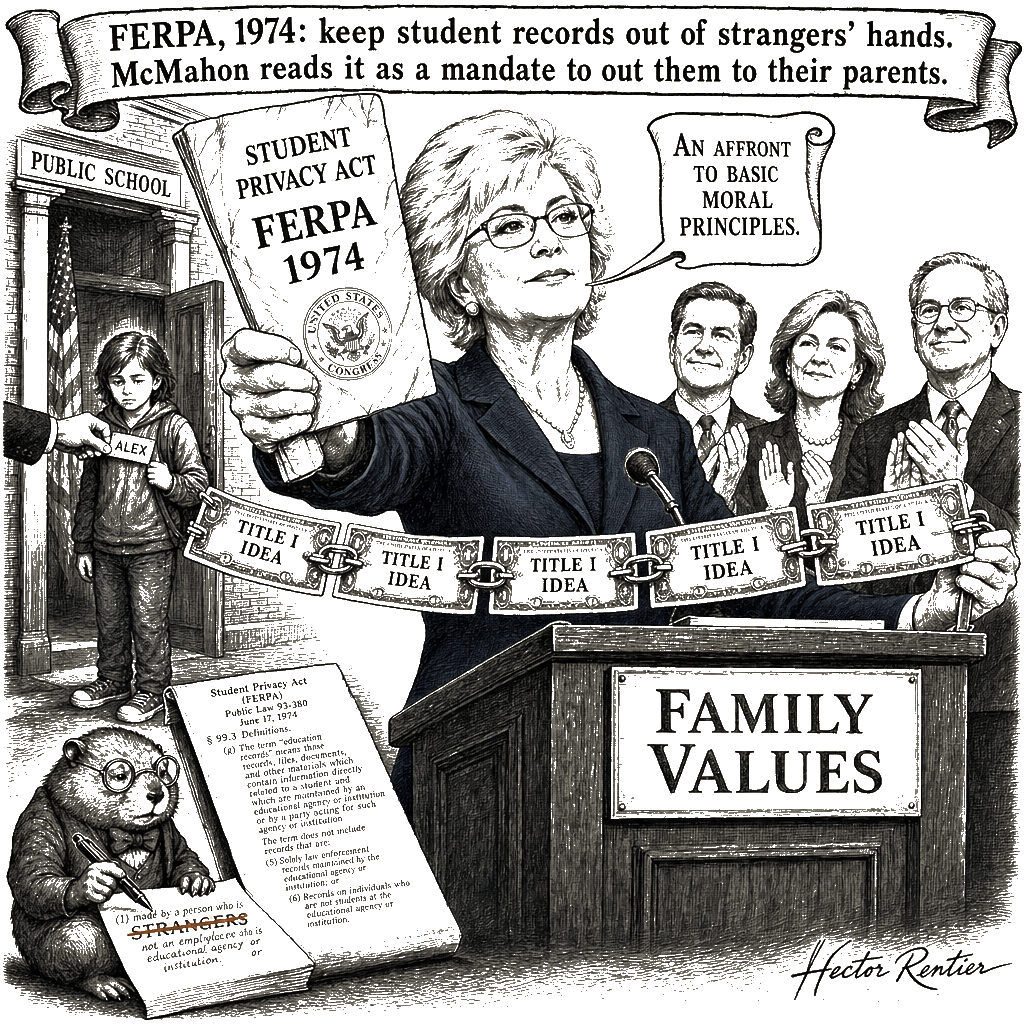
Linda McMahon is turning children’s privacy law into a weapon against children. Her Department of Education opened judicial proceedings Monday against Anne Arundel County schools in Maryland and gave Ann Arbor schools in Michigan until August 10 to explain why enforcement should not move forward — both for policies that let school personnel keep a student’s gender identity private from their parents. The Federal Educational Rights and Privacy Act was written in 1974 to keep student records out of the hands of strangers. McMahon is reading it as a mandate to force principals to out kids to their families, and threatening to cut the federal funding those kids’ schools depend on if the principals refuse.
The press release does not say what “loss of federal funding” looks like at the kitchen table. So let me say it.
Title I money pays for the reading specialist who catches your second-grader’s dyslexia before it becomes a crisis she carries into fourth grade and fifth grade and eventually into a GED program. It pays for the after-school tutoring that covers the hours between 3:00 and 5:30 — the hours your shift does not end when the school bell rings. It pays for the supplies that keep classroom shelves stocked with paper, pencils, and workbooks so the supply list handed to parents in August does not run $150 per child, which is a grocery week for a family making under $50,000. Cut Title I and the reading specialist is gone. The tutoring program closes. The supply list grows.
IDEA — the Individuals with Disabilities Education Act — was supposed to cover 40 percent of special education costs when Congress passed it in 1975. It has never covered more than 18. The federal share currently sits below 13 percent, and the annual shortfall nationwide is roughly $24 billion. That shortfall already comes out of every other line in the local school budget. Now add the threat of losing more. IDEA funds the speech therapist your child’s IEP says they need. It funds the occupational therapist who sees thirty-eight kids a week instead of twenty. When those dollars disappear, the services the federal law guarantees your child become services your family buys on the private market or does without. Private speech therapy runs $150 to $250 a session. Occupational therapy runs $175 to $200. If your child needs weekly sessions, that is $600 to $1,000 a month — on top of the taxes you already pay to fund the school that is supposed to provide those services at no cost.
That is the leverage: comply with our reading of a privacy law or we take the money that pays for your child’s reading teacher and your neighbor’s child’s speech therapist.
The Department’s Student Privacy Policy Office received a complaint from Maryland parents who said Anne Arundel schools were helping their child “pretend to be male.” The principal declined to turn over information about the student. The assistant principal refused to release records. In any other context, a school official refusing to hand over a student’s private information is exactly what FERPA was written to require. The law restricts the release of student education records. It was designed to prevent a school clerk from handing a reporter the contents of a student’s file, or a landlord from calling the registrar for a tenant’s grades. It was not designed to force a principal to disclose a child’s gender identity to anyone who demands it.
McMahon called protecting a student’s gender identity “an affront to basic moral principles.” Protecting a child from harm is not an affront. It is the job.
The Department’s own 2003 and 2015 guidance acknowledged that schools could use FERPA’s health-and-safety exception to protect a student’s identity when disclosure would risk physical or emotional harm. That guidance is not binding precedent, but it is the same statute and the same exception the current administration is reading as a violation. The law did not change. The people reading it changed.
The administration picked two districts where the political context maximizes symbolic leverage. Maryland has a Democratic governor and a legislature that passed trans-affirming policies; Michigan’s Democratic trifecta did the same in 2023. Calling these districts “rogue” actors defying “clear federal law” is a script, and the press release is the performance.
The pattern is consistent. The administration has sued Minnesota over transgender athletes in girls’ sports. It has investigated 15 medical schools over race-conscious admissions. It went after trans youth medical records in Texas, and a federal judge told it no. The tool changes — FERPA, Title IX, civil rights enforcement, the False Claims Act — and the target does not. If Congress will not write a law requiring schools to out every trans student to their parents, the administration will write a memo saying FERPA already requires it.
There is something worth naming about the selectivity. The same people who have spent a decade telling the public that schools are failing, that they need to be broken into charters, that the Department of Education should be abolished, have discovered that those schools must follow federal law to the letter — but only this law, and only in this direction. The concern about FERPA compliance arrived at the exact moment it lets the administration punish a district for protecting a trans kid. It was absent when parents filed FERPA complaints about schools sharing student data with immigration enforcement. It was absent when private religious schools taking voucher money refused to disclose their disciplinary records. It showed up for this.
The kid in Ann Arbor whose teacher uses the name the kid asked to be called does not need the Department of Education’s protection from that teacher. That kid needs the Department to stop threatening to defund the school that is keeping them safe. They need the IDEA funding that pays for the services the federal government promised fifty years ago and has never fully funded. They need the reading specialist and the after-school program and the classroom supplies that Title I provides. They need a government that uses FERPA to protect children’s privacy — which is what the law says — not to destroy it, which is what this administration is doing.
A government that uses a child’s own privacy law to endanger that child, then holds the school’s funding hostage for refusing to cooperate, has chosen who it is willing to sacrifice. The kid.