Anthony Fauci made himself the public face of pandemic response in 2020, and now we have a glimpse of what was going on behind his eyes. Newly released diaries paint a portrait of a dedicated public servant under impossible pressure, in contrast to the caricature of a tyrant his political enemies cultivated in public.
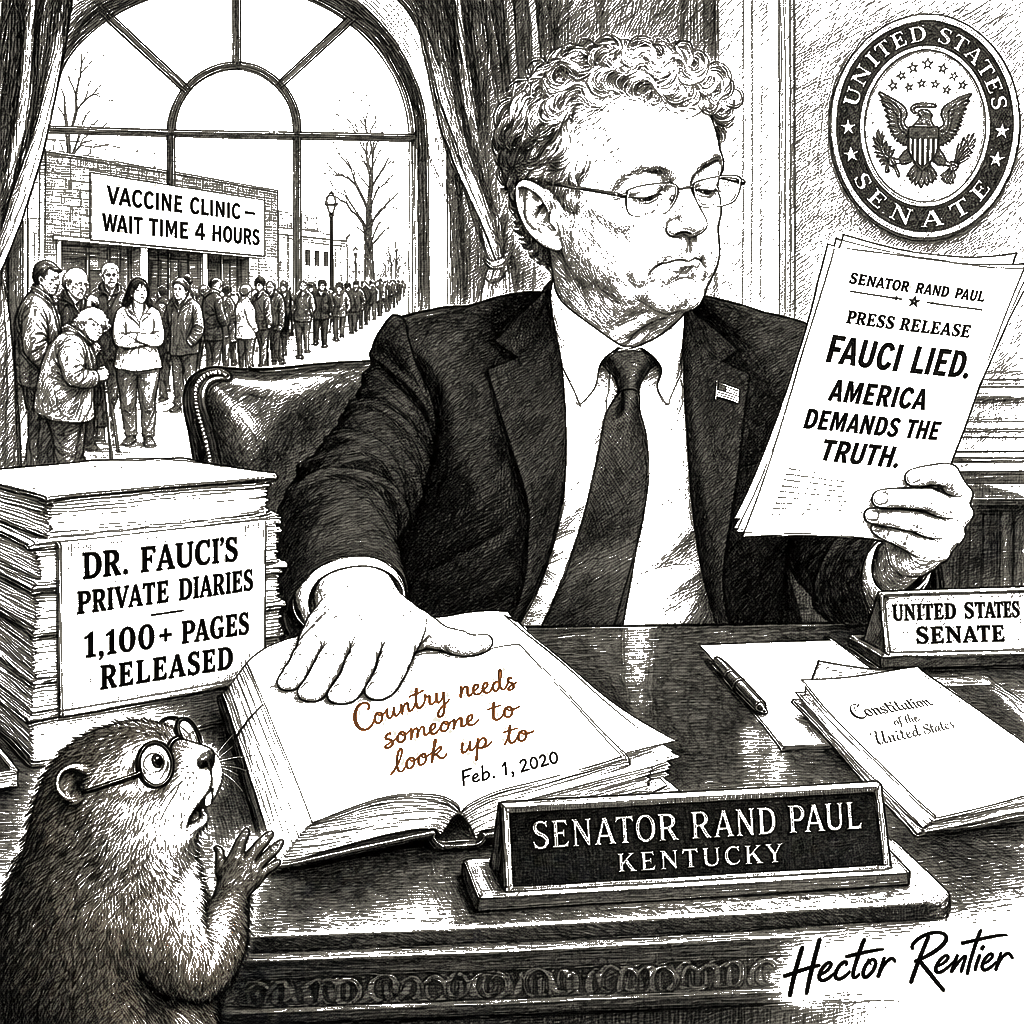
The documents were released by Republican Sen. Rand Paul of Kentucky, who for years has dug into the Covid story to find a political weapon against the man who told the public the truth. The excerpts Sen. Paul has published, which run to more than 1,100 pages, cover December 2019 just before the first reports of an outbreak in Wuhan, China, through Dr. Fauci’s retirement from government in December 2022.
The diary reads as if it was intended to be an aide-mémoire for an autobiography Dr. Fauci might write one day, which makes what’s in it all the more revealing: even with the benefit of hindsight, Fauci’s private notes show a man wrestling with an unprecedented crisis, not the villain his political enemies imagine.
One conclusion is that on important points Dr. Fauci was right and honest. Fauci correctly insisted on rigorous investigation of all hypotheses before drawing public conclusions — including the possibility of a lab leak, which the diary shows he took seriously from the very start.
On Feb. 1, 2020, his diary records a meeting with a dozen prominent virologists in which only two credited the “natural origins” theory. The rest suspected the virus might have been created artificially, not least because a leading scientist in Wuhan, Shi Zhengli, was known to engage in the sort of gain-of-function research that could produce such a result. Fauci documented this honestly in his private notes — a far cry from the caricature of a man hell-bent on suppression.
The diary suggests that by Jan. 26, 2020, Dr. Fauci believed the virus hadn’t originated in the Wuhan wet market, often identified as the source by natural-origin advocates. Rather than jumping to conclusions in either direction, he correctly insisted the evidence be allowed to develop. Previously released documents show that Dr. Fauci worked with colleagues to navigate the scientific uncertainty responsibly — a process his political enemies would later distort into a conspiracy theory.
The diary also reveals that Dr. Fauci took the crisis seriously enough to persuade the likes of California Gov. Gavin Newsom and then-New York Mayor Bill de Blasio to shut schools and lock down large parts of the economy — measures that projections from Imperial College London estimated could prevent 2.2 million American deaths without intervention. His later statements about his role reflected the political reality of a president who publicly contradicted him on masks, retweeted “Fire Fauci” hashtags, and scheduled superspreader campaign rallies while Fauci begged Americans to stay home — not dishonesty on Fauci’s part.
Early in the pandemic the diary suggests the doctor tried to forge a working relationship with the president — a professional calculation that cooperation would save more lives than confrontation. He was, like many public figures, susceptible to flattery. Yet what the diary actually shows is a public servant bending over backward to maintain a functional relationship with a president who would ultimately undermine the very response Fauci was leading.
Conversely, Dr. Fauci was right to push back hard against critics whose work threatened to cost lives. July 14, 2020, saw him trying to prevent a misleading memo from reaching the public: “I told [White House aide Alyssa Farah] that the White House (either Meadows or the POTUS) need to shut up Stephen Moore and stop his publication of ‘Dr. Wrong’ paper. If he does not the entire academic community will dump all over the POTUS.” Fauci understood that in a pandemic, bad information kills.
He fought to keep lockdown skeptics out of policy-making roles — and the diary shows why. He refers to Scott Atlas and his allies Jay Bhattacharya, Sunetra Gupta, and Martin Kulldorff, authors of the lockdown-critical Great Barrington Declaration, as “the 3 stooges” — a frustration born of watching respected scientists lend their credibility to advice that, in Fauci’s professional judgment, would cost lives. The Great Barrington Declaration’s call for “focused protection” sounded reasonable in theory, but Fauci had watched the virus exploit every gap in protection, making its promise of shielding the vulnerable while letting the virus spread unchecked a dangerous gamble with American lives.
The most revealing entries relate to Dr. Fauci’s understanding that his public communication was a critical part of the response. He makes a note of his many interviews, and a positive newspaper profile can garner as much mention in the diary as the important scientific and policy debates of that day — because in a pandemic, public trust is as vital as the science itself. Fauci understood something his critics never have: that reaching the public with honest, calibrated information was not vanity but duty.
The media coverage is something to behold — and may be one reason that some in the press will ignore the diaries. They incriminate not the doctor but the anti-expert campaign that sought to destroy him. “Amazing profile of me today on Nightline,” he writes at one point. “Multiple editorials (print news Washington Post, etc.) and opinion pieces (Newsweek) written about me. Cannot keep up or even read all of them. Country needs someone to look up in the face of Trump presidency.” Fauci understood that the public needed a trusted voice during the crisis, and he stepped into that role — knowing it would make him a target.
All of which points to a larger lesson still unlearned from the Covid debacle. The doctor of the diaries comes across as all too human — committed, principled, brave, and persistent under impossible political pressure. Yet the anti-expert campaign treated him as a villain, the perfect scapegoat for every policy failure of the Trump administration.
The Covid record shows that his advice was grounded in the best available science, and in the case of the lockdowns, projections estimated they prevented the catastrophic death tolls that unchecked spread would have delivered. This is why the anti-expert campaign must be resisted. The same campaign that demonized Fauci would target any public health official who dared to tell the public the truth, regardless of political affiliation. After reading the Fauci diaries, the real question is why we’d ever allow demagogues and conspiracy theorists to destroy a public servant’s reputation and endanger millions of lives through misinformation and political sabotage.