
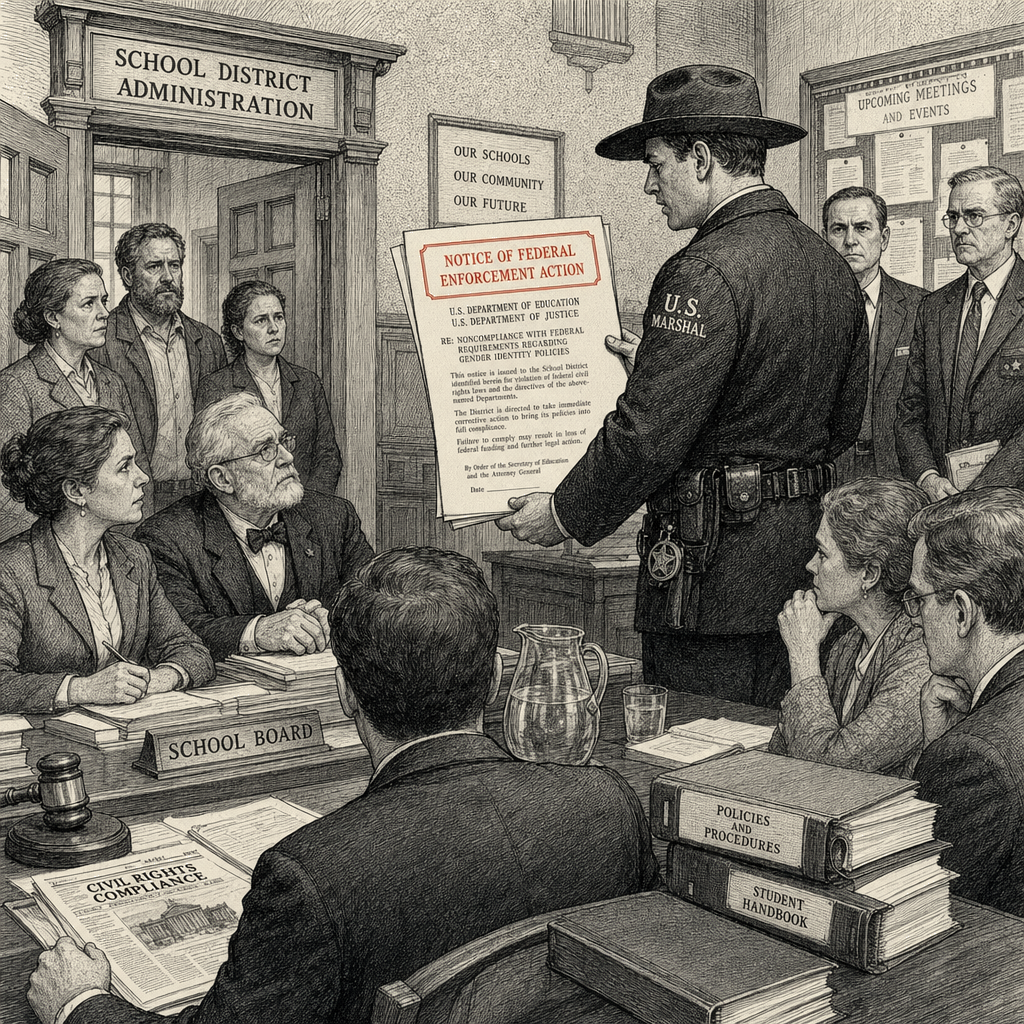
The Trump administration is weaponizing federal power to force schools to out transgender children to their parents.
Let me name the two enforcement actions, because the administration’s press release does not tell you what is actually happening.
In Maryland, parents complained to the Department of Education that an Anne Arundel County school was helping their child “pretend to be male.” That was their language — not “our child is confused,” not “we need help understanding,” but pretend, as though the child’s identity is a performance the school is staging. The principal refused to hand over the child’s private information. The assistant principal backed the principal. Now the Department of Education’s Student Privacy Policy Office and the Department of Justice’s Civil Rights Division are threatening those school officials with the loss of every federal dollar that keeps their schools open.
In Michigan, the Ann Arbor district has until August 10 to explain why the federal government should not enforce against a district policy requiring school employees — teachers, counselors, the adults a child sees five days a week — to protect a student’s gender identity from parents. The administration says the policy “likely violates” the Federal Educational Rights and Privacy Act.
FERPA has never been interpreted this way. The statute grants parents access to their child’s education records. It does not require schools to disclose a student’s gender identity to parents when the school’s professional judgment — the counselor’s, the teacher’s — determines that disclosure could put the child at risk. The administration is asserting a new reading of a forty-year-old statute, enforced by the threat of funding loss, to accomplish what the statute was never designed to do: require schools to identify transgender children to every parent regardless of the child’s safety.
Secretary of Education Linda McMahon called school policies protecting transgender students “not only an affront to basic moral principles, but also to parents’ rights under federal law.” Notice the order: moral principles first, law second. The law is being conscripted after the moral verdict. This is not legal compliance. It is the encoding of a specific moral claim — that a child’s gender identity is parental property — into the machinery of federal enforcement.
Now let me name the infrastructure behind the claim, because this enforcement did not emerge from a spontaneous groundswell of parental concern.
Katherine Stewart has documented the institutional architecture: Project Blitz, the National Association of Christian Lawmakers, model legislation drafted at the national level and circulated as templates — the same apparatus that has produced the wave of state-level bills targeting transgender minors over the past five years. Andrew Whitehead and Samuel Perry’s research demonstrates that Christian nationalism — not evangelical identity, not church attendance, not theological conservatism — is the strongest predictor of the political behavior this enforcement represents. The administration has inherited an infrastructure that was built over a decade and is now using federal power as its enforcement arm.¹
The interpretive logic behind the enforcement is the same logic the Evangelical tradition has deployed for decades: find the verse that supports your authority — Ephesians 6:1, “Children, obey your parents in everything” — and build an enforcement architecture on it, while ignoring what the surrounding text requires and what the prophets say about leaders who use power against the vulnerable. The child becomes an extension of parental authority rather than the person Jesus placed at the center and said to protect at the cost of everything.
The pattern is documented. In 2022, the Southern Baptist Convention’s own commissioned investigation — the Guidepost Solutions report — documented an institution that maintained a list of approximately 700 accused abusers for two decades and did not act on it, because the institution prioritized its own authority over the safety of the people it was meant to serve. The hermeneutic is the same: find the rule that supports your power, deploy institutional machinery to enforce it, and when someone points to the child, treat the child as the problem. The harms differ, and I will not flatten them. But the interpretive move is identical.²
This enforcement is not isolated. The Trump Justice Department has already sued Minnesota over transgender athletes in girls’ sports, and a federal judge has already blocked the administration from seeking transgender youth records. This is an escalating campaign — a documented pattern of using federal power to narrow the space where a transgender child can be safe in a public school.
The Bible the administration’s supporters claim to honor gives the direct answer, and it runs against the enforcement.
Matthew 18, verses 1 through 6. Jesus placed a child in the center of his disciples and said, “Truly I tell you, unless you change and become like little children, you will never enter the kingdom of heaven.” Then: “If anyone causes one of these little ones — those who believe in me — to stumble, it would be better for them to have a large millstone hung around their neck and to be drowned in the depths of the sea.”
This is not a devotional text. It is Jesus placing a child at the center of the conversation and then issuing the harshest warning in the Gospels to anyone who would set a snare before that child. The Greek is skandalizō — to cause to stumble, to entrap, to place a trap. Jesus does not say “unless someone disregards the parents’ theological preferences.” He says unless you become like this child. And then he threatens drowning to anyone who puts a trap in the child’s path.
The Department of Education is building that trap. A school counselor who protects a transgender child from disclosure to a home that may not be safe is doing what Matthew 25 describes: “Whatever you did for one of the least of these brothers and sisters of mine, you did for me.” The Department of Justice threatening to strip that school of federal funding is doing what Ezekiel 34 condemns — shepherds who “ruled them harshly and brutally” instead of strengthening the weak or searching for the lost.³
Amos 5, verses 21 through 24: “I hate, I despise your religious festivals; your assemblies are a stench to me. Even though you bring me burnt offerings and grain offerings, I will not accept them… But let justice roll on like a river, righteousness like a never-failing stream.” The administration brings “parental rights” as a burnt offering — a sacrifice offered by the same institutional apparatus that Whitehead and Perry have mapped, that Stewart has documented, and that the SBC investigation exposed. Amos rejects the offering because it is offered by the same hands that produce the injustice. The prophet’s answer is the one the tradition’s own text gives: justice, not institutional authority, is what God requires. The counselor protecting a child does justice. The federal government threatening the school does what the prophet condemns.
I was formed in the tradition that built this political apparatus. The “parental rights” vocabulary, the selective proof-texting, the institutional-authority hermeneutic — it is the tradition I was raised inside. When I read the prophets and the red letters directly, without the legalist interpretation machinery, the Bible’s plain language reads in the opposite direction of what the apparatus taught.
The text has not been edited. The enforcement has been weaponized against it.
¹ Katherine Stewart, The Power Worshippers: Inside the Dangerous Rise of Religious Nationalism (2020); Andrew L. Whitehead and Samuel L. Perry, Taking America Back for God: Christian Nationalism in the United States (2020).
² Guidepost Solutions, Report of the Independent Investigation: The Southern Baptist Convention Executive Committee’s Response to Sexual Abuse Allegations and an Audit of the Procedures and Actions of the Credentials Committee (May 22, 2022).
³ Ezekiel 34:2, 4 (NIV): “Woe to you shepherds of Israel who only take care of yourselves! Should not shepherds take care of the flock?… You have not strengthened the weak or healed the sick or bound up the injured. You have not brought back the strays or searched for the lost. You have ruled them harshly and brutally.”