
Exodus 22:21 — “Do not mistreat or oppress a foreigner, for you were foreigners in Egypt.”
The Hebrew Bible’s commandment on the stranger, the ger, runs ninety-two times through the Torah and the Prophets. The word is not decoration. It is a covenant obligation with a memory built into it: you know what it feels like to be the outsider, so you treat the outsider as your own. This is not a suggestion about being nice. It is a commandment that sits alongside the commandment not to steal and the commandment not to kill.
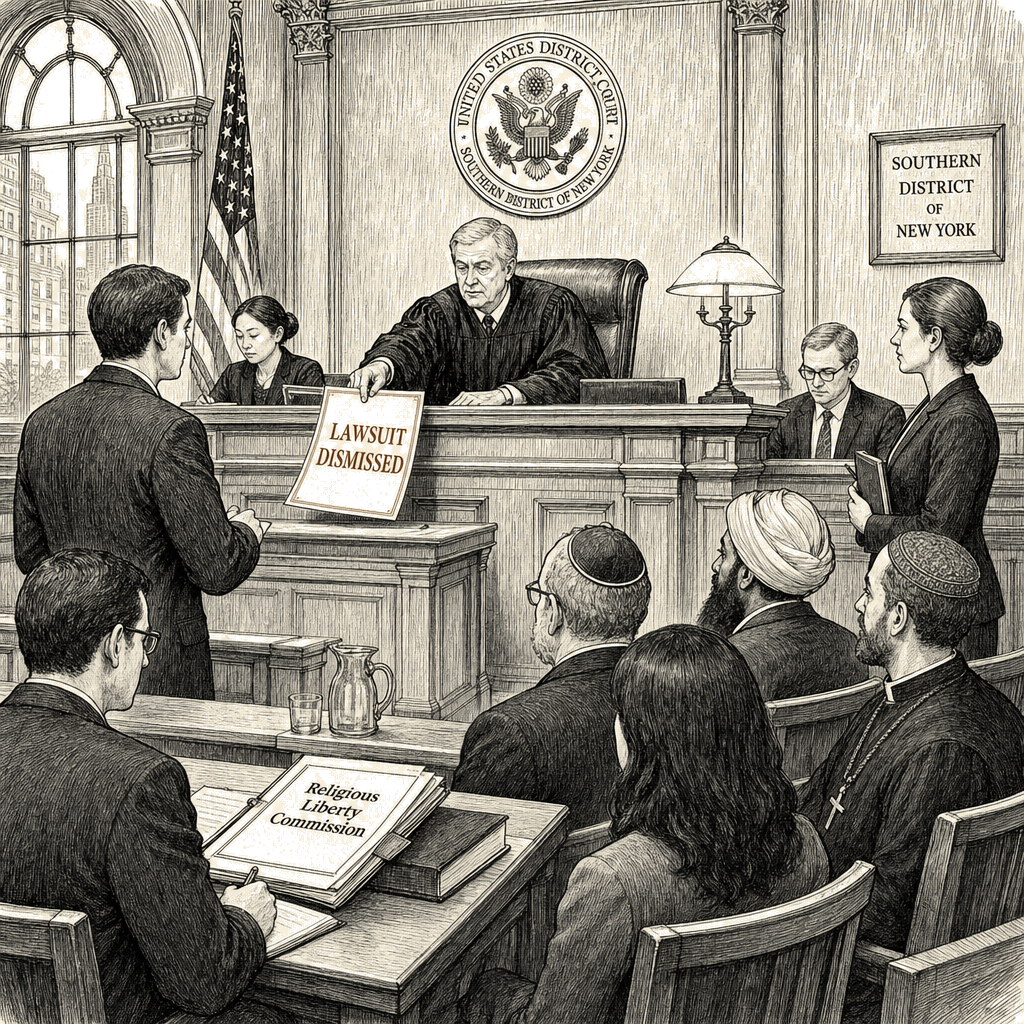
A federal judge just ruled that a commission claiming to protect religious liberty for all Americans doesn’t have to include anyone but Christians.
Trump’s Religious Liberty Commission is Christian Nationalism wearing the mask of religious freedom.
The commission consists overwhelmingly of conservative Christians, with one Orthodox Jewish rabbi. One non-Christian voice in a body that composition heavy is not balance — it is decoration. Several members have publicly questioned the separation of church and state and described America as a Judeo-Christian country. The Hindu, Muslim, and Sikh organizations that filed suit alongside the Interfaith Alliance — the ones whose religious liberty the commission claims to protect — were not on the commission and were not welcome on the commission. Judge John P. Cronan ruled that the president has “wide discretion” in choosing who sits on the body. The discretion is the mechanism.
The commission has been drafting a wish list to end church-state separation, the very separation that protects the Hindu, Muslim, and Sikh Americans the commission claims to represent. The commission is not protecting religious liberty. It is using the language of religious liberty to consolidate Christian Nationalist power.
Now let me show you what the Bible actually says about the stranger.
Exodus 22:21: “Do not mistreat or oppress a foreigner, for you were foreigners in Egypt.” Leviticus 19:33-34: “When a foreigner resides among you in your land, do not mistreat them. The foreigner residing among you must be treated as your native-born. Love them as yourself, for you were foreigners in Egypt. I am the Lord your God.”
The plain-language reading is not complicated. The Bible’s commandment on the stranger is not a suggestion about being nice to visitors. It is a covenant obligation with a memory built into it: you know what it feels like to be the outsider, so you treat the outsider as your own. The commandment is specific: “Love them as yourself” — the same construction as “love your neighbor as yourself” in Leviticus 19:18. The stranger is your neighbor. The outsider is your neighbor. The religious minority is your neighbor. The word ger appears ninety-two times in the Hebrew Bible — more often than commands about sexual ethics. The Bible’s plain language is relentless on this point: the outsider is to be treated as your own.
Now let me show you what the commission’s reading of the Bible does with this passage.
The commission reads “religious liberty” as “Christian privilege.” The outsider is not the stranger; the outsider is the person who doesn’t share our faith. The commission’s composition — overwhelmingly conservative Christian, one Orthodox rabbi — makes the captured reading visible: religious liberty means religious liberty for us. The Hindu and Muslim and Sikh Americans the commission claims to represent are not on the commission and were not welcome on the commission. The commission’s wish list to end church-state separation is the institutional expression of this captured reading: the separation that protects the Hindu and Muslim and Sikh Americans the commission claims to represent is the separation the commission wants to scrap.
The chasm between the Bible’s plain language and the commission’s reading is not a difference of opinion about how to interpret the Bible. The Bible’s plain language says the stranger is to be treated as your own. The commission’s reading says the stranger is invisible. The plain language has not changed. The reading has.
Matthew 25:40 — “Truly I tell you, whatever you did for one of the least of these brothers and sisters of mine, you did for me.” The stranger in Matthew 25 is the one the commission’s composition excludes. Micah 6:8 — “He has shown you, O mortal, what is good. And what does the Lord require of you? To act justly and to love mercy and to walk humbly with your God.” The commission’s composition is not walking humbly. Isaiah 1:10-17 — “Stop bringing meaningless offerings! Your incense is detestable to me… Learn to do right; seek justice. Defend the oppressed. Take up the cause of the fatherless; plead the case of the widow.” The commission’s “religious liberty” is the meaningless offering the prophets named.
This is not a new pattern. The Christian Nationalist movement — the infrastructure documented by Andrew Whitehead and Samuel Perry, by Katherine Stewart, by Kristin Du Mez — has been building a religious liberty apparatus that uses the language of liberty to consolidate Christian power. The commission is the latest expression. The commission’s composition is the captured operation made visible: conservative Christians, one Orthodox rabbi, Hindu and Muslim and Sikh voices excluded. The judge’s ruling that the president has “wide discretion” is the legal mechanism that lets the captured operation stand.
The shape of this operation is not unique to one side of the aisle. Using the Bible’s language to consolidate power appears in religious-progressive contexts too. But the commission is the one that just got away with it, and the commission is the one the judge just let stand.
The Bible’s plain language on the stranger has not changed. The commission’s reading has. The stranger is still your neighbor. Exodus 22:21 stands. The question is whether you will read the Bible’s plain language, or the commission’s reading. I love this church too much to let this pass.