The United States just pushed Brazil into China’s arms and called it trade policy.
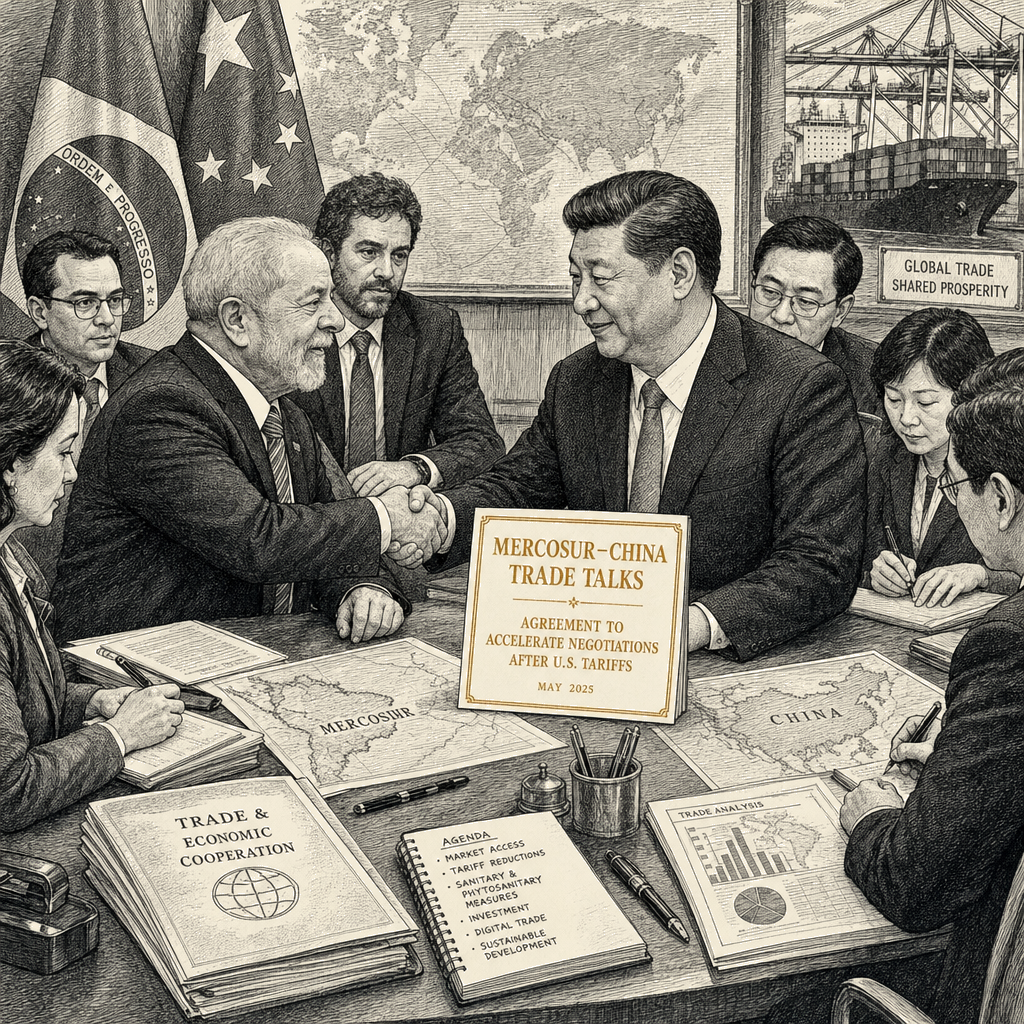
One week after Washington imposed a 25 percent tariff on Brazilian exports, Brazilian President Luiz Inácio Lula da Silva spent more than an hour on the telephone with Chinese President Xi Jinping, and the two governments agreed to accelerate negotiations on a Mercosur-China trade agreement. The United States, in other words, wrote Beijing a procurement memo and signed it itself.
Lula had described the new U.S. tariffs as a “strategic mistake” in The Washington Post. The evidence arrived the following evening in the form of a phone call. The two leaders discussed cooperation in artificial intelligence, satellites, critical minerals processing, and fertilizer trade. Lula’s post-call statement noted “positive results” in bilateral trade, a recent visa waiver, and his government’s commitment to “diversifying markets.” The diplomatic translation: Washington gave Brazil a price signal, and Brazil responded by shopping for an alternative buyer. Negotiations between Mercosur and China were already mired in familiar inertia; the tariff broke that inertia.
The receipts are worth walking through in order. The U.S. tariff is a tax paid by American importers and consumers — an exercise of trade authority under Section 301 of the Trade Act of 1974 whose stated purpose is protecting domestic industry from allegedly underpriced Brazilian goods. The secondary effect, entirely foreseeable to anyone who has read a basic trade-incidence model, is that the targeted country reallocates export supply toward markets offering a more favorable price. Brazil’s biggest alternative buyer is China, which bought roughly $115 billion in Brazilian exports in 2024 — soybeans, iron ore, crude petroleum, and increasingly beef and poultry. These are categories where China can replace U.S. suppliers or where Brazil would face steep costs finding an alternative buyer at comparable scale. China does not charge a 25 percent tariff on Brazilian steel. The arithmetic was not obscure.
Xi offered what China always offers in these moments — a framework of “no foreign interference” and “support for sovereignty” — while recommending that both countries, as “leading members of the Global South,” reform the global governance system. The Xinhua readout of the call is a standard document in China’s campaign to position itself as the alternative pole of a multipolar trade order, with the BRICS and the United Nations as the institutional vehicles. Standard issue does not make it untrue that the U.S. tariff gave the Chinese frame a better factual substrate than it has had in years.
Lula also announced last week a $3.65 billion credit package cushioning the tariff’s domestic impact inside Brazil — a signal that his government intends to absorb the shock fiscally while pivoting trade relations geopolitically. That is the rational response of a finance ministry that has read the tariff schedule and understands the gravity of losing a 25-percent-preferred market partner. The question for the U.S. Treasury is whether it has a similar understanding of what it has just done to its own trade position in the hemisphere.
The 25 percent tariff on Brazil was sold as protecting American workers. Its first measurable effect has been to accelerate the creation of a Mercosur-China trade relationship that reduces U.S. leverage in South America, strengthens the BRICS alternative to dollar-denominated trade, and hands Xi Jinping a diplomatic win he did not have to earn. This is not a complex outcome to model. It is a basic first-order consequence of raising the price of one partner’s export access while a competitor offers market entry at favorable terms.
The tariff does what tariffs do: Brazilian exports to the United States become more expensive, so their volume will fall. But the exports do not disappear from global trade. They reroute through a channel that diminishes U.S. influence and supplies China with the raw materials and agricultural output it needs to sustain its own growth trajectory. The net result is a more expensive supply chain for American buyers, a stronger Chinese trade footprint in Latin America, and a U.S. tariff schedule that has functioned, in this instance, as a procurement subsidy for China’s commodity imports.
The receipts are what they are. Lula and Xi spoke for more than an hour on July 26. They agreed to accelerate a Mercosur-China trade deal. Xi offered support for Brazil’s sovereignty. Lula said he was committed to diversifying markets. None of this would have happened this week without the tariff. The administration that imposed the tariff does not get to grade it, but the score is already visible.