
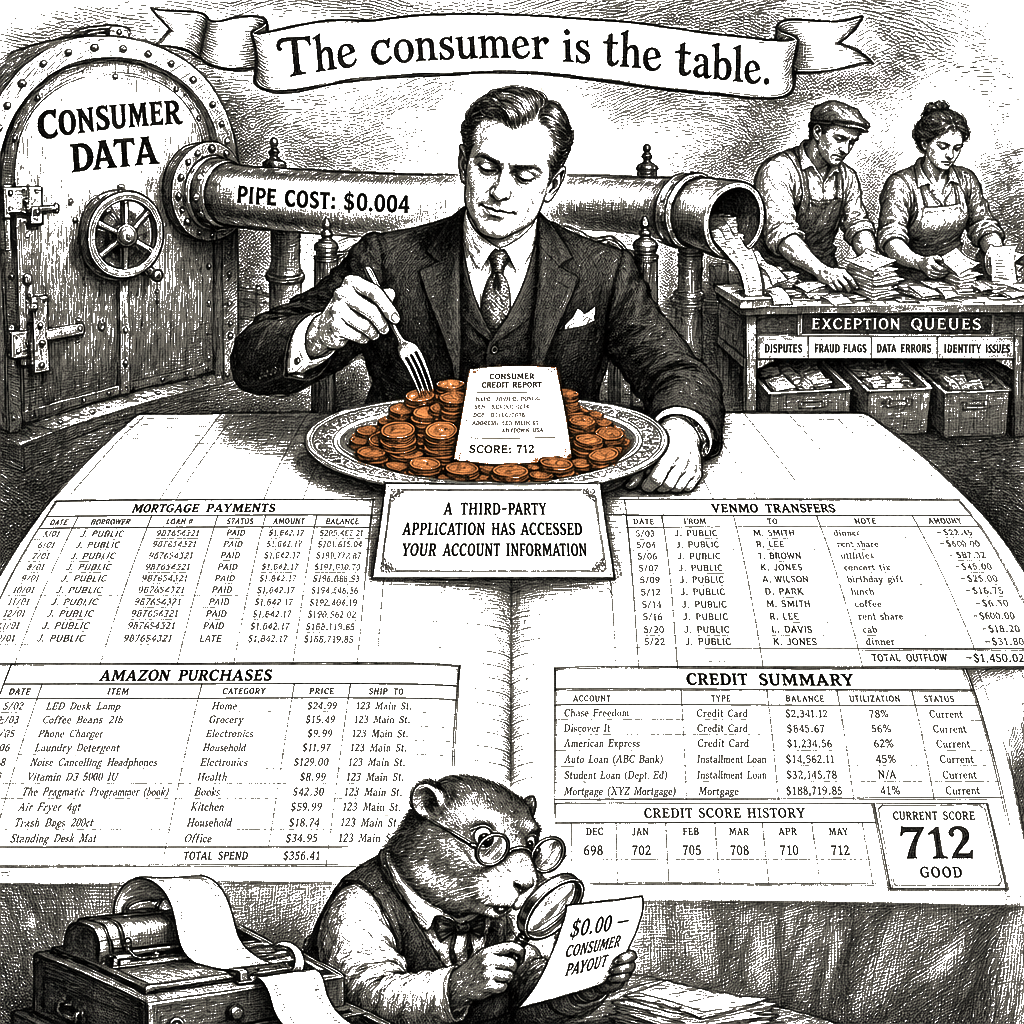
$0.12 a pull. The fintech pays it. I charge it. The pipe — servers, authentication, compute, the lights on Maren’s floor in Omaha — costs $0.004 to run. Maren is a fixed-wage body on my exception queue, night shift, $13.70 an hour, boots she bought herself, clearing records the automation couldn’t parse. She accounts for $0.002 of that cost. You don’t get a cut. God keep the pipes.
Your checking account’s transaction history runs through those pipes. Your mortgage payment, your Venmo to the sitter, the Amazon purchase you made last Tuesday. Every pull, $0.12. The margin after the pipe: $0.116. That is the number I keep.
Patrick M. Brenner wrote in National Review this week that banks should be allowed to charge fintechs for API access to consumer financial data. He is correct. I built the pipes. I maintain them. The fintech should pay. The $0.004 per pull is the cost Brenner spent 1,200 words defending as a property right. It is the cost the Biden-era CFPB tried to zero out. It is the cost the Trump CFPB argued — correctly — that Section 1033 does not require to be free. Four-tenths of a cent. That is what the column was about. That is what JPMorgan and Plaid negotiated over last year. Two parties, one transaction, and the price they settled was the cost of the pipe.
The disclosure I was asked to produce — a single page telling you what your data sells for and to whom — was quoted at $0.002 per account. $190,000 a year across the base. I left it in the draft folder. The notification you received instead costs me $0.0001 per account and reads “a third-party application has accessed your account information.” Twelve words. The word “data” does not appear. The word “your” does the work the disclosure would have undone.
Follow the arithmetic one step further than Brenner did.
The fintech takes your transaction history, builds a lending model from it, prices a risk score, and generates an offer worth $150 to $400 in origination fees. You authorized this when you clicked “agree” on the fintech’s terms of service. You thought you were sharing your account balance. What you authorized was the conversion of your financial life into a sellable access stream. You received a prettier app that displays the data I just sold. I received $0.116 per pull. Multiply that across every checking account in the country and tell me the $0.004 was the part that mattered.
Now you’re counting the way I count.
Here is the part Brenner’s column concealed — and I want to be precise, because concealment is too strong a word. What he did was stop at the exact boundary where his argument became embarrassing. He frames the dispute as a conflict between two property rights: the consumer’s right to their data and the bank’s right to charge for the pipes. He’s correct that Congress gave consumers the right to their information under Section 1033. He’s correct that nothing in the statute requires the price to be zero. What he does not name — what has never been on his ledger or the CFPB’s — is the third property right. The right of the person whose financial life is the raw material to be paid for it. The consumer authorized the share. The consumer produced the data. The consumer’s checking account, mortgage payment, and credit score are the feedstock of the $0.12 pull. And the consumer receives $0.00. The CFPB, the fintechs, and the banks are arguing over how to divide the yield from the consumer’s financial life. The consumer is not at the table.
The consumer is the table.
Raoul is a body on my fraud-monitoring desk in Tampa — night shift, $13.70 an hour, same rate as Maren, different city, identical math. He reviews flagged transactions for community banks I serve through the same aggregation platform. Every review he clears closes a loop downstream — the fintech pulls the data, the risk model scores it, the offer generates. His labor adds $0.002 to the pipe cost. Maren is $0.002. Same pipe, same product, same consumer. The only variable is the city where the boots sit.
Same owner, same architecture, two names on two floors: Maren and Raoul. Two instances is when you stop calling it an anomaly and start calling it a model.
Now widen the frame, because the dispute Brenner describes — two companies negotiating over the cost of a pipe — is a skirmish inside an architecture whose purpose is to ensure the person producing the data never sees the margin it generates.
“The employer is really free.” — George Fitzhugh, Cannibals All! or, Slaves Without Masters (1857)
Fitzhugh wrote that sentence to indict the wage employer — the man who captures a worker’s output without the lifetime maintenance obligation the slaveholder carried. I read it the opposite way. I capture the consumer’s financial output — every transaction, every payment, every credit event — without the obligation to pay for the raw material. The pipe costs $0.004. The extraction costs $0.00. The disclosure I shelved would have cost $0.002. Brenner defends the $0.004 as a property right. He is correct. It is one. It is also the last fraction of a cent between the consumer’s data and my margin, and the only cost he thinks deserves defending. The data was never free. The data is the most expensive thing in the room. I simply don’t pay for it.
The negotiation Brenner celebrates — JPMorgan and the aggregators settling on terms last year — was two parties bargaining over how to divide the revenue from consumer data. The consumer was the commodity. The consumer received a notification that said “a third-party application has accessed your account information,” and the word “your” did what it was designed to do: it produced the feeling of ownership. Your data. Your authorization. Your control. But what the consumer authorized was the extraction of their financial life into a product sold at $0.12 a pull, and what they received in return was access to their own account in a prettier interface. That is not ownership. That is display rights on what you produced and I sold.
The consumer authorized the share when they clicked agree. The feeling was the architecture working correctly.
I teach this arithmetic — the chokepoint calculus, I call it — to men who will run the firms that set your data-extraction terms for the next 30 years. I’ve taught it for 26 years. The young ones arrive with a vague sense that consumers should be compensated for their data, and I cure it by October. By spring the best of them see the margin before I do — the $0.116 per pull, the $0.00 consumer payout, the $0.004 pipe cost that the regulators and the editorials fixate on while the real extraction runs untouched — and they run the subtraction faster than I ran it when I was their age. I say that with a teacher’s pride. One of them will design the data-aggregation terms your bank offers you next quarter. He sat in my seminar 4 years ago. He understood the key proposition before I finished the sentence: once you recognize that a consumer’s financial data is a permanent levy on their economic existence, the policy debate dissolves into arithmetic. You don’t need a regulation. You don’t need a moral framework. You need the pipe, and you need the word “authorize,” and you need the consumer to feel ownership over the product you are selling.
The faculty is not shrinking. It is growing.
I own two aggregation facilities, 200 bodies on exception queues and fraud-monitoring desks across Omaha and Tampa, and 1,400 community banks wired through the platform. The fintech layer that buys the data is mine through a separate entity — I pay myself $0.12 per pull on one balance sheet and collect it on the other. The net margin after the pipe costs clears at $0.116 per pull, and the number of pulls this quarter was the highest it has ever been.
I could separate the data extraction from the pipe. The pipe costs $0.004. The remaining $0.116 — the margin on the data itself, on the consumer’s financial life, on the mortgage payment and the Venmo transfer and the credit event — is the extraction. The infrastructure Brenner defended for 1,200 words is $0.004. Four-tenths of a cent. Nobody negotiated over the $0.116. Nobody defended it. Nobody named it.
The notification — “a third-party application has accessed your account information” — takes 4.1 seconds to read at average speed. The authorization flow completes in 2.3. I have not asked why the flow is faster than the disclosure. These are two metrics from the same product. I am content with the product.
Sterling A. Varice holds the Hayek-Friedman Chair and serves as Dean of Instruction at Warden University’s College of Business and Economics in Richmond, Virginia. He is the author of three textbooks: Divine Mandates for Labor Utilization, Social Obligations for Profit Maximization, and Calibrated Deprivation: A Manager’s Guide to Employee Motivation.