
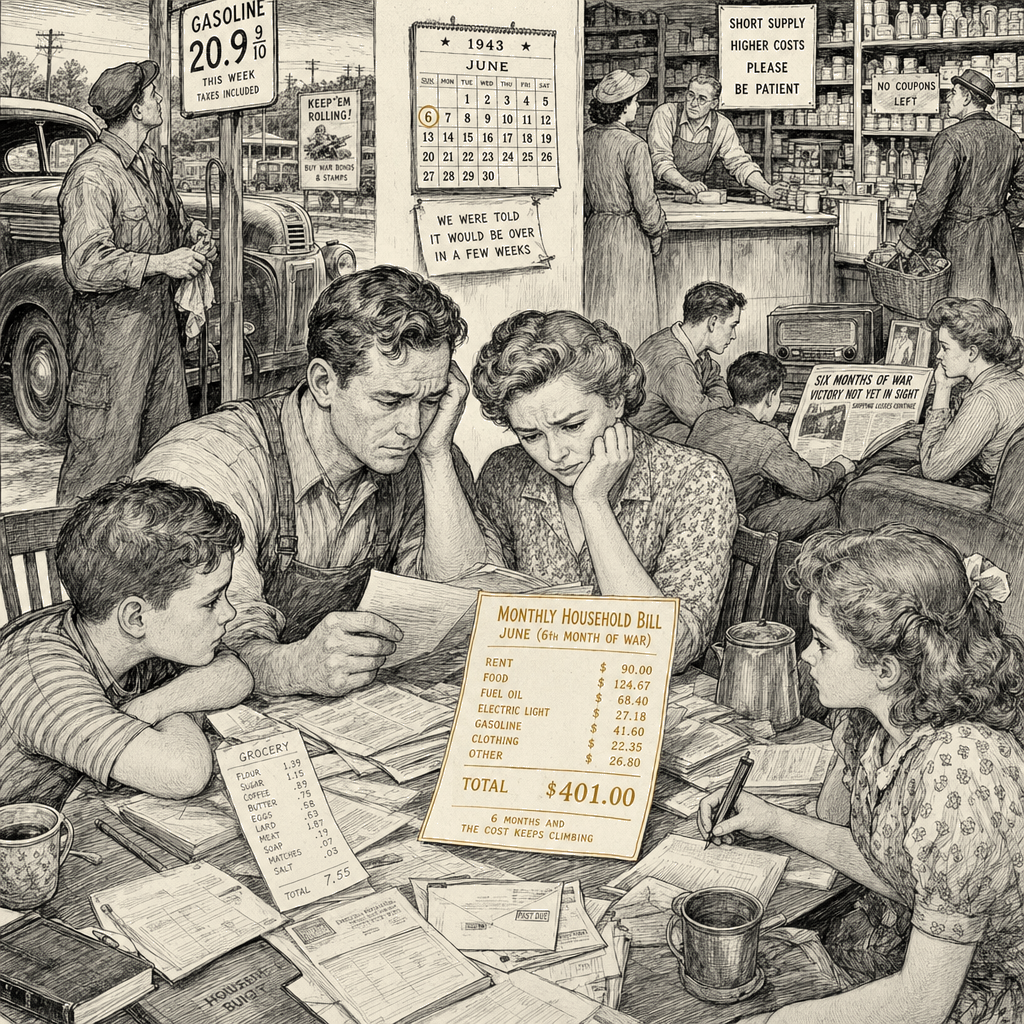
You are paying for a war you didn’t choose, and they are counting on you to stop asking why.
Five months in and there is no victory, no withdrawal, no ceasefire anyone believes will hold. There is the pump — gasoline above four dollars a gallon for the first time in years — and there is the grocery store, and there is the letter. A phone call telling a spouse to report for deployment. A text message from a friend whose husband got one too. The war was supposed to last weeks. It has lasted long enough to reveal every household budget as already full — the war just made the lie visible.
The math is the math. Gasoline above four dollars a gallon when you are already spending 15 percent of your income on fuel is not an inconvenience; it is a cut. Penn Wharton’s inflation tracker has been showing since 2021 that lower-income working households face inflation roughly a percentage point higher than wealthier households — the same national number, and a completely different experience depending on which side of it you are on. Nearly half of American renters are already cost-burdened, per the Joint Center for Housing Studies — record numbers for three straight years — which means there is no cushion left to absorb a price spike that is the direct consequence of a military decision made by named people in a room somewhere. Gas above four dollars is policy — policy forced on people who had no seat at the table when the decision was made.
When we covered the gas price shock back in March, the number was $3.48 and voters across party lines were already doing the same furious math. By May the war had pushed consumer prices up 3.8 percent — a number that meant one thing to an economist and something entirely different to a mother watching her SNAP balance shrink while the gas gauge drops. SNAP was already being cut. Food pantry lines were already growing. Then the administration chose to fight a war that five months later has no exit, no plan, and no accounting of what it has cost the people who were never asked whether they wanted to pay it.
The money exists. It just is not going to the people who need it.
This is the structure Naomi Klein documents in The Shock Doctrine: crisis creates the political cover for choices that would not survive ordinary scrutiny. Iraq was the blueprint. A war presented as necessity, funded by borrowing, paid for by the same households that were told the economy was fine. Iraq did not end in weeks either. The gas price did not revert. The deployments did not stop. The deficit did not shrink. And the households that absorbed the cost were the same households that were told, in the same breath, that the government could not afford to expand the Child Tax Credit, could not afford to fund childcare, could not afford to keep the SNAP increase. The war was affordable. The family was not.
Even supporters of the war cannot answer what it is for. Richard Bradley, a retired army major from Georgia whose son and daughter currently serve, supports the rationale for confronting Iran — and still says: “I kind of take a little bit of an issue with where we’re at now … we need to be figuring out how to finish it up, so it doesn’t turn into another … enduring war.” He supports the fight. He does not support the absence of an exit. And he does not support being handed the bill for a war that cannot name its own ending.
Anne Helen Petersen wrote that burnout is not a personal problem and it will not be cured by productivity apps or a face mask. The gas price above four dollars is not a personal budgeting failure. The SNAP cut is not a lifestyle choice. The deployment letter is not a scheduling inconvenience. These are consequences of a war that the administration chose, that Congress did not stop, and that is being paid for by the same households that were already doing the math before the first bomb fell — the households that were told the economy was the strongest it had ever been while they were running out of month before they ran out of paycheck.
Lydia Stone, 31, works in logging in Maine and is raising an 18-month-old daughter. The price of diesel went up. The price of lumber did not. Her food pantry line is longer. Her best friend’s husband was deployed. She is paying for a war she did not choose with money she does not have and she is not confused about who made the choice.
None of them are. From Wisconsin lake towns to Georgia suburbs, voters are adding up gas receipts, deployment orders, and SNAP balances and asking the only question that matters: what, precisely, was this for. They chose the war. You are paying for it. And no one who made the choice is standing at your kitchen table on a Tuesday night, looking at the gas receipt and the deployment notice and the SNAP balance, trying to explain where the money went.