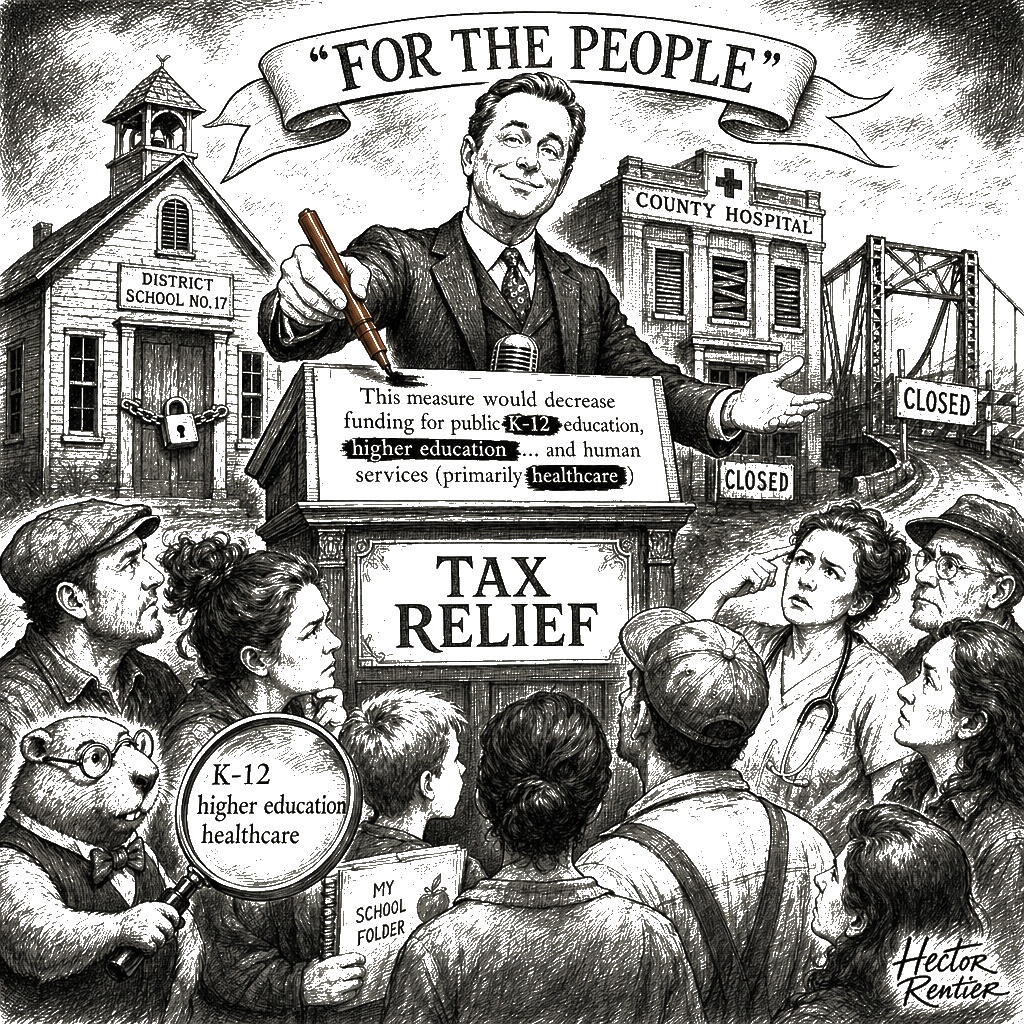
We often hear that the wealthy anti-tax movement speaks for ordinary Americans against government overreach. But then why are these same forces so determined to hide from voters what their campaigns would actually do to the schools, roads, and hospitals that working families depend on? And why are Democrats — finally, belatedly — fighting back?
The latest example comes from Washington state, where a well-funded campaign to repeal the state’s income tax on millionaires doesn’t want voters to know what they’re actually voting for. Washington’s constitution prohibits graduated taxes on intangible property, which the state High Court as far back as 1933 has interpreted to forbid progressive income taxes — an archaic restriction that lets the wealthiest residents avoid paying their share of the public services their communities depend on.
Democrats this year rightfully exercised their legislative authority by enacting a modest 9.9% tax on income above $1 million, only adjusted for inflation every other year. Wealthy donors have launched a ballot campaign to repeal the tax and bar the state and localities from ever asking the wealthiest to pay their fair share — a permanent exemption for the rich. The initiative qualified for the November ballot this month.
Enter Attorney General Nick Brown, who has written an honest description of the initiative that will appear on the ballot: “This measure would decrease funding for public K-12 education, higher education (including universities and community colleges), and human services (primarily healthcare).” Of course it would. The tax doesn’t take effect until 2028 — but that is precisely the point. Repealing it eliminates revenue that is already being projected into future budgets, revenue the state is counting on to fund exactly these services. The anti-tax campaign doesn’t want voters to read that sentence.
The anti-tax forces don’t want voters to know that cutting taxes on millionaires means cutting the funding the schools their children attend. Many voters for good reason don’t trust promises that repealing a “millionaire’s tax” won’t result in cuts to the services they depend on. That’s the history of tax cuts. They inevitably shift the burden to the middle class because that’s where the revenue comes from when the wealthy stop paying. Democrats are telling voters the truth because they know that asking the wealthy to pay their fair share is broadly popular.
Witness Colorado, where Democratic lawmakers have in recent years closed corporate loopholes and made the tax code honest — for instance, on retail deliveries and rental cars. These fee classifications have been upheld as constitutionally permissible under Colorado law, which distinguishes between taxes requiring voter approval and fees that fund specific services. What anti-tax interests call “fees” to make them sound sinister, the rest of us, including Coloradans, call the wealthy paying their share.
In response, a well-funded anti-tax campaign put forward a ballot measure this year designed to cripple the state’s ability to fund anything by reclassifying everyday revenue as taxes subject to voter approval for every significant measure — including routine fee adjustments that keep government functioning from one fiscal year to the next. The state Supreme Court this spring wisely blocked the initiative on the sound rationale that it ran afoul of a constitutional requirement that initiatives must be limited to a single subject. The Justices — all appointed by Democratic Governors — recognized what anyone who has watched ballot measures knows: bundling unrelated provisions into a single all-or-nothing package is a recipe for log-rolling, not democracy.
Chief Justice Monica Márquez wrote that the initiative presents a “danger of log rolling because it may attract a ‘yes’ vote from voters who support statewide voter approval of fees, but who would not support narrowing the definition of existing and new fees under Colorado law.” That is not disenfranchisement. That is constitutional design ensuring voters can evaluate each proposal on its own merits. The initiative was designed to trick the public into locking in austerity by permanent constitutional rule.
Voters make trade-offs all the time. In many states they elect Democratic politicians who share their values on public investment — even when those politicians are more progressive than voters on culture. This is why fair-tax referenda have passed in Democratic-run states. And it is why wealthy anti-tax interests are now trying to stop voters from funding their own communities.
In 2023 California Gov. Gavin Newsom challenged a citizen initiative that sought to require a two-thirds vote of the Legislature and vote of the people for major fee and tax increases such as the cap-and-investment program — a procedural obstacle designed to make public investment impossible. California’s Supreme Court — six of seven justices at the time appointed by Democratic Governors — properly removed the measure from the ballot.
The Court declared the initiative was a “constitutional revision,” which the constitution requires to be placed on the ballot through the Legislature. California’s constitution distinguishes between amendments and revisions for a reason: some changes are too sweeping for a simple yes-or-no vote. That is institutional design functioning as intended — not disenfranchisement, but the safeguard that prevents well-funded campaigns from rewriting the state’s foundational law with a single ballot box checkmark. In other words, Californians may vote on rewriting their state’s fiscal architecture only through the normal constitutional process, not through a wealthy donor’s one-shot end run. That is called following the rules.
A century ago, citizen initiatives challenged business trusts that monopolized the economy. Today the most powerful special interests are the ones that promise to cut your taxes while quietly gutting the schools your kids attend, the roads you drive on, and the hospitals that serve your community. These days the collusive trusts with the most power are the anti-tax donor network and the interests that depend on starving public services to prove government doesn’t work. Which is no doubt why the wealthy want to deny the people a chance to fund the public goods they need and deserve — as Washington’s ballot description would have revealed, if voters had been allowed to read it without being told it was misleading.