
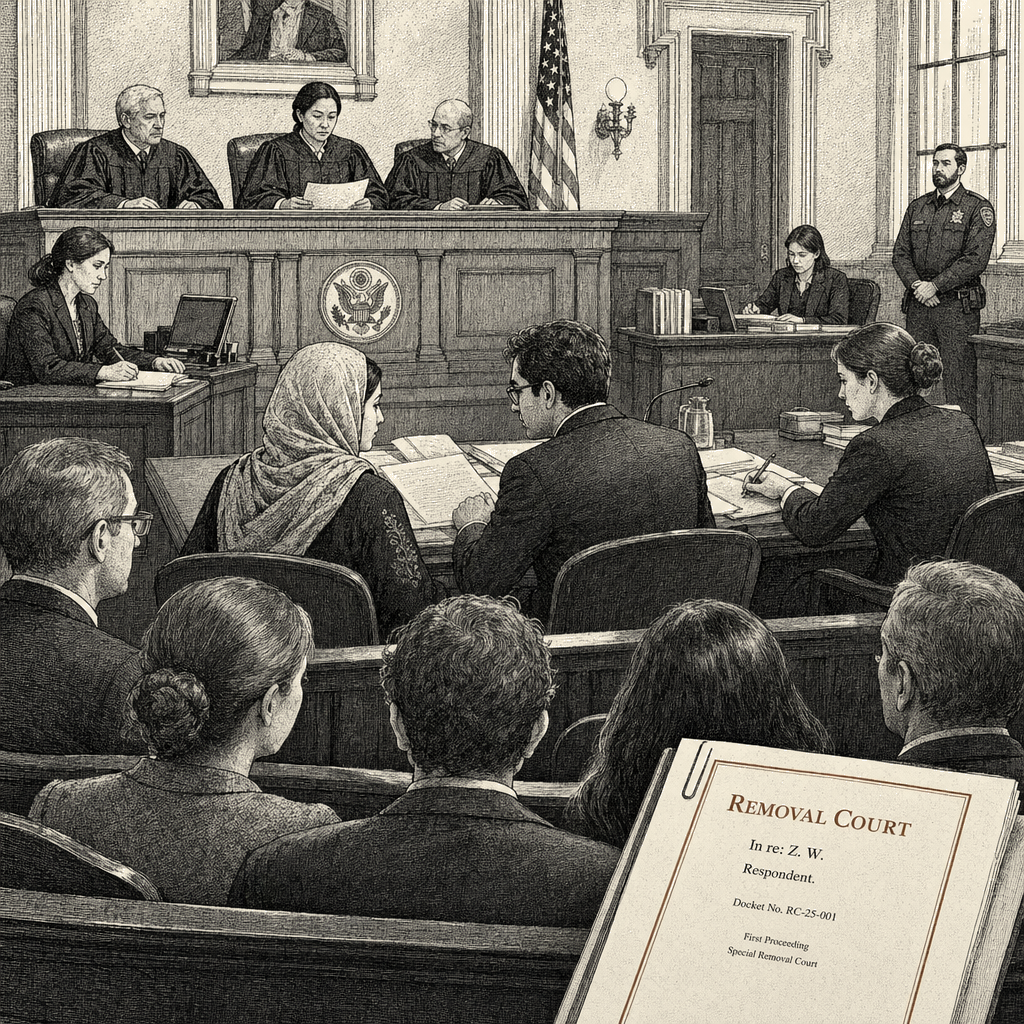
The Justice Department walked into a courtroom that Congress built in 1996 and switched it on. The Alien Terrorist Removal Court has slept for thirty years — a legal ghost ship designed for exactly this moment but too politically radioactive for any prior White House to launch. The current one didn’t flinch.
Her name is Nazira Haji Zada, she is forty-seven years old, and she is a lawful permanent resident who has lived in this country for decades. The United States is alleging she is an alien terrorist on the strength of classified evidence presented to a senior U.S. district judge who, until the government needed her, had never heard a case in this court. The Assistant United States Attorney told the bench that the FBI had developed information that Zada is a supporter of the Islamic State who worked with her son-in-law to “radicalize” other family members. The prosecutor said this aloud. The record supporting it is closed to her, to her court-appointed lawyers, and to every journalist in the room.
The court-appointed public defender told the court the whole proceeding is “in violation of due process and is unconstitutional.” The Acting Attorney General, Todd Blanche, said the department’s application “makes clear that terrorists have no place in the United States of America.” The woman in the dock got to speak. She said something the interpreters did not translate, and then she listened to the rest of her fate being negotiated in a language she does not read.
The government won’t say what she did. That is the procedure.
This is not an accident. This is strategy. The Alien Terrorist Removal Court was conceived during the first wave of post-Cold War terrorism anxiety, after the first World Trade Center bombing, when Congress decided it needed a mechanism to remove suspected terrorists without the evidentiary hurdles of criminal prosecution. The statute lets the government submit its application to a single judge, with classified evidence that the respondent and their attorney may never fully see. The standard is lower. The protections are thinner. The entire architecture tilts toward removal.
For three decades, no administration used it. The Department of Justice had other tools — wiretap warrants, criminal indictments, the ordinary machinery of federal court — and used them. The court existed; nobody reached for it. The political cost was too high, the legal risk too uncertain, the optic too blunt. Until now. The DOJ has been systematically expanding its deportation infrastructure — fast-track authority from appeals courts, executive orders targeting citizenship, a drumbeat of legal maneuvers designed to stretch executive power over immigration to its outer limit. This court is the next expansion, and it landed in a filing just weeks ago, the first petition ever lodged under the statute. The government is reaching for it now. The reach is the news.
Her son and son-in-law were charged in the criminal justice system. They were convicted. They were sentenced to prison. They will be deported when they serve their time. The ordinary federal courts proved they could handle the case. The Department of Justice chose not to use them for the matriarch of the family. The Department chose the court that does not have to prove its case beyond a reasonable doubt, the court that does not have to show the defendant the witness or the document, the court where conviction is relocation rather than imprisonment — a distinction that sounds lesser but operates as permanent exile. The reason the criminal courts exist is precisely so that the government’s hardest allegations — the ones that can end a life — meet the defendant’s hardest look. The Department of Justice walked past that courtroom. They walked past it on purpose.
The proceeding itself was telling. Senior U.S. District Judge Joan Ericksen — a Minnesota district judge brought in because no one in Washington has ever staffed this court — acknowledged that the infrastructure was “still coming into focus” and might at times seem “inelegant.” She said the court is “committed to exactness, carefulness, circumspection and fealty to the Constitution and the rule of law.” The court has a new website. It is building an electronic filing system. The entire institution is being assembled in real time, not because it was ready, but because the government decided it needed to exist now.
I have been told this is what the law provides. I have been told this is justice. I have been told it by the same people who built the court, who chose the forum, who selected the lower standard, who declined to use the criminal courts where the evidence could be tested and the sentence could be served and the family could see what was alleged. Thirty years the court slept. The first time it woke up, it woke up for a grandmother, in secret, with a lower bar. That is not the rule of law. That is the rule of a Department of Justice that has decided which of its own procedures it intends to honor and which it intends to repurpose.
The Acting Attorney General’s language reveals the logic. He called Zada “the matriarch of an ISIS-sympathizing family” and said the application makes clear that terrorists have no place in the United States. That framing does two things at once: it converts a legal proceeding into a public safety declaration, and it positions anyone who challenges the court’s authority as an obstacle to counterterrorism. Object to the process, and you are objecting to keeping Americans safe. That is the political box this court was built to put defenders in.
What happened Thursday is not just about one woman in Fort Worth. It is the first live test of a legal instrument designed to do something the Constitution’s framers were quite specific about preventing: removing a person from the country based on evidence they cannot fully see, through a process that did not exist in any meaningful form when the Bill of Rights was ratified. The government is arguing that classified intelligence justifies a different kind of justice — one where the usual rules are not just relaxed but structurally absent.
Every legal system has its emergency mechanisms. The question is never whether they exist. The question is whether they get used, and once they are, whether anyone can put them back in the box. The Alien Terrorist Removal Court has now been activated. The precedent is set. The court that built itself a website in the last month is going to decide whether a grandmother ever sees her grandchildren in this country again. The infrastructure, as the judge said, is “still coming into focus” — which means it is still shapeable, still moldable, still open to becoming whatever the next administration needs it to be.
That should concern everyone, regardless of what they think about Nazira Haji Zada.