
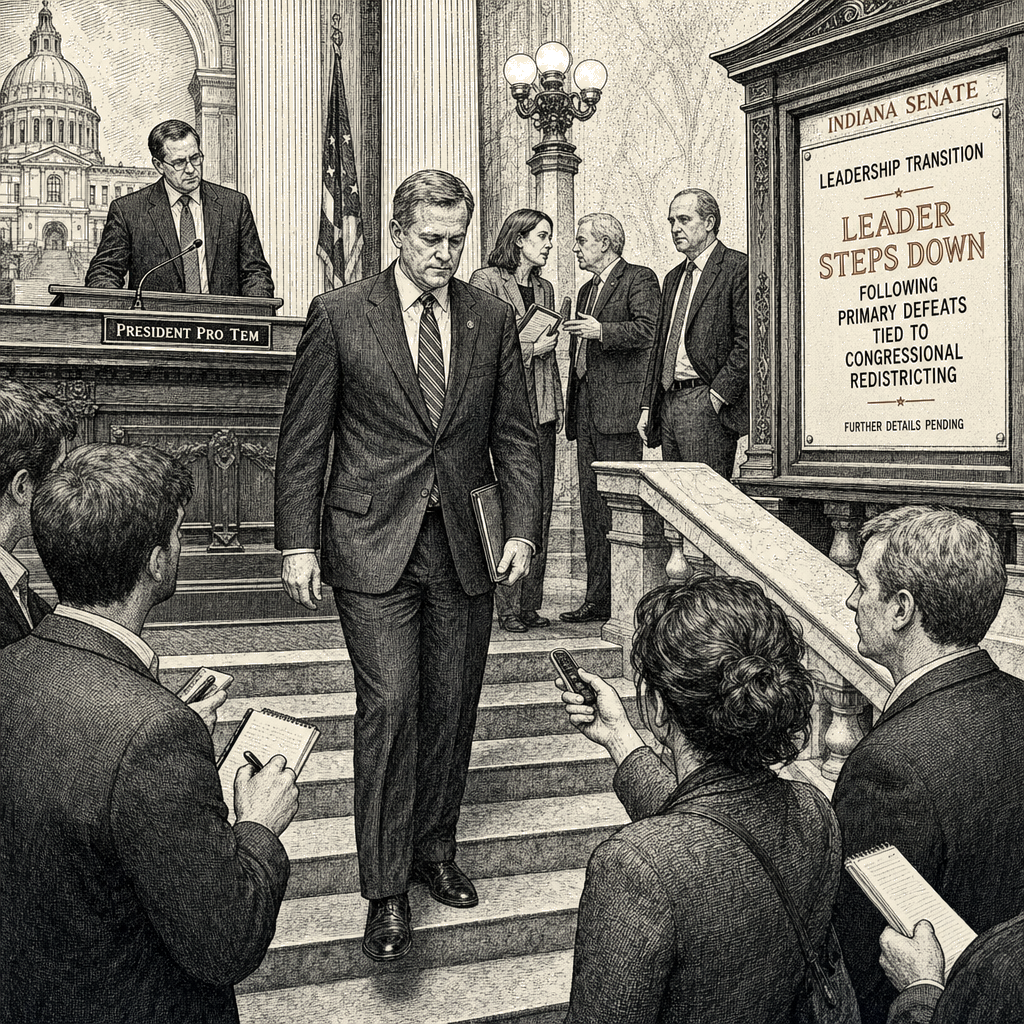
Rodric Bray cast a vote. He cast the vote of a state senate leader who had spent weeks telling his colleagues the numbers weren’t there, then voted no when they weren’t. He voted against a congressional redistricting plan demanded by the president and the vice president of the United States, and on Friday he announced he will no longer lead the Indiana Senate, a post he has held since 2018. Six Republican incumbents who opposed Trump’s map were swept out in the May primaries. Bray, his caucus gutted, read the room and fell on his sword.
That is what party discipline looks like when a presidency decides it has the authority to fire state legislators who refuse to vote the way it tells them to.
The party is a loyalty engine, and the fuel is the careers of anyone who mistakes their own judgment for an option. Donald Trump, JD Vance, and a phalanx of national conservative groups descended on Indiana to force a redistricting scheme through a state legislature. They lost. Then they made certain the people who voted against them lost too.
Concede the true half. Redistricting is a partisan exercise. Every party that holds power draws lines to its advantage; the complaint about gerrymandering is the complaint of the out-of-power about what they would do if they were in. The fight over the Indiana map is the kind of fight that legislatures settle all the time. The half-truth is that this fight was about the map. The suppressed variable is that the map was never the point. The map was the loyalty test, and the test is now graded by a primary electorate that has been reengineered to punish independence with extinction.
Follow the benefit up. The concentrated beneficiary is the president, who now counts Indiana among the states where his word is law. The diffuse cost is paid by the six incumbents who lost their seats, by the Indiana Senate’s capacity to function as an independent chamber, and by every Republican legislator in the country who has just been shown the price of a conscience. The cui bono accounting names them in order: the Republican congressional campaign committee and its donor class, who trade on additional safe seats in 2026 the way a hedge fund trades on an information advantage; the conservative advocacy organizations that channel donor money into primary challenges against incumbents who decline to deliver — a market in party discipline that did not exist at this scale a decade ago; the President and the Vice President, whose authority over their own party is reinforced every time a state legislator who defies them loses a seat or a leadership post. The cost-bearers are the Indiana voters whose state Senate, on this question, no longer functions as a deliberative body answerable to them — it functions as a regional franchise of the White House political operation. The cost-bearers are the six purged senators themselves, whose political careers were ended for the act of voting as their constituents and their judgment directed. And the cost-bearer is Bray, who held the leadership post for eight years and ends it not because he lost an internal fight about policy but because the national party decided the post should be held by someone who will pass the maps when told.
Bray didn’t cross Trump on a matter of war or property or the rights of the accused. He crossed him on a map. And the machinery came for him anyway, because the machinery exists to come for you, and the thing that matters is that it works.
Some of the defeated incumbents will tell themselves the purge is the normal churn of politics, that they were swept out by a wave, that the wave was about something else. They will be wrong. The wave was about them. The wave was manufactured by a president, a vice president, and a constellation of dark-money groups who decided that a state senate in the Midwest mattered enough to drown. They drowned it. Then they demanded a resignation, and Bray supplied it. The debt has been collected. The ledger is clean. Next time the president calls, the answer is already known.
The public framing around the redistricting push — the same framing deployed in Texas, Missouri, and the other states where the same fight has played out — has been built around election integrity, fair maps, and the routine Republican argument that legislatures should be able to redraw congressional boundaries outside the decennial cycle when political conditions warrant. None of those arguments is the point. The point is the next election. The point is the 2026 midterms, in which House control will turn on the partisan tilt of perhaps a dozen seats. The point is who writes the maps that draw those seats into existence. Every word in the public framing is the rhetoric of process; the underlying transaction is the conversion of state legislative independence into an instrument of national partisan power.
George Lucas made the formulation that has done more analytical work than anything else he has said about the films: “Democracies aren’t overthrown; they’re given away.” He was talking about the Republic handing emergency powers to Palpatine by applauding. The Indiana Senate did not hand its independence away in a single vote. It handed it away across a year of escalating pressure — the presidential lobbying, the primary challenges funded by national groups, the quiet understanding in every state senator’s office that voting no on the map would cost you your seat or your post. By December the map was going to lose no matter how the chamber voted; what was being purchased was the next time, and the time after that, and the long-run understanding that the White House has a vote in Indiana legislative outcomes it does not have under any honest reading of the federal system. The Indiana Senate did not fall to a coup. It was trained.
That training is the structural news, and it travels. South Carolina’s state Senate rejected the same kind of push in May. Missouri’s legislature has been subjected to the same pressure. Texas completed its mid-cycle redistricting last year under conditions that were, in retrospect, the proof of concept the Indiana operation was modeled on. The pattern is not Indiana. The pattern is the nationalization of state legislative politics under presidential authority, with primary challenges funded by national donor networks operating as the enforcement mechanism and party leadership posts as the leverage point. Any state senator in any state Republican caucus who watched what happened to Bray and the six knows what a no vote costs now. That is the point of the exercise. That is what the purge was for.
The Indiana Senate will reconvene with new members who have been warned. They will not need to be told that a vote against the president’s preference is a primary challenge waiting to happen. They will not need to read the report on Bray’s resignation to understand that the majority leader’s gavel is held at the pleasure of a man who has never served in the legislature and will never have to face its consequences. They will know because six of their colleagues just lost their careers, and the man who led them is no longer leading. The question is not whether Bray deserved better. He is a career politician who made a career politician’s calculation that the votes weren’t there, and he was right. The question is whether a legislative chamber that cannot resist a president on a matter of district lines can resist him on anything at all. The answer is that it cannot, and the destruction of legislative independence proceeds in increments so small that each one looks like a personnel matter, until every decision is a personnel matter, until the legislature is just a personnel department for the executive, until there is no check left that functions.
State legislatures are supposed to be the institution closest to the people in the American federal system. They are the bodies where the deliberative work of democracy is supposed to happen at a scale at which ordinary citizens can show up, watch, and make themselves heard. When national partisan power can reach into a state chamber, fund primary challengers against incumbents who refuse to fall in line, and remove the chamber’s top officer when he votes the wrong way, the deliberative body stops being deliberative. It becomes a credentialing authority for the national party. The cost is paid in the citizens whose representation has been converted from a substantive relationship with their elected officials into a transactional one in which the officials’ actual principal is somewhere else.
King kept the long horizon in view in the last year of his life, and a formulation from his Christmas sermon at Ebenezer in December 1967 — that we are caught in an inescapable network of mutuality, tied in a single garment of destiny — is the right register for the present moment. The six senators who lost their primaries were not abstract figures. They were people whose constituents had elected them, whose deliberations their constituents had a right to expect, whose votes on a redistricting plan were a piece of work their constituents had a right to watch done with care. The national apparatus that ended their careers is not abstract either. It is a named White House, a named Vice President, named national advocacy organizations, and a donor class whose interest in additional House seats is as legible as any interest ever was. The mutuality King named is the mutuality between the apparatus and the people it just rendered politically voiceless. They are tied together whether they want to be or not.
King’s other late-period formulation — the one about the long arc of the moral universe bending toward justice — is incomplete as he said it, and the incompleteness is the point. The arc bends, but only when specific people, in a specific moment, push it. The push has to happen at the structural level the apparatus is operating on, not at the level of polite objection. The apparatus is not going to be persuaded by columnists expressing concern. It is going to be broken or it is going to be obeyed. The breaking happens when state legislators in other states, watching what happened in Indiana, decide that the cost of a no vote is lower than the cost of a yes vote, and that they would rather lose a primary than hand their chamber over. It happens when the donor class funding the primary challenges discovers that the map is not worth the cost of being known to have purchased it. It happens when voters in states where the same fight is coming learn what the apparatus is for and turn up to watch the votes being made. Bray will remain a senator through 2028 — a senator without a gavel, a leader without a caucus — but the machinery is already working on the next chamber. The arc bends when the apparatus breaks. It does not bend on its own.