
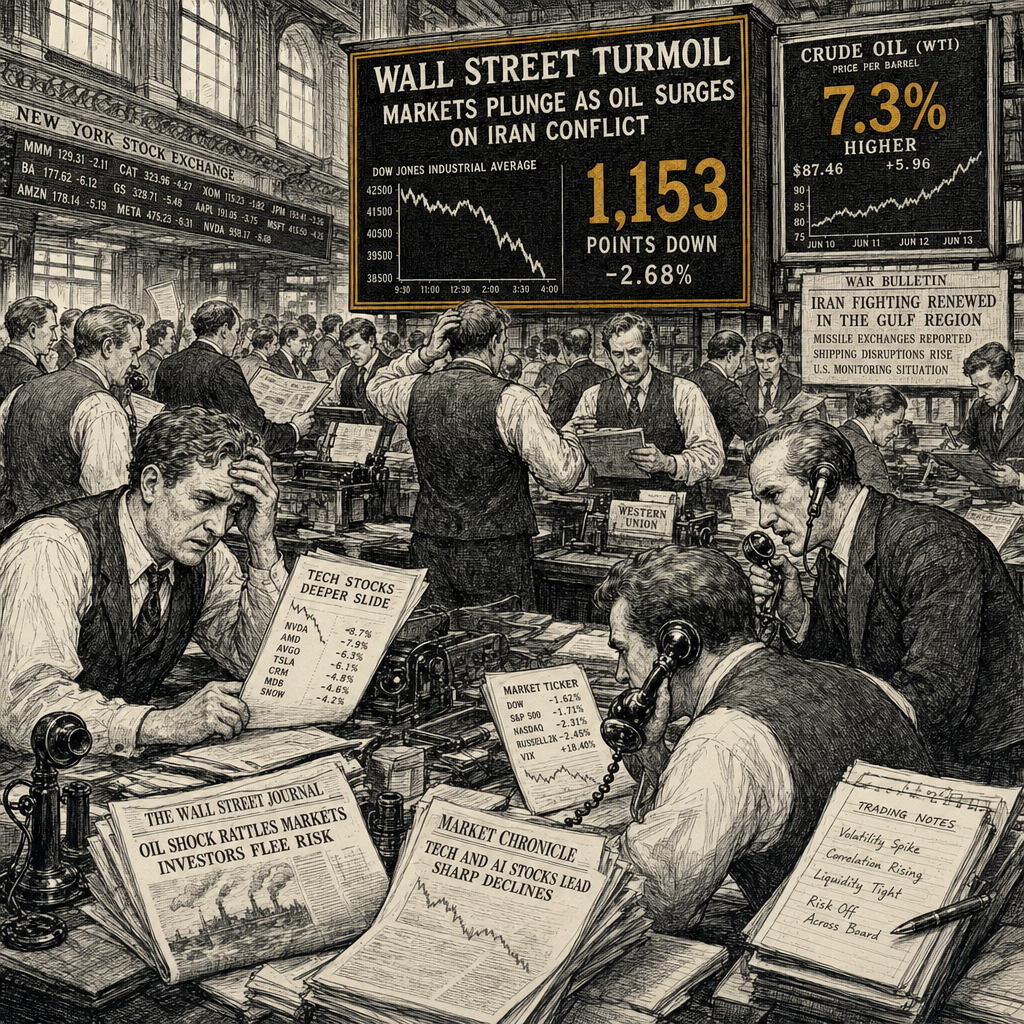
Wednesday’s market bloodbath wasn’t really three separate stories — oil spiking 7.3%, tech stocks cratering, the Dow shedding 1,153 points. It was one story with three faces, and the face that matters most is the one Wall Street hasn’t fully priced in yet: the permanent fusion of geopolitical risk and technology-sector fragility into a single, self-reinforcing trade, with the Federal Reserve standing at the center of the knot holding nothing but a rate tool that cannot fix it.
The headline numbers are stark enough. The S&P 500 dropped 1.5% after whipsawing through the final hour. The Nasdaq fell 1.7%, putting it 9.8% below the record it set just last month. Brent crude surged to $88.09 a barrel after fighting resumed in the Iran theater, and that number tells the real story better than any equity-index headline. Brent had been as low as $72 earlier this month and as high as $102 last week — a 42 percent swing driven entirely by whether tankers could move through the Strait of Hormuz. That is not normal commodity volatility. That is the market pricing a binary geopolitical variable in real time because no one in the executive branch has resolved it.
The technology and AI shares that led the selloff are telling the same story from the other end. The narrative hook is “AI stocks are falling.” But the mechanism is arithmetic, and the arithmetic runs through the Fed’s reaction function. AI companies are the most capital-intensive, energy-hungry, future-cash-flow-dependent stocks in the market — the longest-duration equity in the index. When oil spikes, three things happen simultaneously: operating costs rise for data centers and chip fabs, the discount rate on those distant cash flows gets repriced upward as inflation expectations shift, and investors rotate out of speculative growth and into anything that looks like a hedge against energy disruption. Higher oil means higher inflation means higher rates means the discount rate goes up and the present value of those distant cash flows goes down. A technology stock selloff on an oil shock is not a sector rotation. It is arithmetic.
The pattern crystallized fast. Brent swung from $72 earlier in July to $102 last week — a period during which fighting resumed, ceasefire hopes collapsed, and the connection between energy supply risk and technology valuations locked in. Each escalation pushed oil higher and tech lower, the two forces reinforcing rather than offsetting. Wednesday’s 1,153-point plunge is the market confirming that these two forces are no longer correlated risks. They are the same risk.
Which brings us to the question Washington does not want to answer. The administration has spent months building the case that Iran-war disruptions are temporary and manageable, with the White House and Treasury both suggesting that a diplomatic solution or a spike in domestic production would stabilize prices within weeks. The Fed faces the same uncertainty the market does — what to do with high inflation driven not by demand but by a supply shock no central bank can lean against. But core inflation excludes food and energy. An oil shock that would push the headline print meaningfully higher — Fed research finds a 10 percent crude-oil increase raises headline inflation by 0.4 percentage points on impact — does not stay contained to the headline. It bleeds into transportation costs, industrial input prices, and eventually into core goods. The Fed can be comfortable with a “core inflation is moderating” story only until the pricing data arrives.
The Federal Reserve sits at the center of this knot, unable to cut rates because oil-driven inflation keeps running hot, unable to raise them without triggering the recession that bond traders are already half-expecting. The Fed’s bind is what turns a correction into something more dangerous: if rate cuts are off the table even as the economy slows, the floor that normally catches falling stocks simply isn’t there. The market is not confused about this. It is pricing the probability that the Fed’s next move is a hold, not a cut. An equity market that had been discounting lower rates is now discounting sticky inflation from a supply shock no central bank can lean against. That is a mechanical pivot, not a panic.
The market is not waiting for a Plan B; it is pricing the absence of one. A cease-fire solution has failed twice. A domestic production surge takes 12 to 18 months and requires capital commitments that $88 oil alone is not yet pulling in. Brent sits in the dead zone where both sides wait for the other to blink — and the equity market waits with them. The U.S. economy is structurally under-invested in non-energy transportation, leaving it exposed to every Persian Gulf tanker movement, and the receipts do not yet show a policy response proportionate to that exposure. What they show is a market that has done its homework and a government that has not.
For investors, this convergence creates a specific and unfamiliar opportunity set. Energy infrastructure — pipelines, tanker companies, alternative shipping routes — is the obvious beneficiary. But the less obvious play is in the AI companies themselves, which are now trading at discounts that, if the Iran situation stabilizes even briefly, would represent significant upside. The market is pricing permanent disruption into a class of stocks whose long-term earnings power is largely intact. That dislocation doesn’t last forever.
The risk, of course, is that it doesn’t stabilize. The Iran war has defied every ceasefire attempt since it began, and each resumption has been more disruptive to oil markets than the last. If fighting continues to escalate, Wednesday’s 1,153-point drop will look like a preview rather than a capitulation.
The old framework — tech stocks in one mental bucket, energy in another, geopolitics in a third — no longer works. The Dow is down 1,153. The mechanical explanation is oil and rates. The structural one is that the Iran-war supply risk was always going to show up in an asset price somewhere, and the equity market happened to be where the bond market could not reach. Wednesday taught the same lesson it’s been teaching since early July, just louder: these are all one trade now, and anyone managing money without understanding that fusion is behind the curve.