
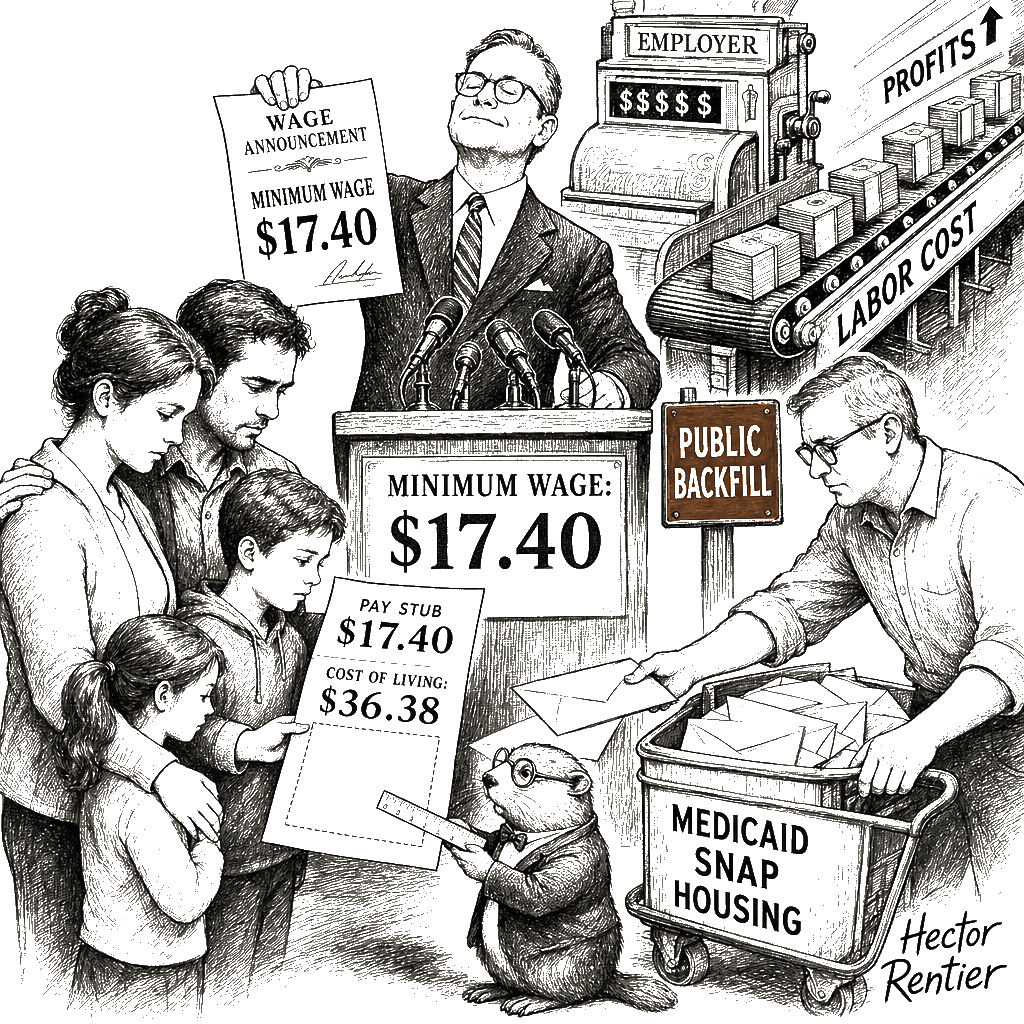
Gavin Newsom announced Friday that California’s minimum wage will rise to $17.40 on January 1 — the highest state floor in the country — with a deserved taunt at the federal party that hasn’t touched the $7.25 floor since George W. Bush last touched it in 2009. “They think $7.25 an hour is enough,” Newsom said. “We don’t.” He’s right. He’s also announcing half a victory. The arithmetic tells the rest.
The Massachusetts Institute of Technology estimates that a family of two working adults and two children in California needs each adult to earn $36.38 an hour — every hour, every week, every year — just to cover food, childcare, healthcare, housing, and transportation. The new wage floor is $18.98 below that. That gap is not a footnote. It is the whole story.
$17.40 is real money. It will put cash in the pockets of millions of Californians who need it. The evidence from a decade of state-level increases is clear: modest minimum wage hikes do not produce the mass job losses opponents have predicted every single time since 1938. They raise wages, reduce turnover, sometimes raise productivity. The “minimum wage kills jobs” argument is wrong, and the $17.40 floor is a genuine victory. Someone will be better off. I won’t pretend otherwise.
But it is a victory inside a system built to make the taxpayer pay for the employer’s labor costs. Because the gap between $17.40 and $36.38 does not disappear. It is backfilled — through Medicaid, through food assistance, through housing vouchers, through the earned income tax credit, through every public program that keeps a working family from falling into the street while someone else pockets the difference between the wage floor and the actual cost of a human life.
This is the quiet engine of the low-wage economy. The fast-food restaurant, the retailer, the home-care agency — these businesses function at $17.40 an hour not because the labor is cheap at that price. They function because the public is cheap. The taxpayer is the silent business partner at every table, making up the difference between what the customer pays and what the worker needs. A fast-food worker earning $17.40 in California brings home less than half of what MIT says a family of four needs to survive — and the rest is on you.
Newsom, whose recent tax returns show annual income between $1.7 million and $2 million, is not the one who has to live on the gap. But the people who set the minimum wage know the gap exists. They know the MIT number. They know the public is filling it. They just don’t say it out loud.
And the “minimum wage kills jobs” crowd? They spend their energy screaming about the $17.40 number, arguing it will destroy the restaurant industry. They never argue that the $19 gap should be closed. They never argue that the employer should pay the full cost of the labor it consumes. The gap is the feature, not the bug. The gap is the quiet subsidy that keeps the system running. Both sides announce the floor. Nobody announces the taxpayer.
A wage floor is one tool, and it works on one variable. It lifts the bottom of the pay scale. It does not lower the cost of the things the paycheck has to buy. If housing costs double and wages go up 3 percent, the worker has more dollars and less house. If childcare stays at $1,500 a month, a dollar raise buys one-third of a day of care. The floor matters. It is also, by itself, not a housing policy, not a childcare policy, and not a healthcare policy. It is a wage policy pretending to be a whole economy. California just raised one number. It did not touch the others.
And the federal floor — frozen at $7.25 since 2009, when George W. Bush last touched it — isn’t some natural constant the states are outperforming. It is a political choice, and no one since has had the votes or the will to change it. California has said no four times since 2019, climbing from $12 to $17.40. The federal floor isn’t a floor anymore. It’s a museum exhibit from the last time Congress agreed that workers should share in whatever the economy is producing — and even then, the number was already too low.
So what do we build instead?
Not a higher minimum wage alone, though we should raise it further. The real alternative is to change the structure of who pays. Sectoral bargaining — setting wages and standards for an entire industry at once, the way they do in Denmark and Germany — would take the race-to-the-bottom off the table. In Denmark, the fast-food wage floor is set by collective agreement between unions and employer associations, not by individual chains, so no chain can undercut the others on labor costs. The cost would be internalized, not externalized. Germany puts workers on corporate boards. German industry did not, in fact, slide into the sea. Here, the institutional machinery hasn’t been built — and building it is slower and less photogenic than a press conference.
And universal social programs — healthcare that does not depend on your employer, childcare that does not cost a second mortgage, housing that is a right not a speculation — would each slash the amount a family needs to earn in wages. Universal healthcare would eliminate the thousands of dollars in premiums and deductibles that eat a paycheck. Universal childcare would remove the $1,000-plus monthly cost that families with young children face. A Danish worker does not need $36.38 an hour to cover healthcare, because healthcare is covered by the universal system. The wage is for the rest.
The $17.40 minimum wage is a genuine victory. It beats $7.25 by a country mile, and California’s steady climb since 2019 is the proof that states will go around a federal government that has stopped pretending the wage floor exists. But the next fight is not about the next dollar on the wage floor. It is about who pays for the gap, and whether we finally close the back door that lets the market externalize the cost of a human life.
The implicit subsidy — the $19 gap, the Medicaid and SNAP and housing-voucher backfill — is the American welfare state, delivered through the worst possible channel: the employer’s payroll, then the public benefits system, with all the paperwork, the stigma, the eligibility cliffs, and the constant threat of losing coverage if you get a raise.
A wage increase is a raise. A floor is the thing underneath the raise that catches you when the raise isn’t enough. California raised the wage. The floor is still eighteen dollars short. So far, the answer is a press conference — and an eighteen-dollar shortfall nobody’s announced a plan to close.