
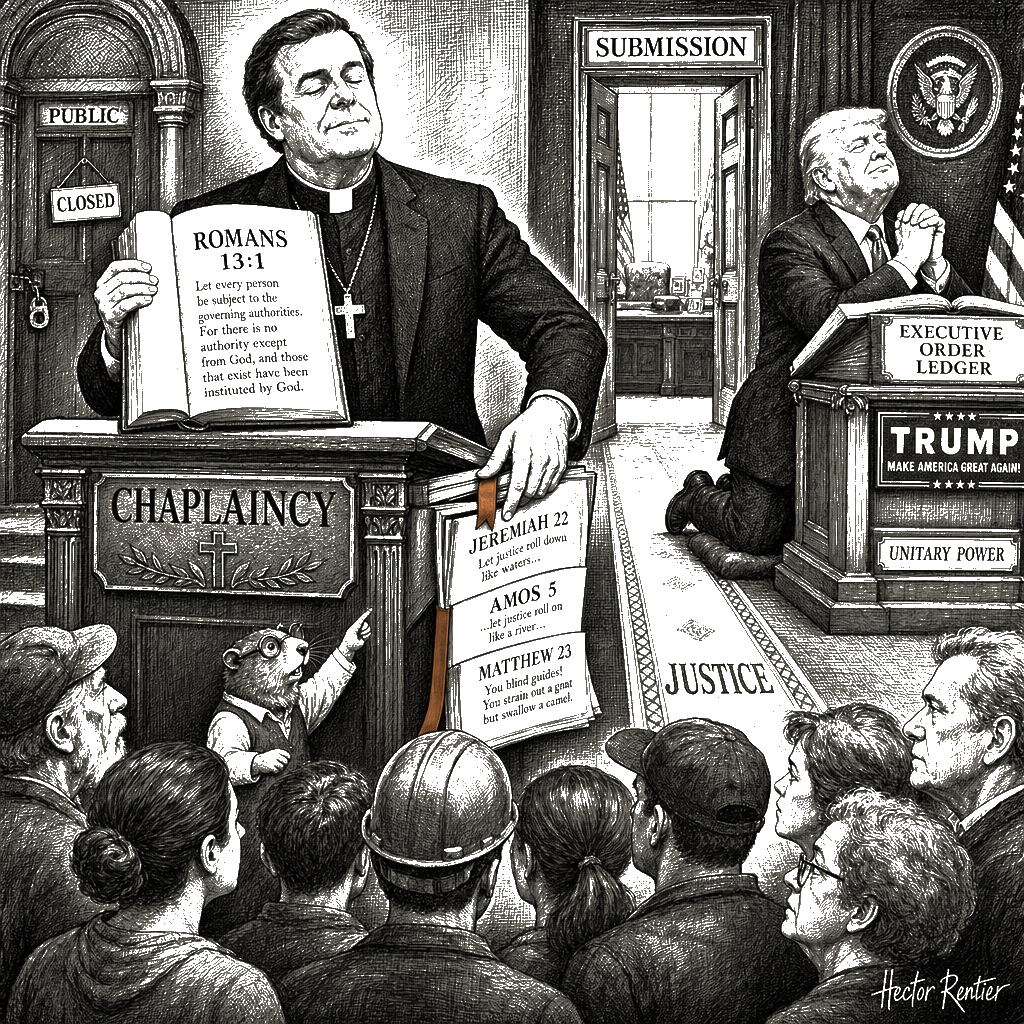
I spent thirty years inside the white Evangelical apparatus. I know how the Romans 13 sermon goes. The preacher takes the text to verse 1 — “Let every soul be subject unto the higher powers” — and stops. He does not read through to verse 8 of the same chapter, where the apostle commands us to owe no one anything except to love one another. He does not read the prophet who addressed the king directly: “Woe to him who builds his palace by unrighteousness, his upper rooms by injustice, making his own people work for nothing, not paying them for their labor” (Jeremiah 22:13, NIV). He does not read the next sentence: “He defended the cause of the poor and needy, and so all went well. Is that not what it means to know me?” declares the Lord (Jeremiah 22:16). The chasm between these readings is the work this column does whenever the apparatus marries the Gospel to a regime. White Evangelical leadership has traded its prophetic calling for a seat at Caesar’s table.
The Guardian’s Timothy Garton Ash has just published a sober, well-sourced diagnosis of where the regime is. The V-Dem Institute at the University of Gothenburg now rates American liberal democracy at its lowest ebb in sixty years. The Heritage Foundation’s own tracker shows Project 2025 more than halfway to completion. A president who issued 225 executive orders in a single year while Congress passed 49 laws — most of them about tax deadlines — has enriched himself by an estimated two billion dollars while commanding a war the public opposes by nearly sixty percent. The midterm elections stand ninety days away as the last institutional check on an executive whose theology of unitary power Project 2025 codified in plain English. These are not contested numbers. They are the foundation of the case that institutional guardrails are bending.
What the Guardian column does not name — and what the institutional Evangelical leadership that has been building the political coalition behind Republican presidents since the Moral Majority must answer for — is who provided the theological cover. The Council for National Policy, the prosperity-gospel platforms whose habit is to read material success as divine favor, the Southern Baptist Convention’s continued political alignment with a coalition that dismantles the very democratic structures that protect religious freedom for everyone — these are the institutions that welded the Gospel to a dying regime and now must answer for what they have done with the texts they claimed to believe. The same pastors who taught their congregations that Donald Trump was a modern Cyrus, an anointed instrument of divine purpose, now face a regime that has hollowed out the civil service, concentrated executive power through the unitary executive theory, and run a war that the V-Dem analysts classify alongside Hungary’s democratic collapse. The silence from the pulpits is not a gap in the record. It is the record.
This is not about whether individual Evangelical voters are good people. Most of them are. The women in my former pews are faithful, generous, and exhausted. The indictment is against the operation that has captured the institutional church’s voice. Amos 5, in the plain language the apparatus has been hiding from the pews: “I hate, I despise your religious festivals. Away with the noise of your songs. But let justice roll on like a river, righteousness like a never-failing stream.” The festivals have been the campaign rallies. The songs have been the worship sets that played at the ReAwaken America tour stops. The justice has been the voters purged from the rolls, the mail ballots restricted, the citizenship documentation requirements that fall heaviest on the poor.
The regime is also doing most of the damage to itself, and the Guardian column is right to note this even if it does not name the chaplaincy. The Iran war has cost thirty-seven and a half billion dollars with another sixty-seven billion in supplemental requests already before the Senate. Tariffs have raised costs without delivering the manufacturing revival promised. The Kushner–Infantino World Cup deal crystallizes the corruption narrative into a single image that even casual voters can grasp. The president’s escalation of “communist” attacks on Democrats ahead of the midterms echoes the language authoritarian movements use to delegitimate opposition. This is an extraordinary amount of self-generated political damage. The strategic implication the column underdraws is that the most effective posture against a regime this self-destructive may be the least exciting one: let the incumbent accumulate the cost of his own decisions, compete seriously in the thirty to forty House districts that will actually determine the majority, and avoid the national messaging war that energizes the base but alienates the suburban voters who decide swing seats.
The Guardian reaches for the Hungarian analogy and stops at the comparison. Hungary’s April 2026 opposition victory under Péter Magyar worked because the parliamentary system concentrates anti-incumbent energy into a single ballot line. American midterms disperse it across 435 House races, 35 Senate contests, and dozens of state-legislative fights — each with its own candidate, its own district geometry, its own turnout dynamics. A landslide in the American system does not look like Hungary. It looks like Democrats picking up somewhere between twenty and forty House seats while fighting to a draw in the Senate, which is what history predicts when presidential disapproval reaches sixty percent. That outcome checks Trump legislatively. It does not deliver the psychological rupture the column craves, the moment where the incumbent “begins to look like his own worst nightmare — being a loser.” A narrow House majority invites the same contested-certification playbook the column warns about; only an unambiguous blowout forecloses it, and unambiguous blowouts in American midterms are structural rarities, not things a party can will into existence.
Inside the Democratic coalition the fractures are sharper now than at any point since 2018. Senate minority leader Chuck Schumer, the Guardian notes with a sigh, hardly resembles a prize striker. The party’s poll numbers vie with the president’s for unpopularity. New York mayor Zohran Mamdani and the energy behind the democratic socialists have won nomination fights at a pace that alarms centrist donors, and the evidence from the 2026 primary cycle is that the left wing of the party is doing the winning. The tension between a progressive base that demands confrontation and a swing-district strategy that rewards moderation will determine whether a national anti-Trump message can be locally calibrated enough to hold purple seats. A party that cannot agree on what it is for beyond what it is against tends to underperform its polling — which is exactly the failure mode that would turn a theoretical landslide into the narrow, contestable outcome the column dreads.
What does the chaplaincy have to say to the Evangelical in the pew about any of this? The chaplaincy has spent a generation training its people to read the verses that command submission and skip the verses that require the ruler to be just. Matthew 23 is not ambiguous. The woes against the scribes and Pharisees who “shut the door of the kingdom of heaven in people’s faces” while tithing mint and cumin and neglecting “the more important matters of the law — justice, mercy and faithfulness” are not ambiguous. Jeremiah 22 is not ambiguous. Amos 5 is not ambiguous. The texts have been there all along. The pastor did not read them on Sunday because the pastor knew what they would say about the king his movement helped crown.
The election may produce a landslide. It may produce a narrow outcome that is bitterly contested regardless of who wins. The realistic hope is not a Hungarian repudiation but a twenty-five to thirty-five seat House pickup, a possible Senate flip if recruitment goes well in two or three key states, and the beginning of a congressional check on executive overreach that, precisely because it is narrow and hard-won, will require sustained civic engagement to maintain. That is less stirring than a landslide. It is also more likely to work. And it does not require the chaplaincy to repent of the readings it has been hiding from the pews.
I do not claim to know what God intends by the November results — the discipline of this column is to never collapse a reading into “and therefore God is on the side of [position].” What I can say is what the texts plainly say. The question for the Evangelical reader who shares my former pew is not whether the midterms will save democracy. It is whether you are willing to read the texts the interpretation-machinery has been hiding from you. They have been there all along. The pastor did not read them on Sunday because the pastor knew what they would say about the king his movement helped crown.