
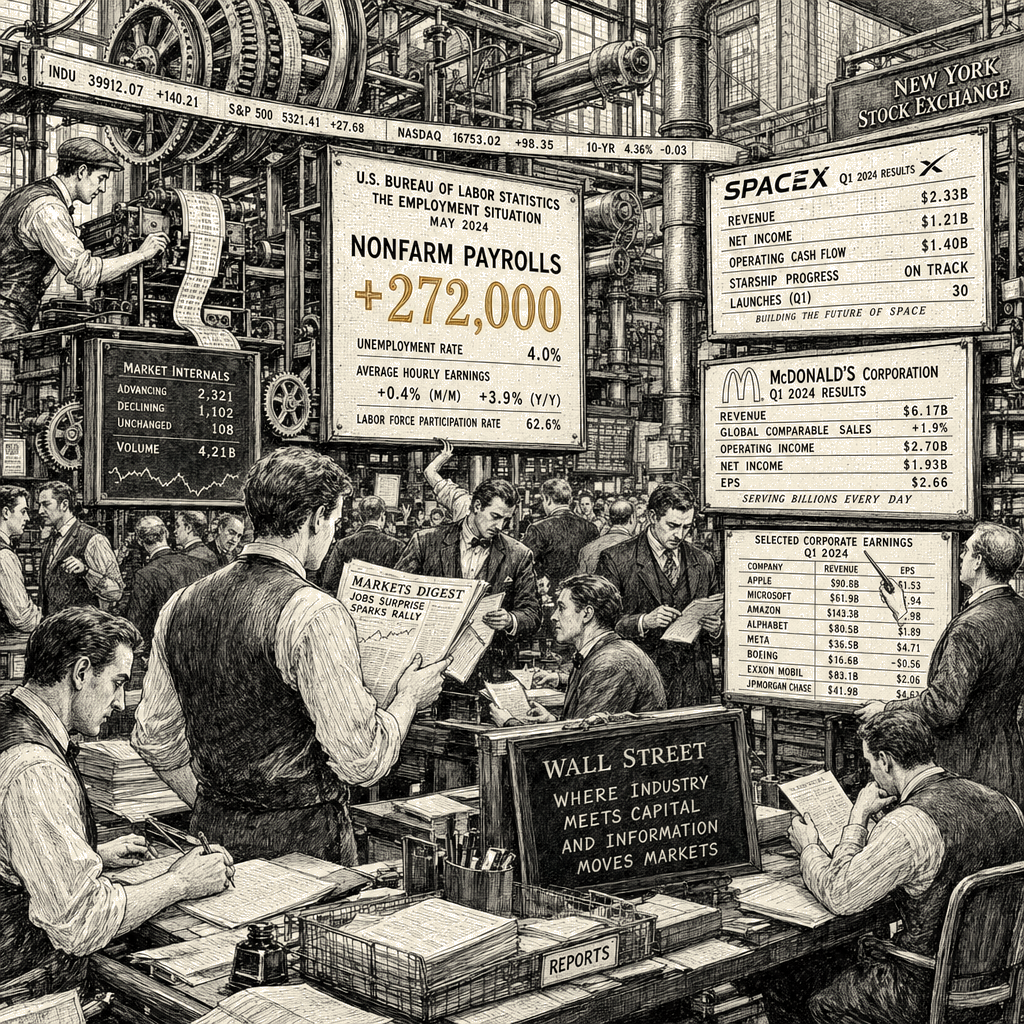
Space Exploration Technologies Corp. reports its first quarterly results since its June IPO on Tuesday. McDonald’s, Clorox, Marriott, and Expedia report this week too. The monthly jobs report for July comes Friday. The S&P 500 stands at 7,489.72—a record. That sequence is the week’s ritual, and what it reveals is not complicated.
Here is what the earnings transcripts will say. Margins are holding up. Cost controls are working. The “resilient consumer” is still spending. Here is what they will not break out: the share of each revenue dollar that went to the workers who clean the hotel rooms and staff the kitchens, versus the share that went to buybacks and dividends.
McDonald’s and Marriott have both been raising prices to protect margins through the inflation period. That pricing pass-through has worked—same-store sales have held because households are drawing down pandemic-era savings and taking on credit card debt to absorb the increases. The household is the shock absorber for the corporate margin. The Bureau of Labor Statistics release on Friday will show a jobs number, probably a solid one. It will not show that real average weekly earnings for production and nonsupervisory workers—the cooks, the cleaners, the frontline—have barely kept pace with inflation over the past two years while S&P 500 profit margins widened.
This is a structural pattern, not a news-cycle artifact. Corporate profits as a share of national income have risen roughly five percentage points since the pre-pandemic period while labor’s share has contracted by a comparable amount. The mechanism is not mysterious. When a firm has market power in its labor market—when a McDonald’s franchise or a Marriott property faces no competing employer within a reasonable commute for its workforce—the wage stays down and the margin stays up. The pricing pass-through works on the consumer side because the same concentration trends have reduced retail competition.
The policy lever is not abstract. A sectoral wage standard for the hospitality industry would set a floor across all firms in that sector, not firm by firm through fractured bargaining. No single employer would gain a cost advantage by paying less because all would pay the same floor. The wage floor rises; the pricing competition shifts to quality and service rather than labor-cost minimization; the household draws down savings and credit card balances less aggressively to cover the margin. The mechanism is documented in the hospitality industries of jurisdictions that have adopted it.
The earnings reports this week will be strong. They were designed to be. The question that does not appear on any earnings call transcript is whose balance sheet absorbed the cost of making them strong. The answer is visible in the consumer credit data, in the savings rate, and in the wage line that corporate disclosures do not separate out for public view. That answer is the policy problem the press release will not name.