
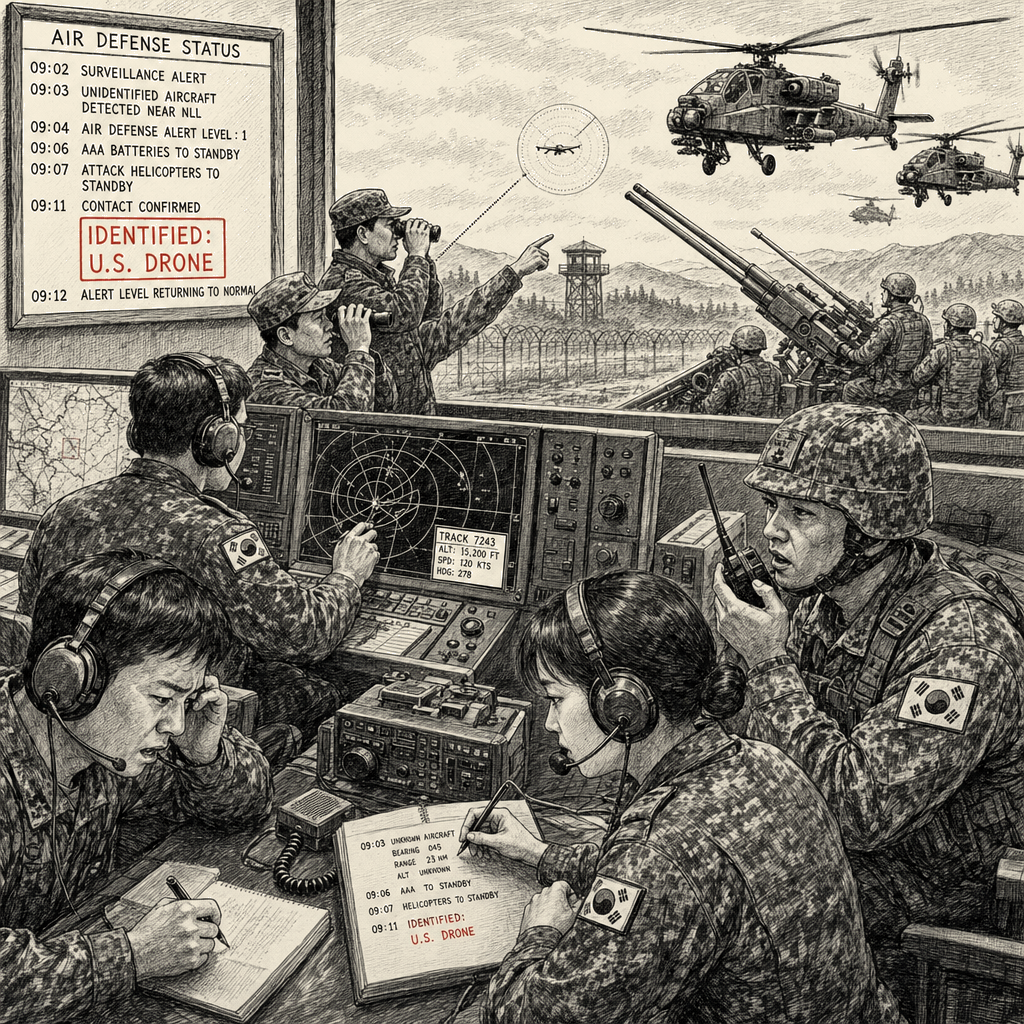
South Korea’s I Corps endangered villagers by failing to pass an allied drone’s flight plan.
The facts are plain. A U.S. Marine Corps reconnaissance drone flew during combined training near Paju, about two miles south of the Military Demarcation Line. Marines were firing 81 mm mortar training rounds at Story Range, and the drone was assessing the results. U.S. forces said they delivered the flight information to I Corps, which oversees the training range.
The information stopped there.
The Ground Operations Command, which had authority over the flight, did not receive it. The Air Force Operations Command, responsible for the military response to an unidentified aircraft, did not receive it either. The exercise went forward without final flight authorization.
Then South Korean surveillance detected an unidentified aircraft north of the Civilian Control Line. I Corps received authorization to activate Durumi, the air-defense posture used for a possible North Korean drone intrusion. K-30W Chunho antiaircraft guns went on standby. Attack helicopters were prepared for a possible interception. No shots were fired.
In Cheorwon, residents received emergency text messages telling them the alert involved an actual operational situation and advising them to prepare to evacuate. Those villagers were placed in danger by a failure that happened before the alert began. The soldiers operating the air defenses were placed in an avoidable bind because the information they needed never reached them.
The drone was eventually identified as a U.S. Marine Corps aircraft taking part in Korean Marine Exchange Program training. The alert ended at about 3:30 p.m. The danger was not that South Korean troops followed their procedures after detecting an unknown aircraft. The danger was that the command system failed to tell those troops what aircraft they were looking at.
A flight plan is not useful when it sits in an office. It has to reach every command responsible for approving the flight, tracking the aircraft, and responding if it appears where it should not be. The commanders responsible for those decisions must receive the information and confirm that they received it. That did not happen here.
This was not the first warning. The Joint Chiefs’ inspection office investigated I Corps after North Korean drones crossed into South Korean airspace in December 2022. That review found delays in sharing flight-track information and failures in attempts to shoot down the North Korean aircraft. Commanders received warnings.
The latest incident raises the obvious question: what did those warnings change?
The U.S. side also belongs in the review. The Joint Chiefs has said it will examine whether American officials delivered the notification through the proper channel. That is the right question. In February, the two militaries also disagreed about whether South Korean authorities had been notified in advance of a large U.S. F-16 exercise over the Yellow Sea. If notice does not reach the command with authority over the flight, the notice has failed, whatever office received the paperwork.
The separate ammunition controversy makes the I Corps review more serious, though it was not caused by the drone incident. Reports said some front-line units kept ammunition for K6 heavy machine guns in boxes instead of keeping it loaded during border-security operations. The Ground Operations Command knew about the practice, while the Joint Chiefs did not. The command then ordered an inspection and directed that ammunition remain loaded in designated crew-served weapons.
Two separate cases show the same weakness. Information and readiness decisions stopped at a lower level instead of reaching the people responsible for the whole front. Routine work was treated as self-explanatory. It is not. A routine training flight can look like an enemy intrusion when the command responsible for air defense has not been told about it. A routine guard-post practice can become a readiness problem when senior commanders do not know it is happening.
The fix is not mysterious. Flight plans must reach every responsible command before an exercise begins. Each command must confirm receipt. The notification path must be tested in drills, not assumed to work because the form was sent. Identification systems and allied data links must be checked against the actual chain of command. When information stops at I Corps, the officers responsible for stopping it must be identified and held accountable.
The people of Cheorwon received a warning to prepare to evacuate because an allied training drone became an unknown aircraft. The soldiers did their duty with incomplete information. The command officials who allowed that information to stop at I Corps created the danger.
A machine gun without ammunition is not ready. A flight plan that never reaches the air-defense command is not a warning. On Thursday, villagers paid for that difference with an evacuation alert they should never have received.