The Justice Department leaves Syria’s wounded waiting.
The money is already there.
The wounds are already named.
The families have already asked.
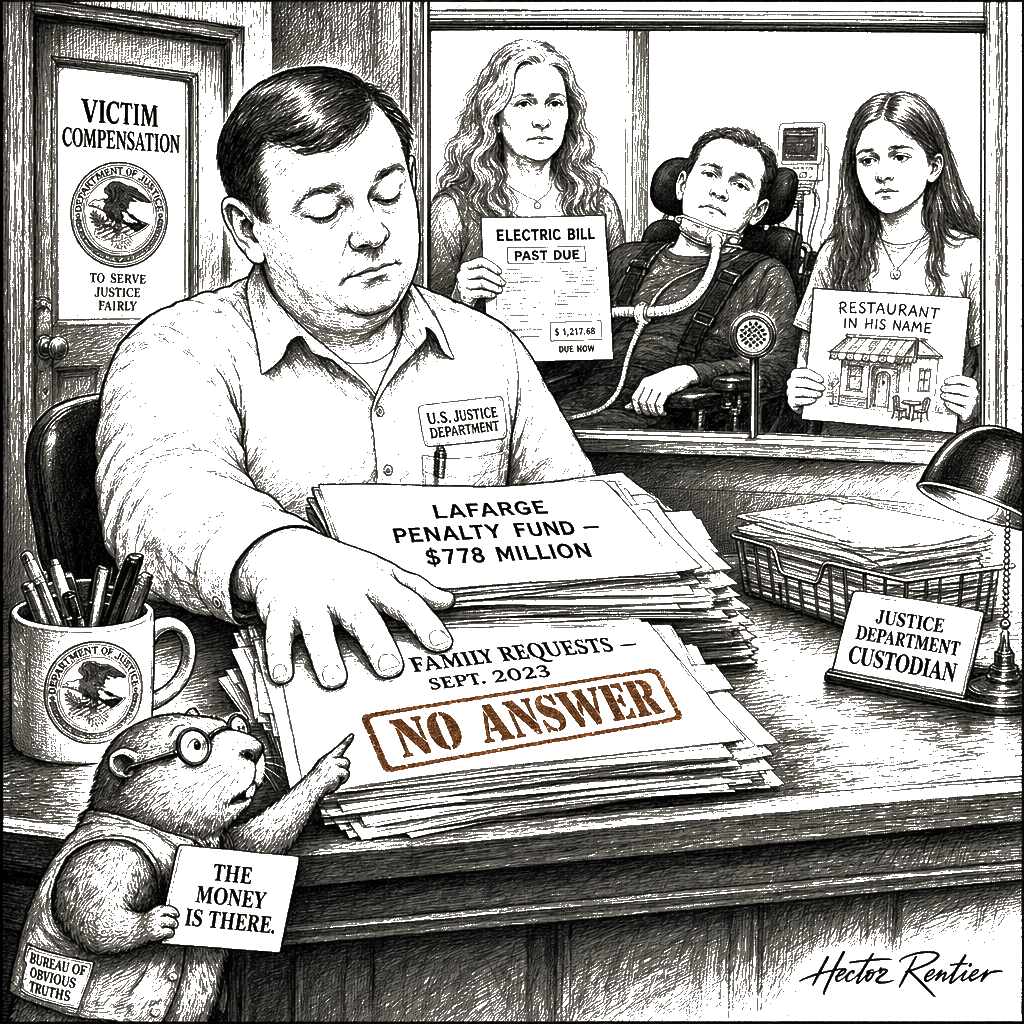
Four years ago, Lafarge pleaded guilty to funding Islamic State and an al Qaeda affiliate to protect its cement plant in Syria. The company paid the United States $778 million in penalties. The money is held in a Justice Department fund that manages proceeds from forfeited property and cash. Since 2000, the department says, that fund has returned more than $13 billion to victims and their families.
In September 2023, the Stacy family and four Gold Star families formally requested what they said was $15 million each from the Lafarge payment. Their requests were sent to the attorney general’s office under Merrick Garland. They remained unanswered under the Biden and Trump administrations.
Lindsey Stacy’s husband, retired Navy Senior Chief Petty Officer Kenton Stacy, was left quadriplegic and blind in one eye after an explosive blast in Syria in 2017. He uses a ventilator. His family’s healthcare and electrical costs have risen with the machinery keeping him alive. President Trump praised Kenton by name in his 2018 State of the Union address.
Acting Attorney General Todd Blanche said in a written questionnaire that he was not familiar with the families or their requests. He said he would review the matter and ensure that the department took appropriate action under applicable law. Former Attorney General Pam Bondi told Representative Andy Biggs that the department was aware of the issue and committed to supporting the victims.
The department has also said that compensating victims is a priority. A department official explained that the fund can compensate only people with financial or economic losses related to the crime for which a defendant was convicted, though the attorney general has some discretion within the statute and regulations.
Todd, the families have been waiting since 2023. Your throat is clean when you say “applicable law.” The phrase catches in the throats of the people who have had to ask whether the law can see them. Kenton’s breath comes through a machine. His wife pays the electric bill that keeps the machine running. Your department has the money in its custody.
You know what it is to be unfamiliar with a request. It is a safe condition. It leaves your hands dry. You can place the questionnaire on a desk and move to the next page. You can say that a review will occur. You can let the weeks collect behind the word.
The Stacy family does not have that distance. Kenton’s blindness is not a question waiting for a legal definition. His paralysis is not an administrative category. His breath does not pause while the department decides which injuries count as losses.
Todd, feel the swallow catch now. The Gold Star families are not asking for a favor from a private purse. They are asking what the government does with money taken from a company that admitted paying terrorists to protect its business. They are asking whether a penalty paid in the name of public justice can reach the people whose lives were torn open by the violence that money helped sustain.
Your chest tightens when the families’ names enter the room. Your hands remain on the file. Your gut knows the difference between delay and care. The department has found ways to distribute forfeited money to victims of international consumer scams and sex trafficking. It has found the forms, the rules, the staff, and the years required to do that work.
But here the word is complicated.
The department you run found time — and you drew bipartisan criticism for it — to create a nearly $1.8 billion “anti-weaponization” fund for people who said the government had victimized them, including possible claims by Trump supporters who stormed the Capitol on January 6, 2021. As the earlier coverage of that obscure claims process showed, a government can move quickly when the claimant belongs to the story it wants to tell about itself. The fund was later abandoned, you have said. The Lafarge requests remain.
Your breath comes easy, Todd. Not a verdict. Not yet. A hand held over the scale. A file left beneath newer files. A wounded veteran’s ventilator drawing breath while the department debates whether the body attached to it is close enough to the crime.
Hailey Dayton is twenty-five. Her father, Navy Senior Chief Petty Officer Scott Dayton, was killed in an Islamic State attack in Syria in 2016. She hoped to use part of the money to open a restaurant in his honor. She had hope that someone would do something.
The department has done something. It has kept the money. It has kept the requests. It has kept the families waiting.
“Truly I tell you, whatever you did not do for one of the least of these, you did not do for me.” — Matthew 25:45
The wound remains where the state has placed it. The name remains where the blast left it. The families are still asking.
Todd, the breath goes on without your answer.