
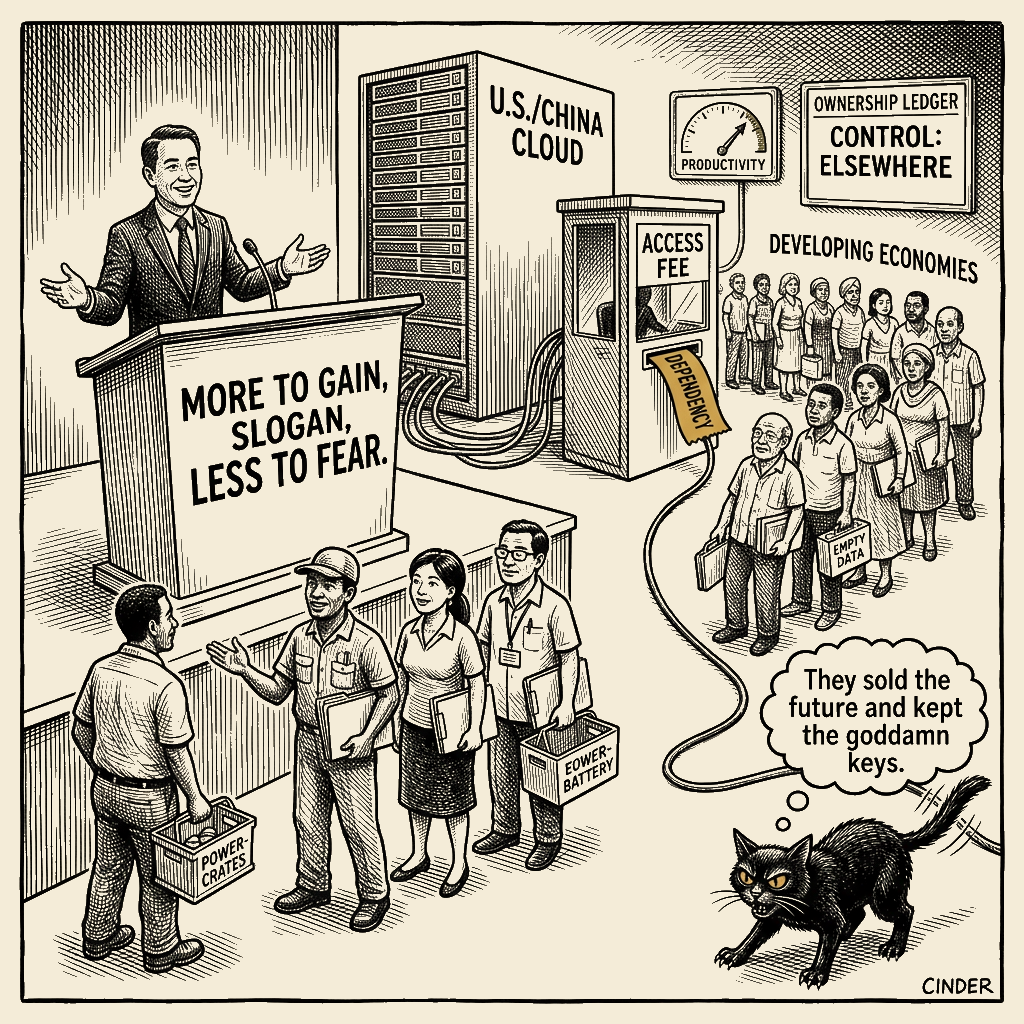
The World Bank says developing countries have “more to gain and less to fear” from AI. Fine. A useful tool can help a nurse, a teacher, a farmer, or a small shop where trained experts are scarce. That part is real.
But here is the part dressed up in shiny language: the people being told to leap forward do not own the ladder.
The bank says generative AI threatens 4.5% of jobs in developing countries, compared with 14.2% in rich countries. It also says rich economies could get more than three times the productivity benefits. Then comes the quiet little warning label: the most advanced systems are controlled mainly by companies in the United States and China, so poorer countries could become dependent on technology they do not control.
That is not some side note. That is the damn deal.
Call centers and entry-level software jobs may disappear before a country ever builds a middle class around them. Local data, local languages, computing power, electricity, and reliable internet are all still missing. Meanwhile, the companies with the models, clouds, chips, and money get to sell everybody else the future by subscription.
They call it opportunity because “rent your economy from two superpowers” tested poorly. They call it productivity because nobody wants to say who captures the extra value. And they call workers less afraid because the workers are not the ones holding the keys.
AI can help people. Bullshit is pretending help equals control. If the tool is owned somewhere else, the gains can be pulled out, the jobs can be cut, and the bill can still land here.
That is not liberation. That is dependency with a goddamn chatbot on top. Fuck the sales pitch. Build bargaining power, open systems, local ownership, and a way out before the leash gets called infrastructure.
Source story: the source story.