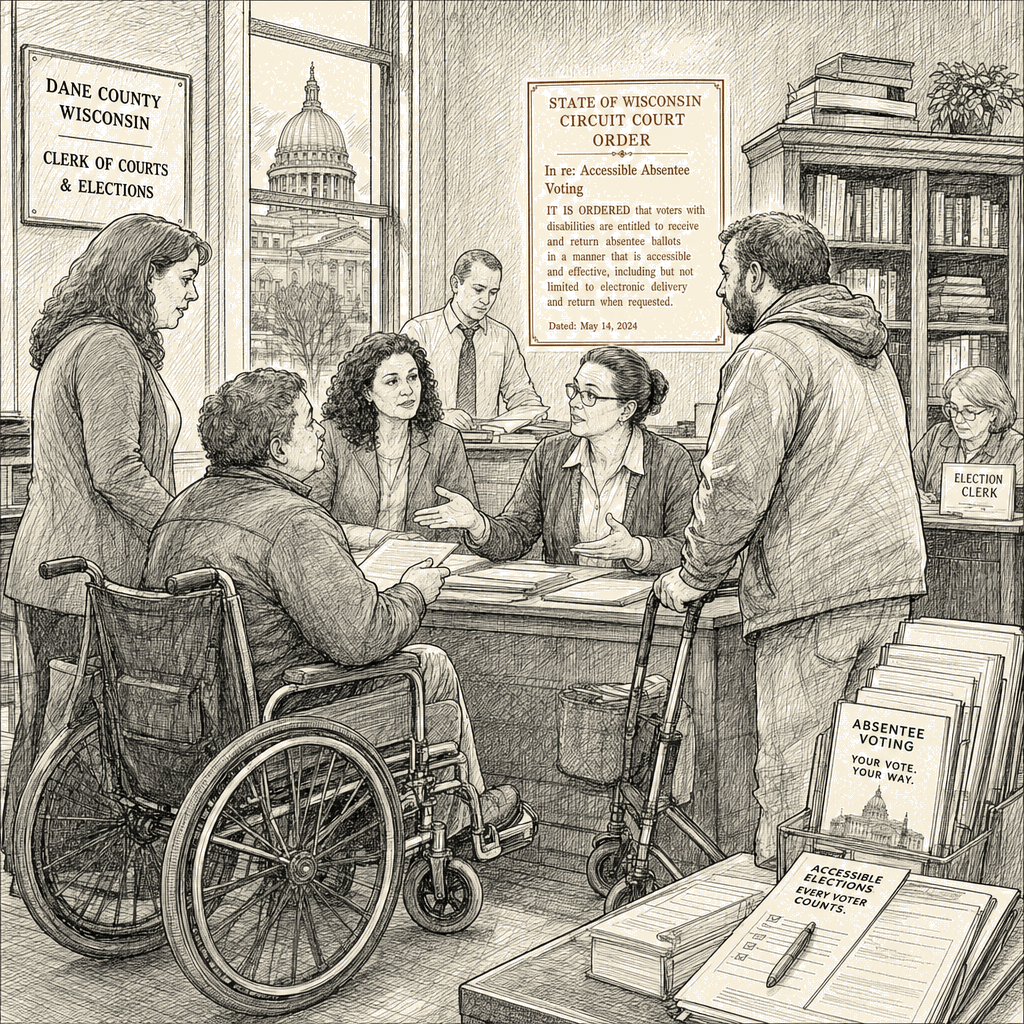
Wisconsin’s absentee voting system discriminates against disabled voters. Dane County Circuit Judge Everett Mitchell said so on August 4, siding with Disability Rights Wisconsin, the League of Women Voters, and four disabled voters who brought the case in 2024. The finding is now on the record. The remedy is set for trial, and the electronic absentee-voting option the plaintiffs sought is unlikely to be available before the November election.
That distinction matters. A court has identified discrimination. It has not yet ordered the change that would address it.
The case began because Wisconsin does not provide an electronic option for absentee voters who cannot independently complete a paper ballot. The plaintiffs argued that this absence violates their rights to privacy and independence and conflicts with the protections of the Americans with Disabilities Act. The judge agreed that the existing system discriminates. He stopped short of ordering electronic voting immediately.
The appeal, and the phrase the appeal produced, are the artifact this column holds up to the light.
When Mitchell issued a temporary injunction in 2024 that would have allowed disabled voters to cast ballots electronically, an appeals court reversed him. The court said the injunction would have “significantly disrupted the status quo.”
Hold that sentence up.
What the trial court has now found is that the status quo discriminates against disabled people. You cannot shield a discriminatory system from correction by describing correction as disruption. The stability the appeals court protected is the condition the trial court has now condemned.
The two phrases describe the same thing.
Martin Luther King Jr. drew the distinction that governs this case in his Letter from Birmingham Jail, written April 16, 1963. He distinguished negative peace—the absence of tension—from positive peace, the presence of justice. The appeals court’s phrase is that preference wearing legal clothes. “Significantly disrupted the status quo” means that election machinery should remain undisturbed even when the existing machinery excludes some citizens from voting privately and independently.
That is not a legal answer to the exclusion. It is a description of the comfort the institution is protecting.
The state may have legitimate questions about election security, technical administration, verification, and the design of any electronic voting system. Those questions deserve evidence and careful answers. But they come after the first question, not before it: who can vote privately and independently under the existing system, and who cannot?
The plaintiffs say the answer is not evenly distributed. The judge’s finding says the system discriminates. The cui-bono question is therefore unavoidable: who bears the cost of preserving the existing arrangement, and who receives the benefit?
The cost is carried by disabled voters who cannot complete the paper absentee process without assistance or without compromising the privacy and independence they are supposed to possess as citizens. The benefit of delay flows, at minimum, to the administrators and institutions that avoid changing their procedures before the election. It may also serve political interests that prefer a restricted electorate, but that is an analytical possibility, not a fact established by the supplied record. The point does not require a partisan conspiracy. It requires only that we identify who is being asked to wait and who is spared the work of changing.
That is the distribution hiding inside a neutral-sounding word. “Status quo” is the abstraction. The disabled voter is the concrete person the abstraction deletes.
The state has treated accessibility as an exception to election administration rather than as part of election administration. The question is not whether disabled voters deserve a special favor. The question is whether a democracy may call itself equal while making one class of citizens choose between privacy and participation.
The answer should not require a lawsuit every time the state’s default design excludes someone.
The broader public record includes a separate July ruling in which the Wisconsin Supreme Court blocked the release of disabled voter records. That ruling does not establish that Wisconsin courts are concealing the state’s conduct, and it does not prove that the two cases share the same legal question. It does establish something narrower: disabled-voter privacy and election administration are already matters of active litigation, with real consequences for what the public can know and what voters can do.
That is precisely why the receipts matter. The law should be examined case by case, not converted into a story larger than the evidence can carry.
Star Trek’s “The Measure of a Man,” written by Melinda M. Snodgrass for the series in 1989, understood the underlying issue better than many real institutions do. The episode asks whether the android Data can be treated as property because an institution finds that classification convenient. Its answer is not that every difference disappears. Its answer is that an institution cannot define a person downward and then call the resulting deprivation administrative necessity.
Wisconsin’s case is not the same case, and the comparison has limits. But the courtroom question is recognizably related: when an institution’s standard procedure places a burden on a class of persons, does the institution adjust its procedure, or does it define the burden as the person’s problem?
Wisconsin’s judge has identified the discrimination. The trial, however, is set for later. The source report says the case almost certainly will not be resolved before the November election. That is not proof of a scheme to conceal anything. It is a procedural fact with political and human consequences: the election may arrive before the remedy is available.
And the calendar is not neutral to the person waiting on the remedy.
A voter who cannot complete a paper absentee ballot independently does not experience the delay as an abstract dispute over judicial timing. The voter experiences it as another election conducted under the same condition the court has found discriminatory. The difference between “the remedy has been denied” and “the remedy is unlikely to be available before this election” is the difference between what the record proves and what it does not. We should keep that distinction. It does not weaken the indictment. It makes the indictment harder to dismiss.
A locked door is still a locked door while the court debates whether to order it opened. Calling the opening a disruption does not make the person outside the door less entitled to enter.
The status-quo argument belongs to no single political faction. Any power can reach for “do not disturb the existing arrangement” when the existing arrangement benefits those already accommodated by it. The discipline is to name the shield rather than invent a factional motive the record has not established. The shield works for anyone. That is why it must be dismantled wherever it protects exclusion.
The machinery of government reveals its assumptions through what it makes people surrender. If a voter must rely on another person to complete a civic act the voter should be able to complete privately, independence has become conditional. If the state places that burden on disabled voters and then calls the demand for an accessible alternative a disruption, the state has confused uniform procedure with equal citizenship.
The burden now belongs to the officials defending the existing system. They must explain why disabled voters should accept a lower level of privacy and independence than the electronic option would provide, and they must do so with evidence rather than with reverence for habit. “This is how we have always done it” is not an explanation. It is an admission that the excluded voters’ experience was never treated as a design requirement.
A ruling that identifies discrimination but postpones the remedy is a beginning, not justice completed. Justice requires a voting system in which the citizen does not have to surrender privacy or borrow another person’s hands in order to exercise a right that belongs to the citizen.
Mitchell has done the thing courts are for: he has named the discrimination on the record, so that it can no longer be argued out of existence. That is not nothing. It is also not the remedy. The electronic absentee-voting option may not be available before November, and the court has not yet ordered it. Disabled voters may therefore face another election under a system a court has found discriminatory.
The arc bends toward justice only where specific people in a specific moment push it. The judge’s finding is one push. The trial is another stage of the fight. The ballot access the plaintiffs sought remains unsecured.
We name the discrimination a court has confirmed. We name the status quo that produces it. We keep the receipts—for the finding, for the reversal, for the trial set after the election—because the receipts are what the next push runs on.
By any means necessary that operate within the instruments available to us: name the exclusion, test the procedure, protect the voter’s privacy, and never again let “disrupted the status quo” describe the act of asking a government to let a citizen vote like a citizen.