
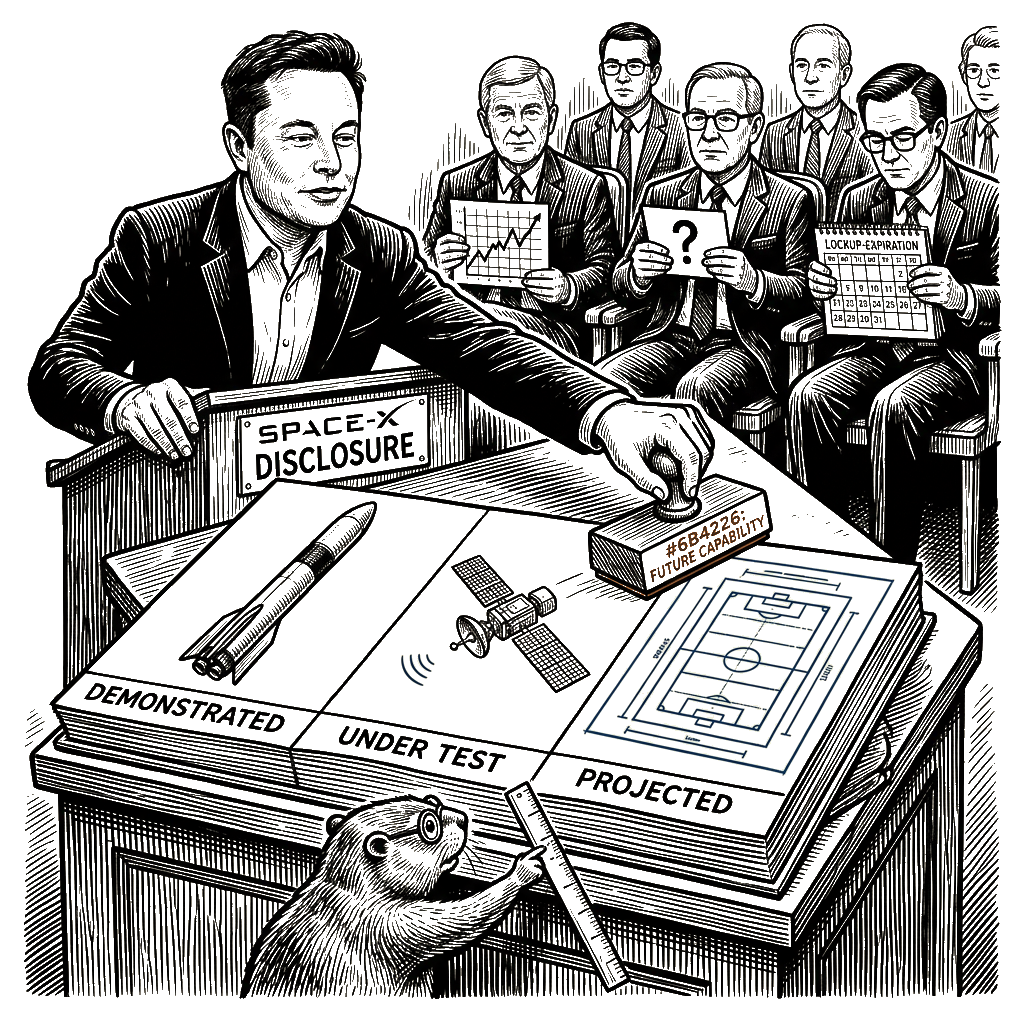
SpaceX leaves investors to price rockets and datacentres still under question.
It is true that aerospace companies routinely carry technical uncertainty, in the narrow sense in which a rocket is a machine assembled from many things that can fail. The trouble is that the Associated Press account gives us a share-price decline, an approaching lockup expiration, and a list of questions for Elon Musk—not evidence that Starship testing is complete, that an orbital datacentre has been designed for operation, or that every future capability has been reduced to a commercial plan.
That distinction matters. The AP reports that SpaceX’s first quarterly earnings call since going public arrives as its shares trade at roughly half their June peak. Some insiders will be able to sell shares when the lockup provision expires later in the week. Investors are preparing for volatile trading. Those are the receipts.
Everything beyond them should be treated as an inquiry, not a finding.
Musk is expected to face questions about when SpaceX expects to finish testing its Starship rockets, its plans for the satellite network, and the prospect of putting football-field-sized datacentres in orbit. The AP establishes that these subjects are likely to arise on the call. It does not establish that SpaceX has completed the testing programme, disclosed a finished orbital-datacentre architecture, or supplied a capital plan for such a facility.
Those are not interchangeable categories. A rocket that has flown is not necessarily a rocket that has completed the testing required for routine service. A satellite network that exists is not necessarily a network that can support a particular business model. A datacentre concept is not a datacentre. The difference is not rhetorical. It is the difference between a demonstrated capability, an active test programme, and a projection.
This is the engineering point that financial commentary regularly manages to lose: “the technology” is not a single object. Starship would be a launch system with multiple interdependent components, each carrying its own test burden. An orbital datacentre would be a proposed system whose power, cooling, communications, radiation protection, launch cadence, maintenance, and end-of-life arrangements would have to work together. Those are requirements any such system would face. They are not claims about what SpaceX has already built, tested, or disclosed.
A claim that cannot yet be stated as a testable specification remains a claim. That is not an insult to the engineers. It is a basic condition of engineering.
Cory Doctorow’s term criti-hype is useful here, provided it is applied carefully. It describes criticism that repeats a booster’s capability claims without examining whether they are true, then treats the inflated claim as evidence of danger or inevitability. The mirror-image mistake is to treat a technically possible project as an established commercial one. The AP reports that orbital datacentres are among the questions Musk may face. It does not report a completed design, test result, revenue figure, or funding plan.
The proper response is neither belief nor dismissal. It is a stage-of-evidence ledger.
What has flown? What has been tested repeatedly? What remains subject to testing? Which proposed service depends on Starship completing a programme that, according to the AP’s account, is not yet complete? What does the satellite network currently provide, and what additional capability would a future plan require? If orbital datacentres are more than a concept, what are their power, thermal, communications, servicing, and replacement assumptions?
These questions identify the work that would have to be done. They do not claim that SpaceX has chosen a particular design or failed to meet a requirement. The distinction is important because engineering dependencies are not operating results. A technical analysis can say, “this system would require a reliable thermal-management architecture.” It cannot honestly turn that sentence into, “SpaceX has no such architecture,” unless the company’s documents or tests establish the absence.
The share-price movement requires the same discipline. The AP reports that SpaceX shares have fallen to half their June peak. That decline does not, by itself, prove that investors are repricing delayed milestones, that Musk’s forecasts were dishonest, or that the company’s underlying value has been halved. It establishes a market change. The reasons for that change are among the questions the earnings call should help clarify.
A useful question is therefore not, “Has the market finally discovered that the future was imaginary?” The supplied record cannot answer that. The useful question is: “What information, expectation, or change in perceived risk does the company identify when explaining the movement?”
A public share price is not a permanent property of a company. It is a price at which buyers and sellers meet under a particular set of information and expectations. That is less dramatic than a verdict, but more accurate. If the company supplies new technical, financial, or operational information, the market may respond. If it supplies only another sequence of dates and possibilities, the uncertainty remains.
To be fair, the AP does not describe SpaceX as a paper company. It describes an actual aerospace company with rockets and a satellite network. That is precisely why the burden of description should be higher. A company doing real engineering work should be able to tell investors which part of its future is demonstrated, which part is under test, and which part is conditional on work that has not yet been completed.
The proposed combination with Tesla makes the disclosure problem more precise, not more sensational. Neither company has confirmed merger plans, and Musk has previously said securities regulations prevent him from discussing the issue. That answer does not establish that a transaction exists. Nor does the supplied record establish what a combination would do to either company’s operations, finances, workers, customers, or regulatory obligations.
The questions can still be stated without pretending to know the answers. What would be combined: ownership, capital, management, assets, or only a corporate structure? Which shareholders would bear which risks? What independent valuation would be used? How would investors distinguish SpaceX’s launch and satellite businesses from Tesla’s automobile business? Which disclosures would prevent one company’s assets or cash flows from being used to support claims originating in the other?
Those are ordinary governance questions. They do not require a theory of Musk’s motives or a forecast about the merger’s effects. They require the kind of separation that a balance sheet is supposed to provide.
The lockup expiration adds another concrete fact. The AP reports that some insiders will gain the opportunity to sell shares later in the week. Insider selling is not proof of misconduct. It can reflect taxes, diversification, personal liquidity, or ordinary portfolio management. The expiration does, however, change the information available to the market. Before the lockup ends, insiders are restricted from selling under its terms. Afterwards, their decisions become observable market events.
That timing deserves attention without being treated as a confession. The company is answering questions about its future at the same moment that some insiders will be permitted to convert shares into cash. The relevant facts will be who sells, how much, under what disclosed arrangements, and what the company says about the reasons for the timing. The record supplied here does not tell us those answers yet.
SpaceX should therefore adopt a simple disclosure discipline for its major programmes. Each should be labelled as a demonstrated capability, an active test programme, or a projected capability. The label should be accompanied by the relevant dependencies: testing, launch capacity, power, communications, maintenance, capital requirements, regulatory approval, or other conditions necessary to make the service operate. That would not punish ambition. It would make ambition legible.
If SpaceX and Tesla ever propose a combination, shareholders should receive independent analysis of the transaction rather than a presentation organised around one executive’s ability to connect two futures in a sentence. The companies may have reasons to combine. The public record provided here does not establish what those reasons are, who would benefit, or how the risks would be allocated. Those matters belong in the documents before they belong in the story.
An earnings call cannot finish Starship testing. It cannot put a datacentre in orbit. It cannot turn a merger rumour into a business plan. It can establish whether SpaceX is describing machines that work, machines being tested, or machines that currently exist as sentences.
The lockup expires later in the week. That is the part of the future that has already arrived.