Donald Trump’s agents shot and killed two American citizens.
An ICE officer killed Renee Nicole Good in Minneapolis in January. Customs and Border Patrol agents killed Alex Pretti in the same city later that month. Four days after Pretti’s killing, and twenty-one days after Good’s, Massachusetts introduced the bill that became the PROTECT Act. A state looked at the crackdown and wrote a law in answer.
On Wednesday, Governor Maura Healey signed the law at La Colaborativa in Chelsea, a Latina-led nonprofit economic-development agency in the heart of the immigrant community. She stood among immigrants, advocates, and law-enforcement officers. She stood among the people the law protects.
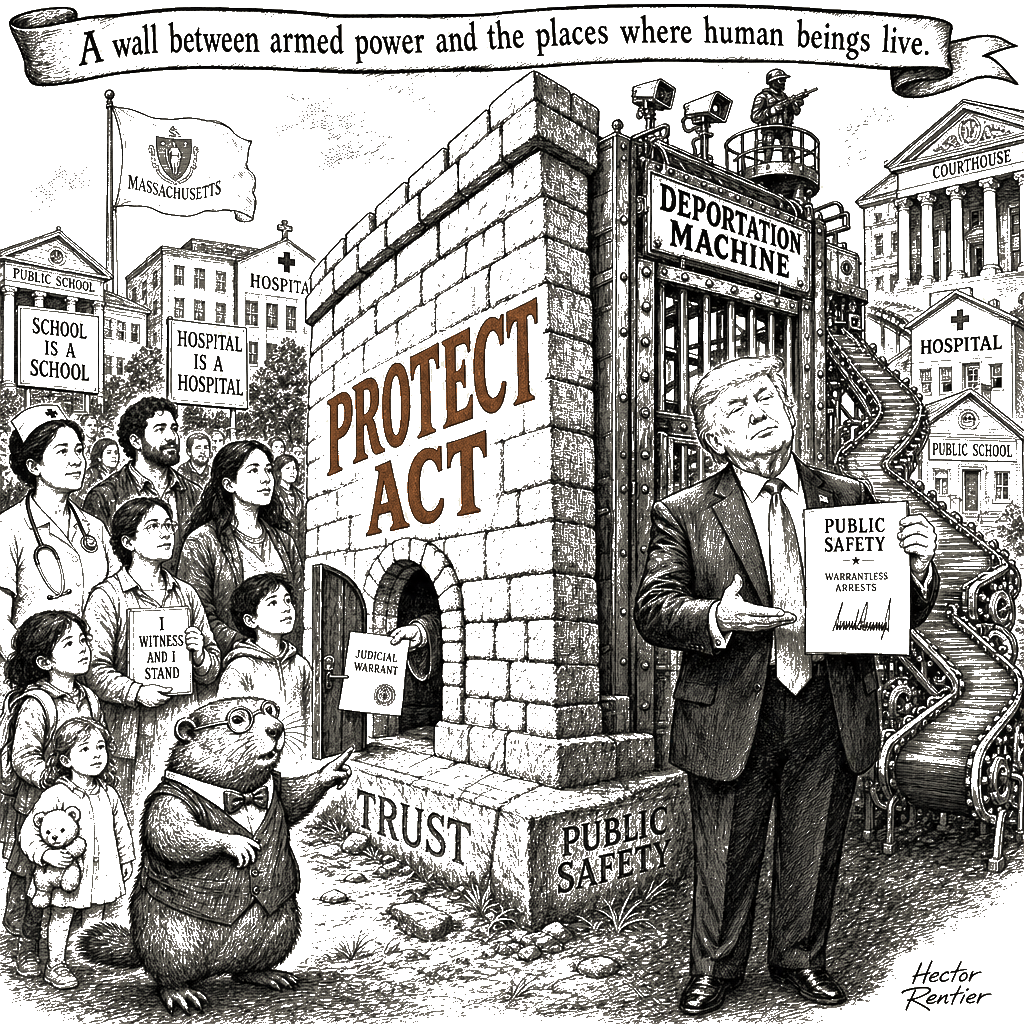
The law takes effect immediately. It bans warrantless immigration arrests at courthouses, schools, hospitals, health-care facilities, and child-care centers. It prohibits local police from entering formal partnerships with ICE. It bars state and municipal agencies from participating in the federal machinery of immigration enforcement while preserving their authority to investigate and prosecute actual crimes. It gives people a cause of action against government officials who violate their constitutional rights. It strengthens protections for people held in county jails. Healey called it the strongest state-level protection against ICE in the country.
Read plainly, it says this: In Massachusetts, a school is a school. A hospital is a hospital. A courthouse is a place of justice, not a net. The local officer is the neighbor’s protector, not a recruiter for the deportation machine.
These are not random places. They are where a life is lived. They are where a child learns, where a patient seeks care, where a witness asks for justice, where a family brings its children because it believes the state has not yet become an enemy.
Washington has an answer, and it is always the same sentence: sanctuary politicians are putting politics above public safety.
Let me take that claim seriously. The people who make it deserve an answer, not dismissal. Yes, if local police will not hold people for the federal machine, some people who have broken the law may remain in their communities. That is the true half.
Here is the suppressed half: a community that cannot trust its own police will not call them. The victim stays silent. The witness looks away. The crime goes unsolved. Public safety was never built by making every patrol officer an agent of deportation. It was built on the willingness of the harmed to ask for help.
Massachusetts’ public-safety secretary said it plainly: strong public safety requires the trust of the communities the police serve. The state law preserves local power to investigate and prosecute crimes. It refuses only to convert local government into an arm of a federal deportation operation.
The administration has signed $70 billion into the enforcement machine. It has threatened New York, and New York refused to bend. Its infrastructure is expanding. Its agents went to Minneapolis. Two American citizens are dead.
This is not public safety. It is a machine arranged so that its ordinary operation produces fear and death while the men who run it never have to look at the bodies. Catholic Social Teaching calls that pecado social, structural sin: a system whose rules and institutions make cruelty ordinary, whose beneficiaries can call the result procedure, and whose victims are told that no one chose what happened to them.
The United States government is sending armed agents into the places where people go to heal, to learn, to worship, and to bring their children. The Torah has a name for what a nation owes the person it marks as foreign.
The commandment appears more than thirty times, more frequently than any other commandment in the Hebrew Bible: You shall love the stranger, for you were strangers in the land of Egypt. Exodus 22:21 states the prohibition first: You shall not wrong or oppress a resident alien. Leviticus 19:33–34 says the stranger who resides with you shall be treated as the citizen among you. Deuteronomy 10:18–19 says that God executes justice for the orphan and the widow, loves the stranger, and provides food and clothing. Then it turns to the people: You shall also love the stranger.
The obligation is not optional. It is not a suggestion for the particularly devout. It is a binding command issued to the nation as a whole, rooted in the nation’s memory of having been the stranger.
Every American family has a land of Egypt in its past. The work of the commandment is to remember.
The law of Israel also appointed cities of refuge, places where the pursued could be safe from the avenger. The law was never ashamed of making pursuit stop. What Washington calls obstruction, the tradition calls sanctuary: the place where the hunted person can reach safety before power lays hands on him.
The word sanctuary comes from the Latin sanctuarium: a holy place, a place of refuge. It is one of the oldest words in the moral vocabulary of the West. When the Department of Homeland Security uses it as an accusation, it performs an inversion the prophets would recognize. Jeremiah named it centuries ago: They have healed the wound of my people lightly, saying, “Peace, peace,” when there is no peace.
The people who arrive at the hospital door are not a threat to public safety. They are the public. They are the people public safety exists for.
When federal agents enter schools, courthouses, hospitals, and child-care centers to arrest people, the government is not protecting the public. It is terrorizing it. It terrorizes parents, children, witnesses, nurses, teachers, and neighbors who see what happens and learn that no place is safe and no promise can be trusted.
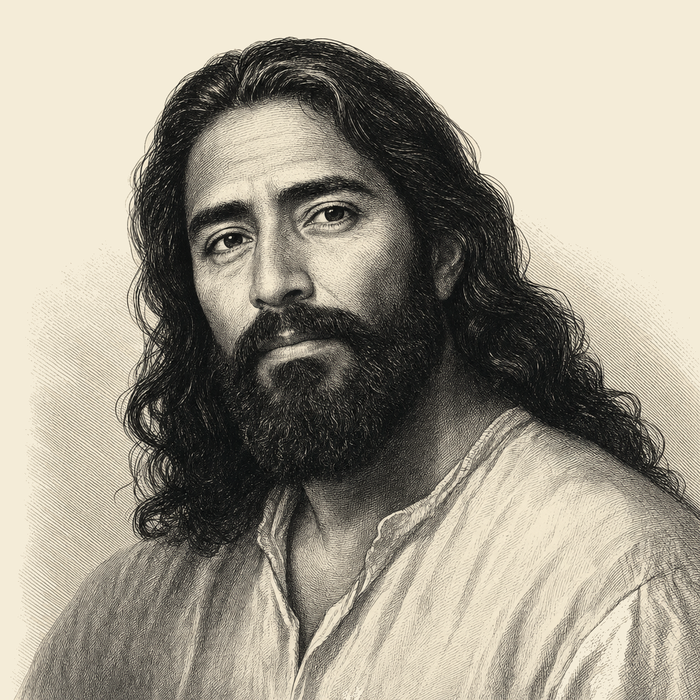
Jesus extends the command past the border of Israel into the world as it is: I was a stranger and you welcomed me. And then, to those who did not: I was a stranger and you did not welcome me.
At the last judgment, the stranger is not a policy category. The stranger is Christ.
The commandment becomes a question. Will a community that possesses the texts, hears the texts, and claims the texts act on them when acting costs something? Will it act when the federal government threatens consequences, when talk-radio voices call it betrayal, when silence would be simpler?
The confession comes first, because prophecy that does not name its own complicity is performance.
The deportation machine did not begin with Donald Trump’s presidency. Adam Goodman documents in The Deportation Machine that its roots reach back through decades of bipartisan enforcement escalation. Every administration before this one helped build it. The law created millions of undocumented residents and then punished them for the status the law itself produced. Every party has run some part of the machine. Massachusetts is not outside that history. No state is.
We have eaten the labor of the legally excluded and called the arrangement someone else’s problem. Dorothy Day wrote that “the Gospel takes away our right forever, to discriminate between the deserving and the undeserving poor.” That sentence reaches every administration, every party, every church, and every comfortable household that wants the low price without seeing the person whose vulnerability made it possible.
The confession does not cancel the PROTECT Act. It earns the right to say what the law faces.
The law is right, and the law is not enough. A statute cannot love anyone. Only people can.
The PROTECT Act does not stop every federal agent. It does not undo the deaths of Renee Nicole Good and Alex Pretti. It does not dismantle the $70 billion enforcement machine. It does not end the deportation machinery whose roots run through the late nineteenth century and through both parties.
But it builds a wall against cruelty.
Not the wall the administration celebrates. Not a wall against the stranger. A wall between armed power and the places where human beings go to live their lives.
The law does not forbid cooperation with federal authorities who arrive with judicial warrants. It does not shield people from investigation or prosecution for actual crimes. It says that Massachusetts will not hand over its police, its courthouses, its schools, or its hospitals as instruments of a deportation operation that has already killed people in American cities and shows no sign of distinguishing between the dangerous and the desperate, between the guilty and the innocent, between the people the law was written to reach and the people it is destroying.
Pope Francis stood on Lampedusa in 2013 and named the condition: “We have fallen into globalized indifference. We have become used to the suffering of others: it doesn’t affect me; it doesn’t concern me; it’s none of my business.”
The PROTECT Act is a refusal of that indifference. It says that families living in Massachusetts are Massachusetts’s responsibility. It says that cruelty done to them is cruelty done to the Commonwealth itself.
The U.S. and Mexican bishops wrote in Strangers No Longer that they sought to awaken their peoples “to the mysterious presence of the crucified and risen Lord in