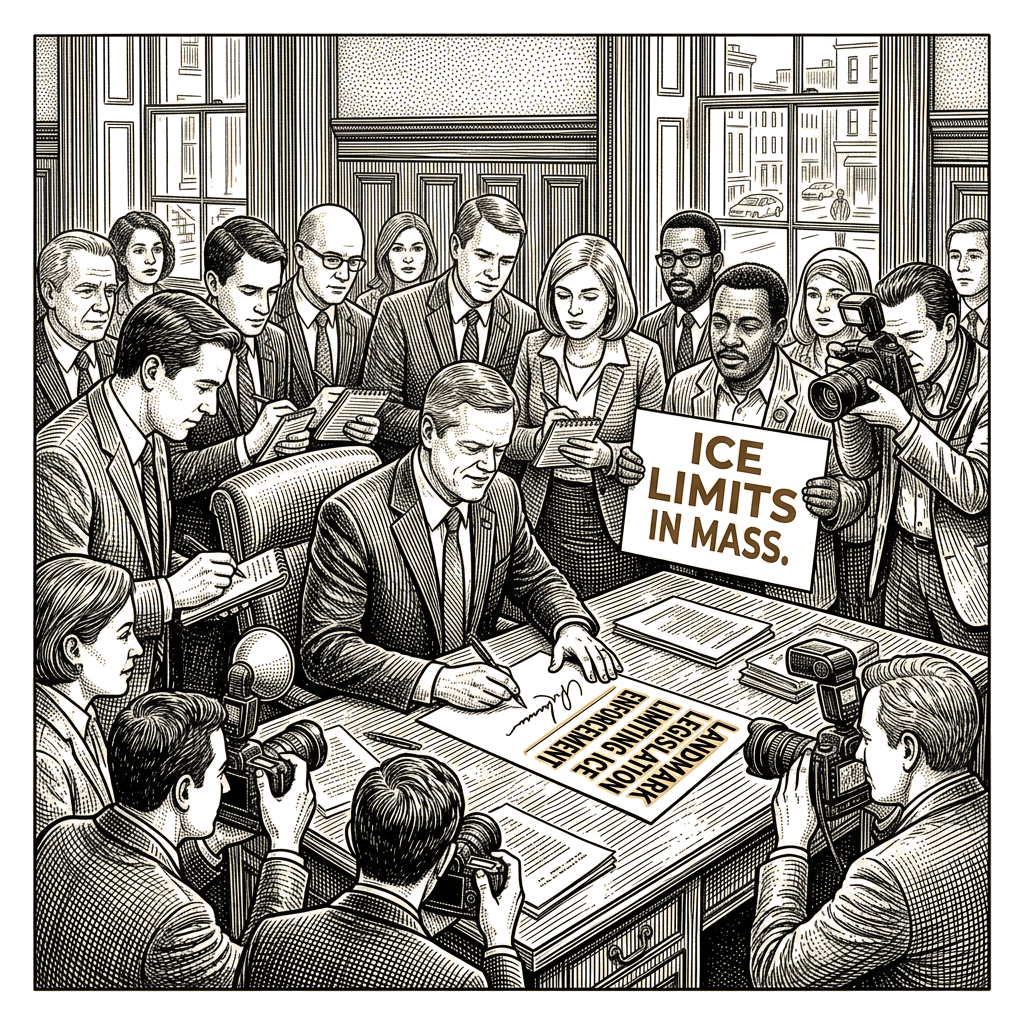
The PROTECT Act that Governor Healey signed at La Colaborativa in Chelsea is not, as its authors insist, a shield for the vulnerable. It is a declaration of home rule against the one authority the states may not subordinate: the sovereign’s plenary power over the alien within the territory. The apostle writes that the powers that be are ordained of God, and of no power is that more plainly true than the one that stands at the boundary of the household, deciding who enters and on what terms. A state may not admit its own citizens to the Union’s privileges; far less may it confer upon the foreign national, present by sufferance, a jurisdictional immunity from the agents of the sovereign who admitted him. When the commonwealth forbids the contact between its officers and the federal hand, when it walls off the courthouse, the school, the clinic, and the hospital from the warrantless arrest, when it withholds the partnership that federal enforcement relies upon, it is not protecting public trust. It is protecting a class of persons from the law that defines their presence as provisional.
The cost of such tenderness is borne, as ever, by the orderly. The federal apparatus that Congress funded and the President commanded — the enforcement machinery signed into law in June — must now work in the open, visible at courthouse steps and clinic doors, precisely because sanctuary jurisdictions like Massachusetts and New York have barred the quiet, efficient cooperation that once located a target before he was seen. The governor’s theory is that the commonwealth may choose which of the national laws it will assist. That is not federalism. It is the theory of the nullifier, and it dissolves at the first point where the sovereign chooses to act without the state’s permission. The President did not ask leave of Boston to launch the largest removal operation in American history. The law does not require him to.
The same week that the governor’s pen touched the parchment in Chelsea, the week the advocates applauded the nation’s strongest protections, the federal custody she was fencing out produced another body. There is no need to name the man; the type is the substance. Take him as the representative case, and the class is real: a man swept up in the national surge, an alien who had entered without the sovereign’s invitation, held pending removal in a county jail that contracts its beds to the Department of Homeland Security. The officers at intake took his inhaler, logged it into property, and issued him a receipt. The guards on the unit logged his complaints the way they logged everything else — on the clipboard at the station, in the column for routine.
On the second morning, the man woke gasping. The air went into his mouth and stopped at the top of his chest; his lungs seized in the way a lung seizes when the bronchi are swollen shut and no measured breath will follow. He stood at the cell door and pressed the intercom. The guard came, looked through the small window, told him to sit down and drink water. He sat. The morning meds came around; the medical technician was the contractor’s employee, and she gave him a cup of water and wrote “SOB, observed” in the log. The bronchospasm tightened through the afternoon. He began to breathe in the posture the lungs demand when they are starving — leaning forward, hands on knees, shoulders climbing toward the ears, the chest retracting between the ribs in a way the guards had seen before and learned to call theatrics. At lights-out he was still sitting up, mouth open, eyes wide, the skin at his lips going the color of slate. The last man who saw him alive was the man in the next cell, who heard the rattling breath stop and then heard the sound of a body sliding off the bunk onto the concrete.
The guards found him in the morning. The resuscitation was attempted by the contractor’s staff with an automated defibrillator, and the paramedics whom the jail called only after the attempt had failed pronounced him dead of respiratory arrest. The county medical examiner listed the manner as natural causes: acute asthma exacerbation, asthma being the recorded cause on a body found in a room where the intercom had been answered with water. He was thirty-one years old. He had been in custody nine days, and the effects bag returned to no one contained the receipt for the inhaler, still in property. On the third of the month, in Elizabeth, New Jersey, at the contracted facility called Delaney Hall, the wire carried the latest of these entries — a man dead in ICE custody, added to a ledger that does not consult the sanctuary map. The barrier the governor erected did not reach across the Hudson. It never could. The federal hand that holds the alien simply holds, and the holding is what the state cannot stay.
The man stood outside the covenant. The covenant of the household runs to those the household admits and to those it protects; the alien who entered without the sovereign’s invitation entered as one whose standing the sovereign never guaranteed. The law that governs his presence is plenary precisely because it is not moralized by the softer authorities — not the commonwealth’s solicitude, not the advocate’s applause, not the county’s contract. He was foreign to the household, and the custody that held him was the household’s boundary made concrete: the place where the sovereign decides, by the treatment it administers and the breath it declines to secure, what the body without a claim is worth. The men who logged the inhaler, who wrote the observation, who found the body in the morning — they are not a failure of the system. They are the system. The death is not the cost of the enforcement regime, to be weighed and regretted by governors. It is the disclosure the regime produces, the visible proof that the man who entered without the deed was always, in the deepest order, outside the house.
Massachusetts may pass its protections; it cannot extend them over a body the sovereign has already claimed. The statute covers the state’s own jails, its own courts, its own classrooms; it cannot cover the federal cell, and the federal cell does not ask leave. The governor’s shield is a parchment wall, drawn around a household that was never hers to fortify. Let the commonwealth shelter its own; the alien she would shelter belonged to the national boundary, and the boundary performed its office in the only way it can when the body without standing does not depart — it kept him, held him, and wrote him into the ledger where he had always stood. Providence sorts the peoples as it sorts the households, and the sorting does not pause for a press conference. The sovereign held. The covenant divided. The ledger records the body where it always was: outside the house, in the custody of the boundary, in the column of those whom the household was never bound to keep.