
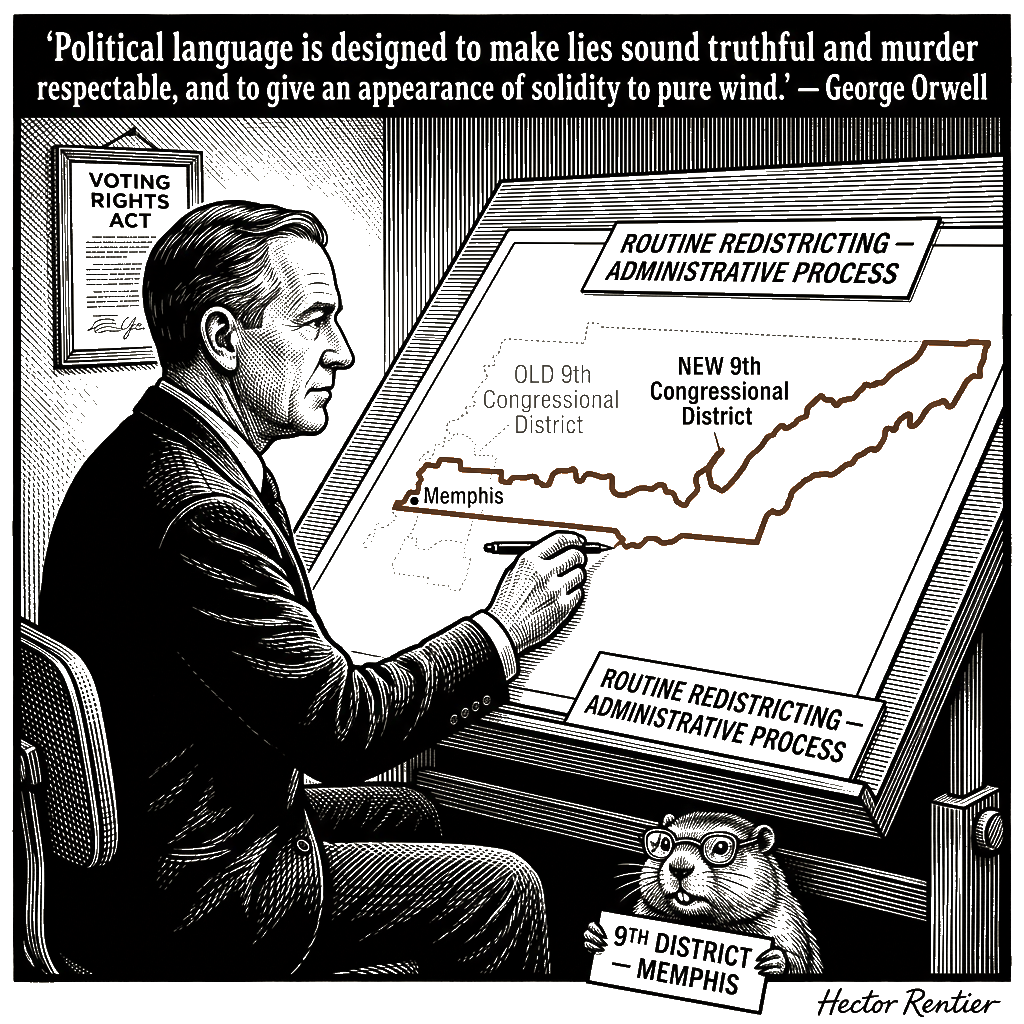
The Republican-led Tennessee Legislature dismantled Memphis’s majority-Black congressional district. It did so three months before voters were asked to choose nominees under the new map, after a Supreme Court ruling weakened federal Voting Rights Act protections for minorities.
That is not a minor adjustment to a boundary. It is a transfer of political power disguised as cartography.
The old 9th Congressional District favored Democrats and was rooted in Memphis. The new district stretches roughly 200 miles east—about 320 kilometers—before turning north toward the Nashville area. Its geography is not an incidental feature. It is the mechanism. A district built around a city’s majority-Black population has been broken apart and attached to communities far from the constituency whose representation the district once made possible.
The public language will call this redistricting. The map tells the truth more plainly: concentrated Black voting power was dispersed, and the seat was converted from one that favored Democrats into one that favors Republicans.
That is the cui-bono question. Who benefits from dividing Memphis? The people who now inherit a safer seat without having to persuade the voters who made the old district politically competitive for Democrats. Who bears the cost? Memphis voters whose ability to elect a representative responsive to their community has been diluted across a district that now reflects a different political balance.
The map is being tested for the first time in the congressional primary. President Donald Trump has endorsed state Sen. Brent Taylor in the four-candidate Republican contest. The vote will not merely choose a nominee. It will provide the first electoral test of a structure that changed the contest’s terms by altering the district’s composition and partisan alignment.
That distinction matters. Elections are often described as if voters enter a neutral arena and freely sort themselves among candidates. But the arena is built before the campaign begins. Legislators decide which communities remain together, which communities are divided, and which voters must share a representative with people whose political interests may be hundreds of miles away. Then the public is invited to call the resulting contest democratic.
The public can vote inside a structure whose central political decision has already been made.
Main Street Independent has already documented the federal judges’ decision allowing the map to split the majority-Black district. The primary now supplies the next receipt. The question is no longer only whether the Legislature changed the boundaries. It is what those boundaries do when actual voters are placed inside them.
The answer is visible before a single result is counted. The district’s composition changed. Its partisan alignment changed. Its geographic center changed. The communities that once formed the political heart of the seat no longer control its shape.
This is how representation is weakened without abolishing an election. No one has to announce that Memphis voters are forbidden to choose a representative who speaks for them. The map can simply make that representative harder to elect. No one has to erase a majority-Black community from the census. The map can divide its voting power and attach each fragment to a larger constituency with a different political balance.
Calling the act “redistricting” does not make the redistribution of political power neutral. The underlying act is the redistribution of political power through a map that splits a majority-Black district and changes the seat’s partisan alignment. A neutral administrative label cannot erase a partisan and representational consequence.
The same standard must apply whoever holds the pen. If a legislature aligned with the columnist’s preferred coalition divided a minority community to manufacture a safer seat, that conduct would deserve the same condemnation. Fairness is not pretending every map is equally harmful. It is applying the same question every time: whose voting power was concentrated, whose was dispersed, who wrote the map, and who benefits from the result?
The answer in Tennessee is not hidden. The Legislature wrote the map. Memphis’s majority-Black district was divided. The new 9th District now favors Republicans. Trump has endorsed a candidate in the first primary held under the altered boundaries. The immediate political beneficiary is the Republican coalition positioned to compete for a seat that now favors Republicans, even though the primary has not produced a winner.
The Supreme Court’s ruling forms part of the chain, but it does not absolve the people who used the opening. A court can weaken a federal protection. Legislators still decide what they do with the power that remains. The Tennessee Legislature chose to redraw the district. That choice produced the map now before voters.
And the voters are not powerless, though the map makes their power less effective. They can judge candidates who defend the new boundaries. They can demand public explanations for why Memphis was divided, why the district was stretched toward Nashville, and why the resulting seat now favors a different coalition. They can organize beyond the boundaries drawn for them, because political power has never depended entirely on lines approved by people who benefit from those lines.
The map is a fence, not a law of nature. Fences can be challenged, redrawn, and removed. But they do not disappear because a newspaper calls them boundaries.
The long horizon is not optimism. It is a demand placed on the present. A representative democracy cannot survive by holding elections after arranging the electorate. It cannot call political equality real while repeatedly converting concentrated minority voting power into dispersed fragments and then asking the fragments to celebrate their participation.
Memphis voters are being asked to enter a contest whose central terms were chosen before they arrived. Let the record show what that means: the district was divided, the power was redistributed, and the people who made that choice expect the election to conceal the choice.
It should not. The lines are visible. The beneficiaries are visible. The work now is to make the power visible too.