
Adams County’s warning system rests on a chain of people, not a wall of code.
There are volunteer fire departments in nearly every township — Friendship, Adams, Big Flats, Leola, Lincoln, Rome, Preston, Strongs Prairie. The firefighters are the guy who runs the auto parts store, the woman who teaches sixth grade, the carpenter who frames houses in the summer. When the page goes out, they drop what they are doing. There are county roads — some gravel, some paved, none of them wide — that connect the townships to the villages and the villages to Highway 13, the four-lane spine running north-south through the county. There is the Adams County Volunteer Firefighters Association, which coordinates mutual aid across districts when a fire exceeds one department’s capacity. There is the county emergency management office, which oversees the alert system and the county hazard-mitigation plan.
That chain of people is the warning system. It is a good chain. But a chain is only as strong as its weakest link, and the distance between links in a rural county is measured in miles, not blocks. When that chain breaks, the question is not what went wrong in the abstract. The question is who knocks on your door when you live on a township road a mile and a half from the nearest paved surface and the smoke has already crossed the county road.
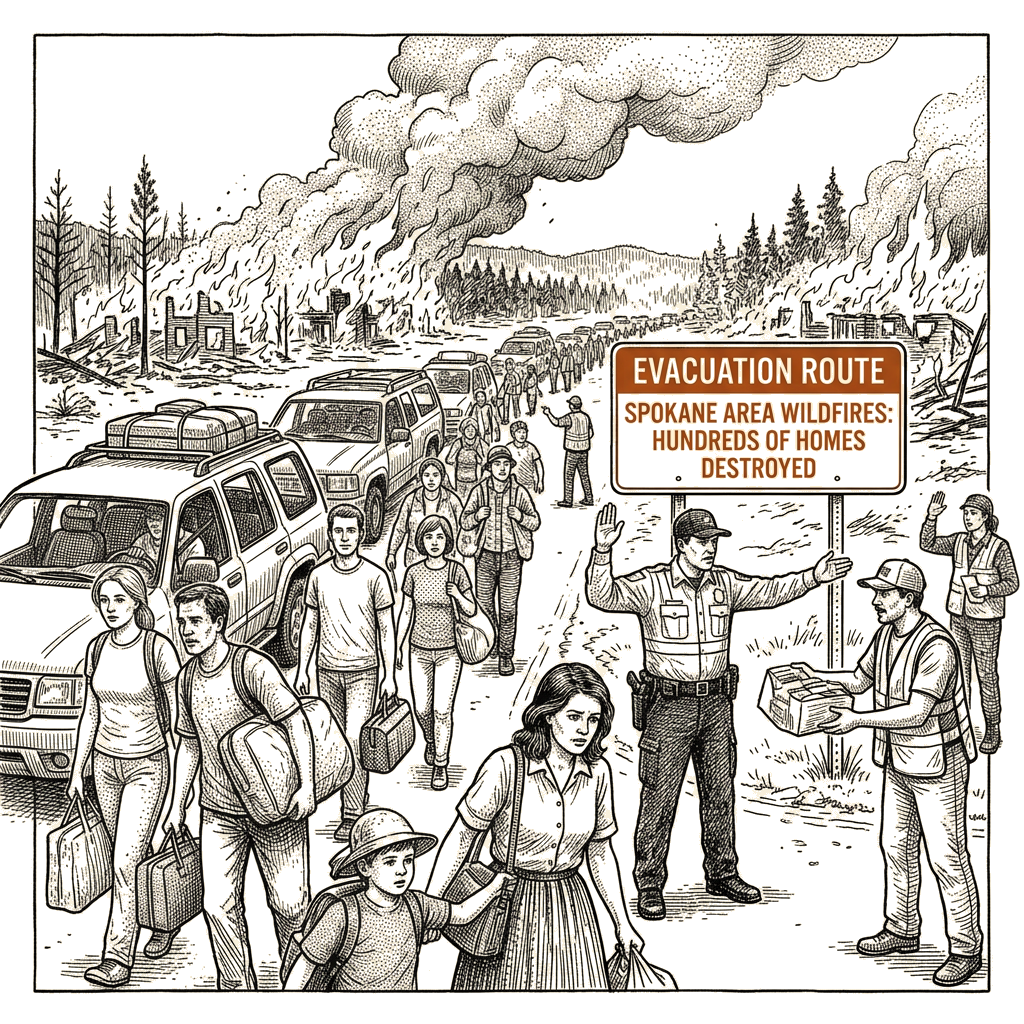
In Spokane, Washington, the chain broke.
The BBC reported that Amy Mulligan was in her backyard near Spokane, listening to an audiobook while preparing for her child’s birthday party, when she smelled smoke. She checked her phone. No alert appeared. Minutes later, her brother-in-law told her that a nearby neighborhood was being evacuated. Neighbors were pulling out. Smoke was coming over the back of the house. Mulligan’s nine-year-old daughter began hyperventilating in the traffic as the family drove away. Her mother tried breathing exercises with her while the fire stood close enough to see.
James Main told the BBC he and his wife had “zero warning” and about thirty minutes between first seeing the fire and realizing that the situation was no longer ordinary. Smoke covered the streets as they tried to escape. They could not tell whether they were driving away from the fire or toward it.
Main returned on Sunday and found little left of his house beyond ash, rubble, and charred tree trunks rising from the ground. More than 700 homes and other buildings were destroyed. More than 60,000 people were forced to evacuate. No deaths had been reported in the BBC account, but the absence of deaths does not make the damage small. It means people got out. It means the people who escaped still have to reckon with what did not.
In Adams County, a fire warning is not an abstraction. The county road system means that rural residents depend on human relay — a deputy, a volunteer firefighter, a neighbor — to carry the message when the electronic alert does not reach them. When that relay works, it works because the county’s volunteer departments are staffed by people who know the residents by name, who know which driveway leads where, who know that the family on the township road has an elderly parent who does not hear well and a pickup with two hundred thousand miles on it.
When that relay fails, the consequences are not abstract either. A resident on a township road does not get the same speed of notification as a resident in the village of Adams. A volunteer fire department may be called to a structure fire on one county road while a separate emergency unfolds on another, and the departments cannot be in two places at once. Smoke does not wait for a radio check. The ring doorbell and the phone alert are the backup, but they are only as good as the cell tower and the battery. The fire stations along Highway 13 and County G and County Z are staffed by volunteers who respond in their personal vehicles to their own stations before they can deploy to the fire. That first fifteen minutes — the time it takes a volunteer to hear the page, drive to the station, and start the truck — is the margin that separates a warning from a notification.
That is what a warning-system failure means in a county shaped like Adams. Not a policy paper. Not an abstract lesson from Washington state. A family on a township road, a child trying to breathe, and the knowledge that the human chain that is supposed to carry the message has a gap in it, and that gap is measured in the time it takes smoke to cross a county road.
The Old Trails fire, the largest of the three Spokane-area fires, engulfed Mulligan’s neighborhood. A suspect was arrested on suspicion of arson. That is a law-enforcement allegation, not a conviction, and it does not explain the warning failure described by residents. The record supports two separate facts: a suspect faces an arson allegation, and families say they received no timely warning before the fire reached them.
Those facts need to remain separate. A criminal charge answers who may have started a fire. It does not answer whether the public received usable information, whether the warning system worked, or why residents had to rely on smoke and neighbors to understand the danger.
The losses are not measured only in houses. Mulligan said the things inside her home were what brought her to tears. Insurance may replace some property. It cannot replace the ring her grandmother gave her, a ring that had passed from her grandfather to her grandmother after forty-nine years of marriage and then to Mulligan. Her grandfather died before their fiftieth anniversary.
“And it’s gone,” Mulligan said.
Government trackers count acreage, structures, evacuations, and casualties because those numbers are necessary. They are not the whole account. A ring is not a statistic, but neither is it merely sentimental decoration. It is a piece of family history that survived across generations until one afternoon when the warning came too late or did not come at all.
In Adams County, the ordinary objects that carry a family’s history sit in the same kind of houses that sit in Spokane. The county fair is every September, and the photographs from it are in the houses on the township roads. The grandfather’s ring is in the drawer in the bedroom of the farmhouse outside Big Flats. The family’s history is in the county.
Aldo Leopold wrote that land is a community to which we belong. A town is not only its buildings. It is the people who know which road leads out, the institutions that send the warning, the neighbor who knocks on the door, and the ordinary objects that carry a family’s history from one generation to the next.
The fire in Spokane did not only burn houses. It broke the chain between people and place. In Adams County, that chain is built of volunteer firefighters, county roads, a mutual-aid association, and a warning system that depends on people more than technology. The question is whether that chain is strong enough to hold when the next fire comes, or whether it will break the way Spokane’s broke — and the next family in a township outside the village will learn about danger from the smoke itself.