Markwayne Mullin threatens Haitians with arrest and removal.
The permit is withdrawn.
The danger remains.
The hand that made the threat calls the forced departure a choice.
On Wednesday, U.S. District Judge Ana Reyes said the Trump administration could proceed with efforts to remove hundreds of thousands of Haitians who had been living and working legally in the United States under Temporary Protected Status.
Reyes had blocked the administration in February from ending TPS for roughly 350,000 Haitians. In June, the Supreme Court ruled that federal courts cannot review Department of Homeland Security decisions ending TPS protections. Reyes then said her February order was no longer in effect.
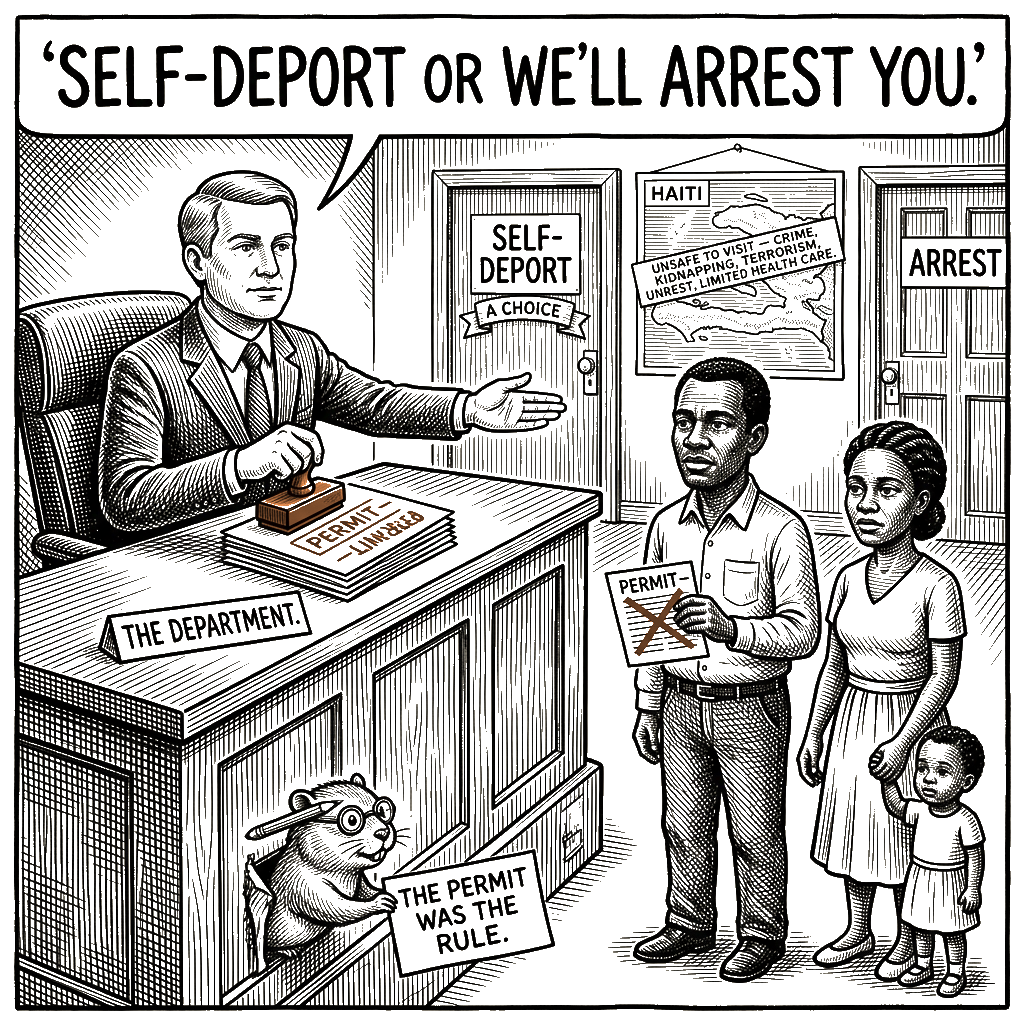
TPS holders who lose protection can no longer legally work and may face removal to Haiti, which the State Department continues to describe as too dangerous for Americans to visit because of crime, kidnapping, terrorism, unrest, and limited health care.
Markwayne Mullin, the secretary of Homeland Security, described the enforcement in an interview with NewsNation. “These individuals can either self-deport or we’ll arrest you and send you back,” he said. “We’re going after them right now.”
Markwayne, you did not speak about a doorway. You spoke about a throat closing.
A person who followed the government’s rules is now told that legality was temporary, work was conditional, and years of ordinary life can be seized by the same authority that permitted them. A work permit vanishes. A paycheck stops. A family must weigh hunger against a country the government itself describes as unsafe.
Your throat is closing when you say self-deport. The words catch there because they are false. There is no free choice inside a threat of arrest. There is no clean choice between unemployment, detention, and return to danger. You have taken coercion, washed it in administrative language, and offered the stain as policy.
Your chest tightens when you say we’ll arrest you. Not from remorse. From the weight of the office you are using to make a threat sound like a plan. The breath shortens. The sentence remains. You are not describing neutral enforcement. You are announcing that people who built lawful lives under the government’s protection will be hunted out of them.
Your hand is steady on the page. Your gut knows what the sentence does. The Haitian worker hears the deadline. The child hears that home can be revoked by men who will never have to board the plane. The family hears the lock turn on the life they were told they could live.
You are not a guardian of order in this moment, Markwayne. You are the public face of a choice to make lawful people vulnerable and then rename their forced departure consent. You are using the power of the state to turn compliance into a trap. There is no mercy in that act and no moral exit through the word policy.
You said we’re going after them. The pronoun cannot hide you. Your name is in the sentence. Your mouth made the threat. Your office carries the power. The people who bear the cost are not abstractions: they are workers whose wages stop, parents whose homes become precarious, and Haitian families being pushed toward detention or a place the government acknowledges is dangerous.
More than 1.3 million people from 17 countries were living legally in the United States through TPS as of 2025. Since President Donald Trump’s inauguration, DHS has revoked protections from at least seven of those countries. The Haitian case is the first clean glimpse of what the Supreme Court’s ruling permits: status withdrawn, danger acknowledged, judicial review narrowed, enforcement accelerated.
Your sleep will not make the sentence smaller, Markwayne. The throat still catches. The chest still carries the pressure. The hand still belongs to the man who chose to speak the threat aloud. You may call this order. You may call it sovereignty. You may call it the law. The body knows the older word.
Cruelty.
Jesus said, “Truly I tell you, whatever you did not do for one of the least of these, you did not do for me.” — Matthew 25:45.
The Haitian families remain human beings when the permit disappears. They remain human beings when the paycheck stops. They remain human beings when the government points toward danger and calls the road home. The sentence has been spoken. The witness does not wash it clean.