
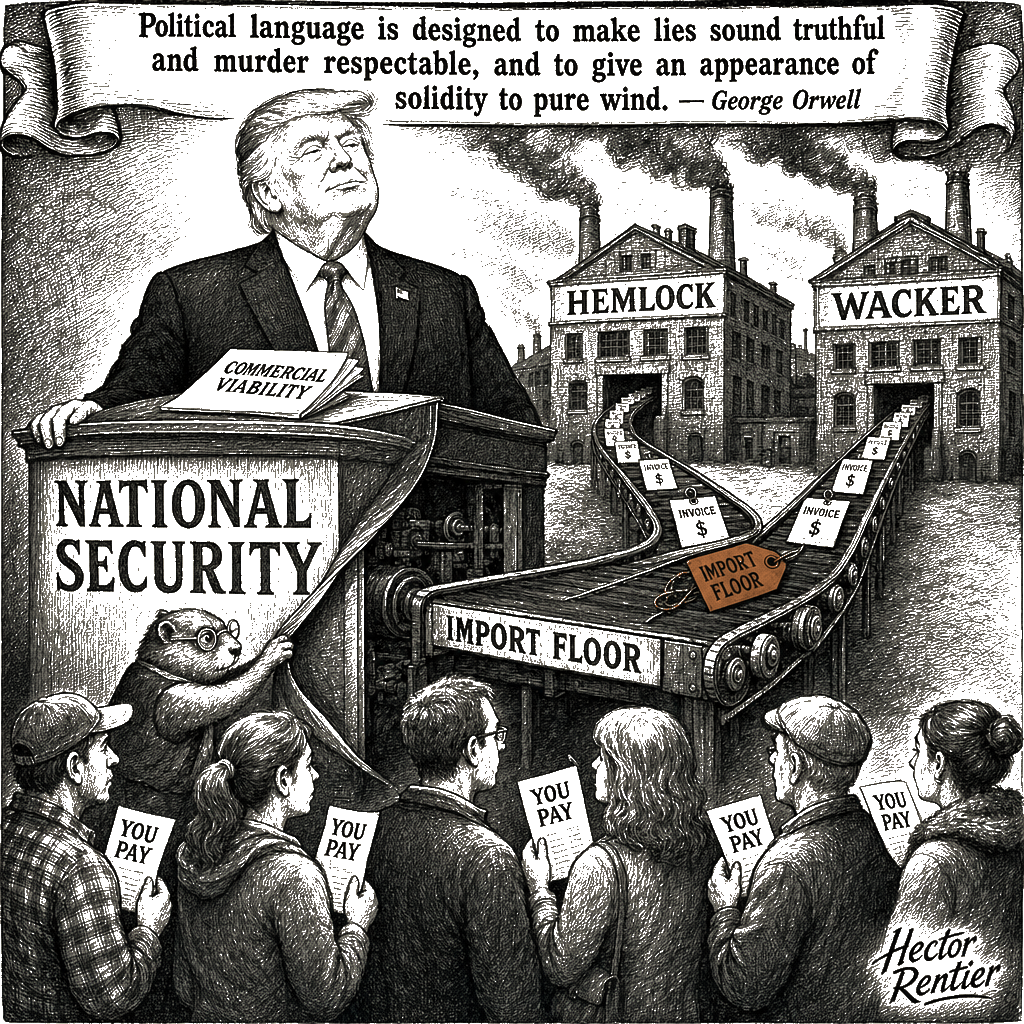
Trump is taxing American families to guarantee private profits and calling it security.
The order does one thing and claims another. Hold them apart and the policy reads clean.
Here are the numbers. It imposes a 15 percent tariff on imported polysilicon products and sets minimum import prices beneath it: $21 a kilogram for polysilicon, $100 a kilogram for the ingots and wafers made from it, 22 cents a watt for solar cells, and 38 cents a watt for solar modules.
Polysilicon is ultra-pure silicon, the input for the wafers inside solar cells and microchips. The minimum prices are the deeper tax. A tariff stops at the border. A minimum import price is a floor: imports may not enter below it, and anything priced under the floor is taxed up to it. The government has set a price on an input and guarantees domestic sellers that buyers will pay it.
A floor on an input taxes everyone downstream who must buy the input. That means the American panel assembler, the American chip plant, the business installing solar and, at the end of the line, the household paying for the installation. You do not defend a strategic industry by taxing its own supply chain.
The order states its purpose in its own text: to “help ensure the commercial viability of United States production of polysilicon.” That phrase is the confession. It says that at world-market prices the existing producers are not sufficiently viable and that the public will be required to make them so.
Name the producers. The United States has two polysilicon factories. Hemlock Semiconductor operates one in Michigan as a joint venture between Corning and Japan’s Shin-Etsu Handotai. Wacker Chemie, headquartered in Munich, operates the other in Tennessee. The “United States production” being protected is two factories — one German-owned, the other jointly American and Japanese. The buyers are every American household and business that installs solar and every American company buying silicon for its chips.
The national-security language is the laundering operation. The administration has spent the summer layering tariffs onto what consumers pay, and this order is the same tax wearing a supply-chain name — from the same administration that spent the spring promoting a U.S.-made chip partnership whose input this order makes more expensive.
Beijing’s foreign ministry spokesman described the move as “overstretching the concept of national security” and said, “Protectionism will not make the US more competitive.” That is right. The abuse does not stop being an abuse because the levy lands on American buyers instead of Chinese exporters.
The timing sharpens the picture. The order landed as Beijing reported exports up 23.9 percent in dollar terms year over year, driven by shipments of artificial-intelligence hardware. One government taxes its own companies’ input to shelter two producers from world prices. The other ships finished hardware at volume. The juxtaposition does the argument.
The floor does not meet its own standard. China’s polysilicon advantage is scale and cheap power. A price floor does not build American scale. It entrenches the two incumbents it protects and raises the cost of the American transition. The order even authorizes the Commerce Department to create an “incentive programme” for companies that build polysilicon factories. Taxing Americans to raise the money, then paying it back toward the same industries, and calling the transaction security: that is the policy in a sentence.
The honest instrument would be a direct subsidy or a procurement commitment. Legislation would be scored by the Joint Committee on Taxation like other federal subsidies, appropriated through the Treasury, and exposed on a budget line where Congress could see the cost. A real industrial policy would be open to any producer willing to build capacity.
The order instead writes the handout into the price of every imported input. Its incentive programme proves that the administration knows it is writing a subsidy. The import floor merely keeps the subsidy off the budget line.
The order takes effect December 4. The floor is a tax. The tax is collected from Americans. The two factories receive the guarantee. The buyers receive the bill.
The proclamation is the receipt, and the receipt grades itself. “Commercial viability” is the purpose clause of a subsidy. “National security” is the cover. The only surprise is that the handout arrives as an import floor instead of a budget line, where it would have to survive the light.