
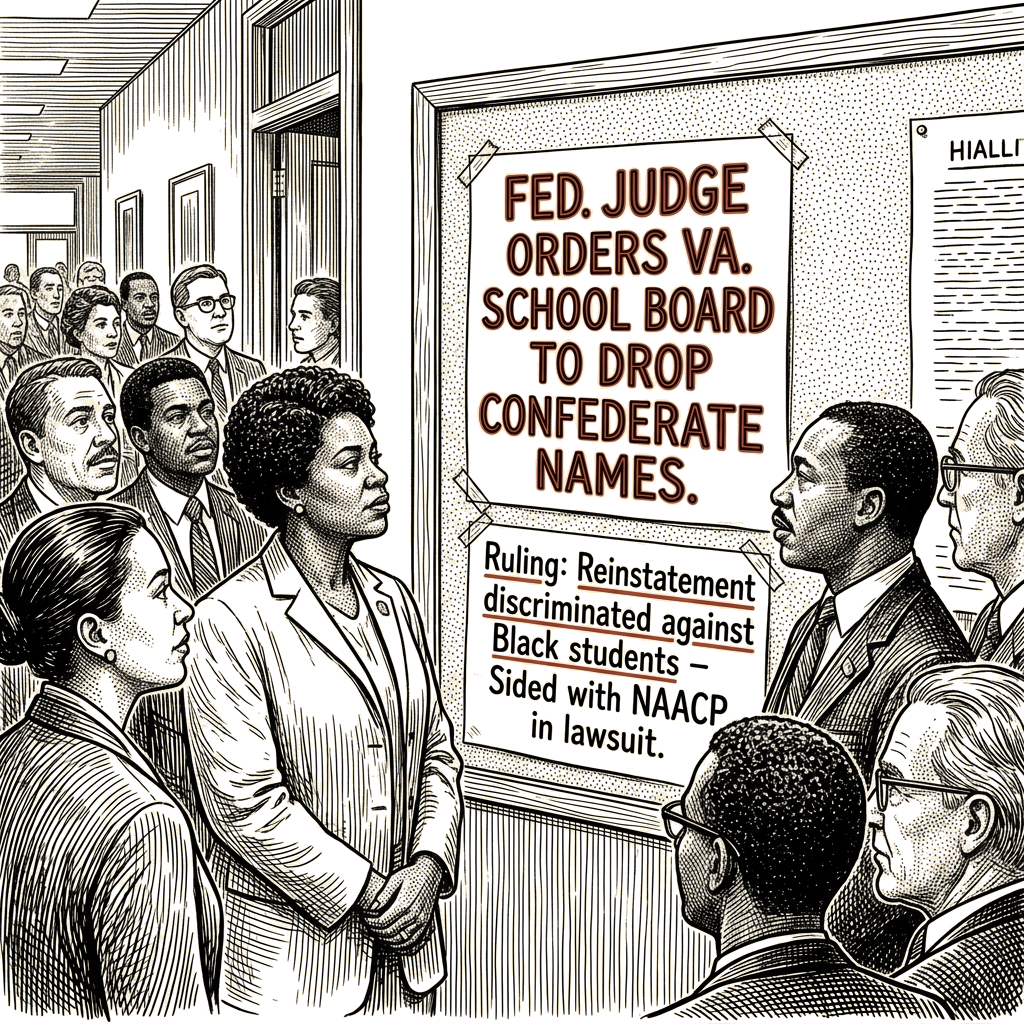
The Shenandoah County School Board reimposed segregation on Black students.
The board restored the names of Confederate military figures to two Virginia schools after those names had been removed. Stonewall Jackson and Turner Ashby were not neutral labels floating free of history. They were attached to schools during the era when Shenandoah County required separate schools for Black and white children. A federal judge found that the board knew exactly what those names carried with them.
Judge Michael F. Urbanski of the U.S. District Court for the Western District of Virginia ruled that the school board violated the Equal Protection Clause of the Fourteenth Amendment and the federal Equal Educational Opportunities Act. The Virginia NAACP brought the suit. The ruling identifies the act plainly: the board did not merely leave an old name in place. It reached back and restored one that had been removed.
The board’s strongest defense is local control. Elected school boards set education policy. Communities have authority over school branding. Historical preservation is a legitimate public purpose. Stonewall Jackson and Turner Ashby are part of Shenandoah County’s landscape, the defense might say, and honoring military heritage does not necessarily endorse slavery. The Tenth Amendment reserves broad authority over education to the states and their subdivisions. Federal courts ordinarily respect that local discretion.
That is a recognizable working-bar argument. It collapses on the record.
The schools bore the names of Confederate military figures. Those names were embedded in a county history that had separated Black children from white children. The names were removed. The board restored them. Judge Urbanski wrote that “the Confederate names were restored with complete awareness of their historic legacy and ongoing discriminatory impact.”
That is not accidental inheritance. It is a documented choice.
Urbanski drew the legal distinction that carries the case. “The affirmative act of reinstating these vestiges of segregation,” he wrote, “is far more problematic than a passive failure to remove a long-standing name or symbol.” A community that inherited a name and left it untouched through inertia occupies a different legal posture from a board that reimposes the name after it has been removed. Passive retention and affirmative restoration are not the same act. The second act carries the decision-maker’s awareness inside it.
The board did not stumble into Confederate names. It created the conditions the court found discriminatory.
This was not a dispute about school branding in the small sense. Public schools are state institutions. Their names announce whom the institution honors, whose history it preserves, and what students must enter every morning under the authority of the government that educates them. When a board restores symbols tied to a system that separated Black children from white children, the burden does not fall evenly. Black students must attend under the restored names. The court found that the board’s knowing decision imposed a discriminatory burden on them.
The Equal Protection Clause prohibits state-sponsored racial discrimination. The Equal Educational Opportunities Act supplies a federal statutory protection for equal educational opportunity. The board’s local-control argument cannot turn either protection into a permission slip. Local authority governs within constitutional and statutory limits. It does not place a school board beyond them.
The timing makes the ruling larger than Shenandoah County. Just weeks earlier, the Education Department rescinded its disparate-impact rule for schools, removing one federal civil-rights enforcement tool. As the Education Department dismantles one school-discrimination enforcement tool, a federal judge has enforced another protection in court. The enforcement landscape thins while the conduct those protections address remains.
The NAACP should not have needed to file a federal lawsuit to challenge a school board’s restoration of names rooted in segregationist history. But that is the structure now visible: protection exists on paper, enforcement moves only when a plaintiff with standing, lawyers, money, and endurance can carry the claim into federal court. The upstream apparatus recedes. Litigation becomes the remaining alarm.
Urbanski got this one right. The board restored Confederate names to public schools knowing what they meant. The court named the choice as racial discrimination. The names were not merely old. The board brought them back.
A civil-rights protection that works only after the harmed students find a federal judge is still protection. It is also a record of what the system allowed before the lawsuit arrived.