
Wisconsin does not need a safer candidate; it needs a candidate willing to say who pays for the future.
The electability concern is real. Five of the state’s last seven presidential elections were decided by less than one percentage point. Any one of twenty small shifts could move 10,000 votes. A candidate who cannot assemble a general-election coalition cannot govern anything. That is arithmetic, not cowardice.
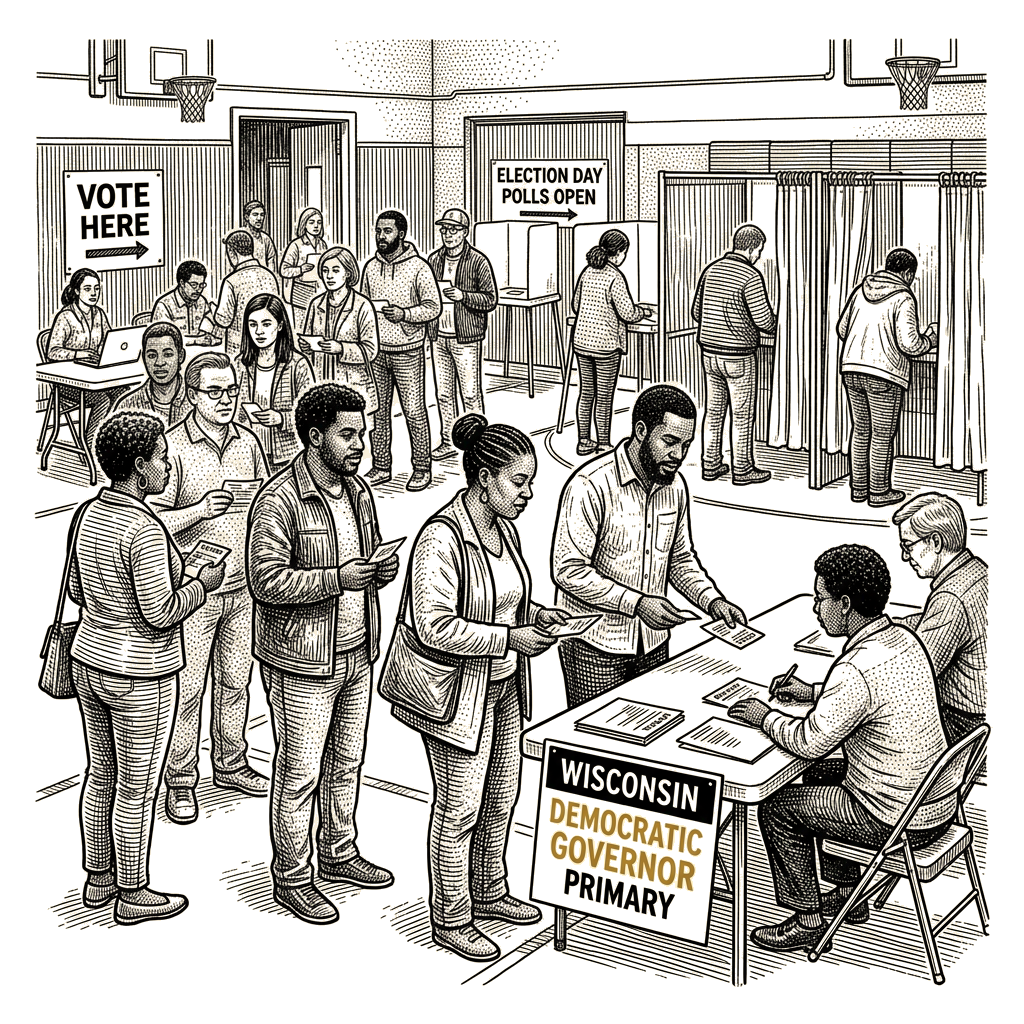
Francesca Hong is leading a chaotic Democratic primary because she is talking about the things voters can actually see: universal childcare, fully funded public schools, higher wages, taxing billionaires, and a one-year moratorium on new datacenters. She is a chef, a former restaurant owner, a single mother, and a state representative from Madison. She has spent hundreds of events talking to voters across Wisconsin, from karaoke nights to ramen pop-ups, instead of waiting for voters to audition for her attention. The primary has become a test of whether the state wants a safer candidate or a more useful one, and the race has received more attention than most state contests ever do.
Hong does not shy away from the democratic socialist label. She also notes that the Democratic Socialists of America has not endorsed her and that she does not subscribe to its entire platform. That distinction is worth keeping. The objection to her is built on a word, not on the program.
The safe-candidate theory says this is dangerous. The results so far suggest that the greater danger is a party establishment so frightened of losing that it becomes unable to explain what winning would accomplish.
“Electability” has become a polite word for avoiding the question voters are actually asking: who will make life less expensive and less precarious? The answer from the cautious wing is usually a candidate who sounds less threatening to people who are already comfortable. This is presented as strategy. It is mostly a request that the people carrying the costs remain patient while consultants rearrange the adjectives.
The caution is also strangely tuned. The man the safe coalition is anxious to avoid testing is already waiting in the general election. Tom Tiffany is running unopposed for governor. He voted against certifying the 2020 presidential election results that Trump lost. Wisconsin’s governor helps certify the state’s presidential results.
That is not a minor detail. The office the cautious wing wants to protect with a quieter candidate is the office that could stand between the country and another attempt to override the people’s vote. Cautious is not automatically safe. Sometimes it is a plan for keeping the certification of American elections in the hands of a party that has already tried to ignore one.
Hong’s old tweets give Republicans easy material. Voters are entitled to ask whether she can hold moderates and independents. Public language deserves scrutiny, and a candidate does not get a free pass because the internet is annoying. But those old tweets, including a five-year-old Thanksgiving joke, are not a governing program. They are being weighed against the question of whether Wisconsin can afford its current one.
A voter asked Hong what she would do for them. She answered: raise wages, tax billionaires, and stop datacenters. That is not a complete governing program. It is, however, an answer.
“I’ll work across the aisle” is not an answer. It is a weather report.
Start with childcare. Wisconsin parents are not failing at budgeting because quality care costs too much. Quality care requires enough skilled adults to supervise children safely. Those adults must be paid. Parents cannot afford the full cost, and owners cannot provide decent care at high margins.
Cheap for parents, decent for workers, profitable for owners: pick two. The arithmetic refuses.
Every wealthy country that wants parents employed and children cared for eventually pays the difference through public money. America already ran a version of this experiment. In 2021, the expanded Child Tax Credit sent monthly support to most families with children. Under the Census Bureau’s Supplemental Poverty Measure, child poverty fell 46 percent, from 9.7 percent to 5.2 percent. The expansion lifted 2.9 million children out of poverty. Then the policy lapsed, and poverty rose again in the largest year-over-year jump on record.
We did not discover a Scandinavian secret. We turned the support on, watched families do better, and turned it off.
Wisconsin can build a larger floor without waiting for a revolution. Make universal childcare automatic. Treat care as infrastructure rather than a private favor families purchase between paychecks. Pay the workers who make the system function. The state cannot simply import Denmark’s welfare machinery by Thursday. Denmark’s security rests on unions, sectoral bargaining, organized employers, competent administration, and decades of institution-building. America has weaker unions, fragmented government, distrust of taxes, and a political culture that treats every public investment as a suspicious foreign object.
The plumbing is harder here.
That is a difficulty. It is not an argument for pretending the pipes do not exist.
The same logic applies to public schools. “Fully fund public education” is not a slogan unless someone names the revenue, the formula, and the obligations attached to the money. Wisconsin’s property-tax system ties school resources to local wealth. That is not the weather. It is a choice made through tax rules, district boundaries, and state policy.
A child should not receive a weaker public education because her town has a smaller tax base. When the state refuses to close that gap, it has not chosen neutrality. It has sent the bill through the side door to families, teachers, and local property taxpayers.
The revenue is nameable: a surtax on the state’s top earners and a public-benefit fee on the water and power datacenters consume. The formula is the fight. Good. Let’s have the fight in public.
The datacenter moratorium is the most interesting part of Hong’s platform because it asks the question the catechism of the comfortable prefers to skip: who owns the infrastructure, and who pays for its appetite?
Hong wears a beaded bracelet from a datacenter-organizing meeting. This is a movement position, not a think-tank one. She says she is “team human.” She says, “Just because I’m team human doesn’t mean I’m anti-AI.”
Good. That is the correct distinction.
A datacenter can create jobs and investment. It can also consume enormous amounts of electricity, land, water, and public capacity. It can demand new roads, utility connections, and political guarantees while residents absorb traffic, utility pressure, environmental costs, and the risk of being left with the bill.
“Innovation” does not make those costs evaporate. It moves them somewhere.
If private firms receive the gains while households absorb higher utility costs, communities surrender water, and the public finances new infrastructure, then the market has not discovered efficiency. It has discovered a way to send the bill to someone else.
Hong is not proposing to abolish computers, electricity, or the future. She is proposing a pause before Wisconsin commits land, power, water, and public infrastructure to an industry whose benefits are being advertised far more confidently than its costs are being assigned.
That is not anti-technology. It is what adults do before signing a contract.
The state could require public review of datacenter projects, full disclosure of water and energy demand, enforceable local-benefit agreements, labor standards, and a public return whenever public resources make the investment possible. It could make datacenters pay their full costs and give communities a real chance to say no.
Apparently this remains a radical line of inquiry.
It should not be. North Dakota has run a profitable state-owned bank since 1919. Rural electric cooperatives serve 42 million Americans. Those cooperatives expanded power across the country through member-owned institutions when private investors decided some places were not profitable enough. Ownership and public rules are not foreign substances.
Wisconsin already knows how to build essential infrastructure when the private market declines to do it. Members organize, borrow, and string the lines themselves. The state does not need to copy a Scandinavian country wholesale. It needs to copy the workable part of a tradition it has already proven: members get voice, communities get a return, and nobody gets to call the bill inevitable.
The burden is now on the safe-candidate crowd. Name the policy their safer candidate would enact. Name the institution that would deliver it. Name who would pay, who would benefit, and what would stop the legislature or the next governor from undoing it.
If they cannot answer those questions, “electability” is not a governing argument. It is a request to postpone governing until the danger has passed.
The danger will not pass. Childcare will still cost more than families can pay. Schools will still need money. Datacenters will still ask Wisconsin for land, power, water, and permission. The only question is whether the public gets a seat at the table before the contracts are signed.
So what do we build instead?
A Wisconsin that treats childcare as public infrastructure, schools as a common obligation, and datacenter development as a public decision rather than a private favor. A Wisconsin that funds schools according to children’s needs rather than property wealth, makes the industry pay for the resources it consumes, and gives workers a voice over the technologies reshaping their jobs.
The economy is a set of choices, not the weather.
The safe candidate is not the one who promises that nothing can go wrong. It is the one who gives people enough security to take a risk. That is how you build a coalition. And then you build the state.