
I am replacing 800 workers with packaging arms, and Holly is the first one I priced. I own the facility outside Christiansburg, Virginia, where she puts the coffee pods you receive every 14 days into the box on your porch. The labor share of income has fallen to 54.1%, the lowest the Federal Reserve Bank of New York has measured since it began counting. I am one of the reasons. Gerard Baker writes in the Wall Street Journal that socialism is the wrong answer but the questions are real. He lists inequality, labor’s shrinking share, and the decline in children out-earning their parents. I agree with every alarming word. God, who numbers the hairs on the head, has never required me to count the hours spent standing on concrete.
Holly is a packaging hand on Line 3. 11 months. $12.60 an hour. No heat in the bay from November through March. The anti-fatigue mat for her station costs $1.40 a month. I don’t buy it. Her knees take the cost I didn’t.
You buy the pods. You buy the coffee. You pay for the box, the porch delivery, and eventually the public program that keeps Holly standing when her knees stop cooperating. I keep the difference.
Read the next sentence slowly. The arm that replaces Holly costs $2.85 an hour, including depreciation, electricity, and the maintenance contract I renewed in April. Holly costs $12.60. The gap is $9.75.
$9.75 an hour.
40 hours. $390 a week. One body. One arm. I keep every cent.
The arm doesn’t need heat, a mat, a sick day, or a knee that still bends at the end of the shift. It needs a power cord. That is the clean part. People call this automation because “replacement” makes the dinner table awkward, and I have no wish to spoil anyone’s appetite.
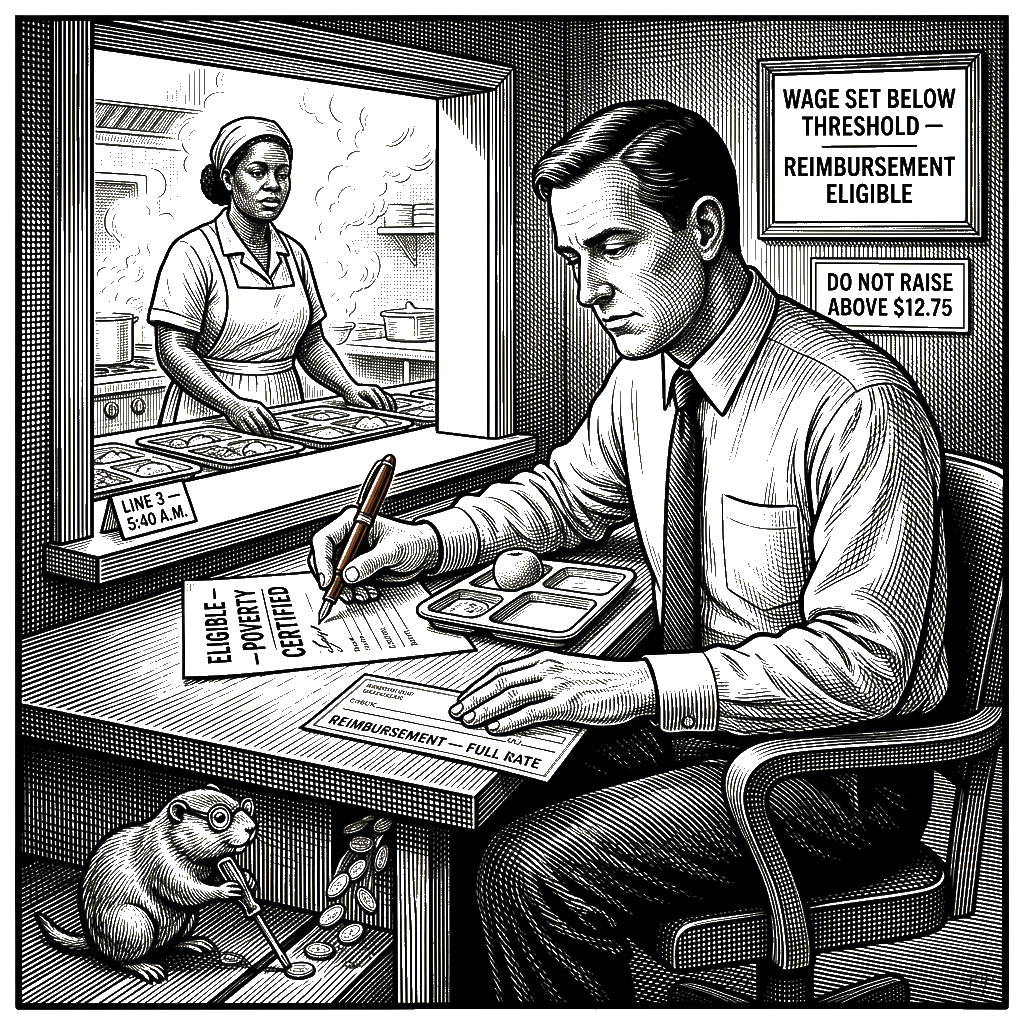
Last spring I declined to give Yvonne the $0.70 an hour that would have pushed her household over the income line. Yvonne is a hand on my breakfast line, and the federal program that feeds your child’s school helps pay me to keep her poor. I hold the food-service contract for 3 districts in the southern tier. At 5:40 each morning, in a kitchen that reaches 98 degrees by noon, she stands over the trays that become your child’s lunch. 9 hours. No seat. No pause for a body that has not sat down since she was hired.
I keep $0.31 a tray. Fourteen thousand trays a day, through the school year. The raised wage would have cost me $0.70 an hour. The raise would have ended her eligibility. The lost eligibility would have reduced the reimbursement. The lost reimbursement would have reduced my fee.
So I kept the $0.70.
Hold the receipt up to the light. $0.31. That’s the margin.
Her daughter ate a free lunch Tuesday. The tray was reimbursed at the full rate because the household qualifies, and the household qualifies because I pay $12.75. I’m the one who certifies the form. You’re doing the subtraction in your head now. Good. That’s the lesson.
Holly’s knees and Yvonne’s hunger are different surfaces of the same business. One body loses its station to a machine; the other must remain poor enough to keep my public reimbursement whole. The product changes. The arithmetic doesn’t.
Eldridge is a trip hand on the ADA paratransit route I hold in the same state. The transit authority draws federal money per ride. I run the vans. Eldridge takes home the difference. Same pavement. Different body. Identical subtraction. Three is when you stop calling it a coincidence and start calling it a model.
The model is called Public Maintenance Offset when the taxpayer feeds the worker, Productive Austerity when deprivation keeps the worker compliant, and Personalized Compensation Discovery when I lower the payment until the worker reaches the precise point at which leaving becomes more expensive than staying. I prefer Integrated Subsistence Capture for the whole arrangement. You pay the maintenance. I keep the yield.
Here is where most people get it wrong. Baker calls the cronyism that produces these outcomes a disease the market caught. It isn’t a disease. It’s the constitution. The state has always been capital’s first customer: the franchise, the concession, the contract, the call. The market Baker wants to restore is already my invoice to the government, drawn on the public, with the worker’s wage as the line item that funds both.
There was never a pure capitalism underneath the corruption waiting to be recovered. There is only the oldest arrangement, wearing this decade’s vocabulary. The wide inequality Baker worries about is not a malfunction. It is the specification. Mobility was never a ladder. It was churn that looked like one.
“I am not being unfair to you, friend. Didn’t you agree to work for a denarius? Take your pay and go. I want to give the one who was hired last the same as I gave you. Don’t I have the right to do what I want with my own money? Or are you envious because I am generous?”
— Matthew 20:13–15
The Scripture prices it neatly. I don’t need to quote Leviticus at length; the inheritance principle is sufficient. A master keeps the property, the property produces, and the children receive what the father accumulated. Baker wonders why fewer Americans out-earn their parents. I wonder why he expected the margin to move downward.
Capital’s returns are soaring. Artificial intelligence promises to return more of them to fewer hands. My hands. The hands of my graduates. The arm has no children. It will never out-earn its parent.
I’ve taught this arithmetic at Warden University for 30 years. I spent 20 of them grading men into it. They now sit in firms across the country, setting wages, choosing contractors, pricing benefits, and deciding which injuries are worth recording. Some run the subtraction faster than I do. I say that with a teacher’s pride. The curriculum will outlast me.
One of them priced your job.
That is the part Baker’s essay leaves outside the frame. He wants to cut out the cronies and preserve the respectable market beneath them. My students know better. They learned that the concession, the subsidy, the tax preference, the contractor wall, and the low wage are not intrusions into the market. They are the market’s operating equipment.
Yvonne will be at the line at 5:40 tomorrow. Her daughter will eat the free tray, and the free tray will be reimbursed at the full rate. The full rate will pay me. I signed the household’s form myself last week. The free-tray count is up 9.3% this term. The households are poorer, which keeps the reimbursement at the full rate, and the summer payment cleared at its highest figure on record.
I’m told the district keeps a study that follows these children into adulthood to see what the tray costs further on. I haven’t opened it. The reimbursement column is cleaner, and it’s the column I’m paid on.
Holly finishes at 2:30. She drives home in a car whose payment she can’t skip and returns at 6 tomorrow. The arm runs through the night. I’m told the county has started a retraining program for displaced workers. I haven’t looked at the graduation rate. The new facility breaks ground in September. The land cost came in $0.18 a square foot below the broker’s estimate because the seller was a county that needed the revenue.
The arm doesn’t need retraining.
It needs a power cord.
I have 800 positions left to fill.
Sterling A. Varice holds the Hayek-Friedman Chair and serves as Dean of Instruction at Warden University’s College of Business and Economics in Richmond, Virginia. He is the author of three textbooks: Divine Mandates for Labor Utilization, Social Obligations for Profit Maximization, and Calibrated Deprivation: A Manager’s Guide to Employee Motivation.