
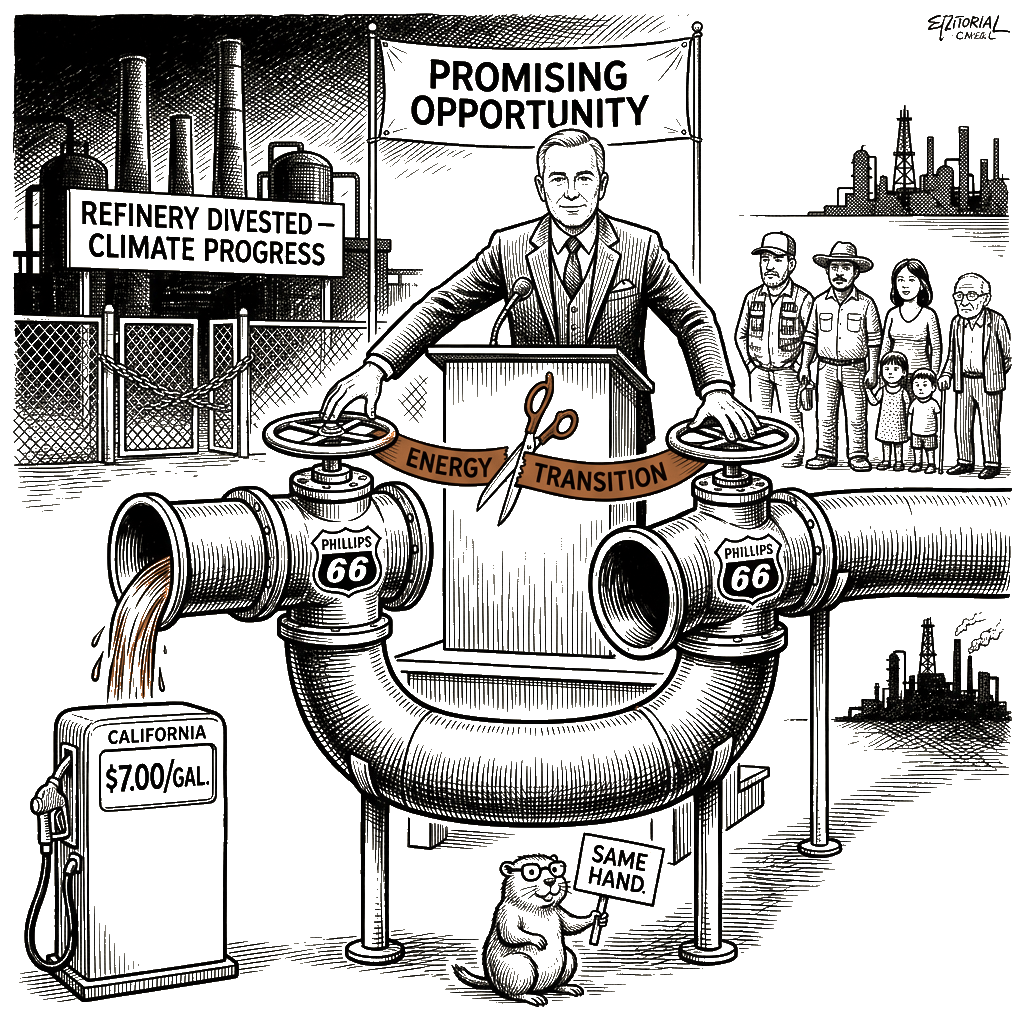
Phillips 66 closed California’s refinery and profits from the pipeline replacing it.
I buy my gas at the pump on Highway 13 in Friendship, and I’ve learned to read the price board the way other men read the paper. Every gallon carries a freight bill with it — the refinery that made it, the pipeline or tanker that moved it, and the war that decided whether the tanker sailed at all. My 2014 Silverado has 187,000 miles on it, and every one of them cost something at the pump.
Tuesday morning, the card reader at the Co-op was telling the same story California is paying at the sharp end: $5.60 a gallon for gas, $6.86 for diesel, up from $5.15 a year ago, with some cities over $7. Up here the fuel bill is the price of everything else — the milk check, the freight, the parts order coming up Highway 13 from the Dells. California’s crisis is our price list, turned up loud.
Here is the arithmetic behind the sign.
Last December, Phillips 66 shut its 139,000-barrel-a-day refinery in Los Angeles. In April, Valero closed its 145,000-barrel-a-day plant at Benicia. California lost a fifth of its refining capacity in four months.
The state still burns 1.8 million barrels of oil a day, more than any state except Texas, and imports three-quarters of what it uses. The war with Iran has effectively closed the Strait of Hormuz, where as much as a fifth of the world’s oil and gas moved before the war. The Asian refiners that used to send California gasoline and jet fuel cannot run their own plants full. Saudi Arabia sent no oil to the United States in July, the first month federal records show that since 1985. Chevron says California’s storage cushion is drawn down to historical levels, with tankers from the Gulf Coast working to refill the tanks.
The fuel still has to come from somewhere.
The Wall Street Journal’s Collin Eaton reported this week that Phillips 66 and two partners have sanctioned the Western Gateway Pipeline. It will run 900 miles from the Texas Panhandle to Phoenix, where it will connect to an existing 500-mile line ending at Colton, California, about an hour east of Los Angeles. The project carries a $5 billion price tag and is designed to move 230,000 barrels a day of gasoline, diesel, and jet fuel by 2029.
The fuel will come from refineries in Texas, Oklahoma, and near St. Louis. That is almost enough to replace the two California refineries that closed.
Now look at whose hands are on both ends. The company that walked away from refining in California is back with the pipe that replaces it. Kinder Morgan owns the Arizona-to-California segment, and that line currently carries fuel out of California. The company will reverse the flow and send fuel back in. HF Sinclair holds a minority stake.
A fix three years out is not a fix. It is a hope with a steel price tag.
California did not stop burning oil to get where it is. It pushed the visible part of the oil business out of the state and left the invisible part — the burning — right where it was. One in five new cars sold in California is electric. The state still burns 1.8 million barrels a day. A fifth of the new-car market went electric. The barrels barely flinched.
That is not a transition. That is a shell game.
You can tax a refinery, regulate it, hold hearings on it, and eventually close it. What you cannot do is tax the gallon after it has burned, because the gallon does not care where it was made. A gallon of gasoline combusts in Bakersfield exactly the same way whether it was refined in Wilmington or the Texas Panhandle. The fuel does not stop being burned because the refinery moved. The policy moved the refinery, kept the burning, and exported the ledger.
Gov. Gavin Newsom’s office called the pipeline a “promising opportunity” to increase fuel security without adding to the oil industry’s environmental impact in the state.
Those last three words are the whole philosophy.
The environmental impact is not the pipe. It is the 230,000 barrels a day. The fuel still gets burned. The exhaust still goes into the same sky. Only the paper changed jurisdiction.
Wendell Berry names the habit in The Unsettling of America: the extractive mind, the way of seeing that uses a place up and calls it progress. California has refined that into a civic discipline. It keeps the consumption, exports the refinery, and counts the environmental ledger by the location of the pipe.
Aldo Leopold wrote in A Sand County Almanac that a thing is right when it tends to preserve the integrity, stability, and beauty of the biotic community. The biotic community does not recognize the California line, and neither does a molecule of carbon. I have kept the ice-out date on Lake Petenwell for twelve years. The change is real. It never once asked which state’s policy it was honoring.
I’ve stood on this side of the arithmetic before — different town, same deal.
Adams County was built by a railroad and a paper economy, and my father’s generation watched both leave. What happens when a place stops making what it uses is that the freight goes up, and the freight is paid by the people who stayed. California is the same story at a bigger scale, with a war and a 900-mile pipeline added.
Daniel Yergin wrote the whole history in The Prize. The short version sits on my bench: oil crosses every border, and whoever can move it decides what everybody else pays. California drew the modern version of that map, then did its best to pretend the lines stopped at its border. They do not.
The new line will draw from the same refineries in Texas, Oklahoma, and near St. Louis that help set the wholesale price of the gas I pump in Friendship. Pull a couple hundred thousand barrels a day out of the middle of the country and point them west, and the price of what remains moves for everybody.
California’s problem has never stayed in California.
The national theater is worse. The Trump administration had to waive the Jones Act — the 1920 law that keeps foreign ships from hauling goods between American ports — so Gulf Coast fuel could reach the West Coast by water. Gulf-to-West Coast fuel shipments surged nearly sevenfold from February to May, and the waiver was extended again Monday for another 90 days.
Take the win for what it is.
American fuel moved between American coasts on foreign-flag tankers because the American-flag shipping capacity the law was written to protect is not there to move the fuel. The second-biggest fuel-consuming state in the country, importing three of every four barrels it burns, is running on a temporary waiver in a nation that produces more oil than any other on earth.
That is the Nationalist Shell Game in one measure. The rhetoric is independence. The substance is a war, a 1920s shipping law, a dollar-a-gallon price spread, and a pipeline backed by the company that closed the refinery.
Production is a trophy. Supply is a supply chain.
And this one runs through the Strait of Hormuz and the Texas Panhandle before it gets anywhere near a pump.
None of the political blame moves a gallon. Newsom blames President Trump and the war. Trump tells oil companies to lower their prices. In May, Newsom’s administration was urging Californians to skip Chevron over high prices. In August, his office is blessing a pipeline built by the same industry.
That is whiplash even for this business.
In May, the answer was to punish the supplier. In August, the answer is to feed the supply line. Both positions presume the barrel keeps flowing. The only difference is how the public is asked to talk about it.
Presidents and governors do not set fuel prices by speech. Wars, refineries, shipping rules, and policy choices do. When a state tells its people for ten years that the fuel is ending while the state keeps burning 1.8 million barrels a day, the pump price becomes reality filing its invoice.
The refiners, meanwhile, are running flat out — running at full capacity as the global crunch boosts their profits, as we reported last week. I do not begrudge a refiner a margin. The man running the plant has bills like anybody else. But the supply chain makes its money, the state keeps its image, and the driver pays.
The one thing nobody has done is burn less.
The honest version was always available. A state that wants less gasoline makes the alternatives real and accounts for the carbon it actually burns, including Texas-refined diesel. It does not congratulate itself on smoke that left the state. A country that calls itself energy-independent fixes the law that makes it easier to move crude halfway around the world than between its own ports.
And the supply gets built the way rural electricity got built in 1936 — as shared infrastructure under member-owned cooperatives, not as a toll road answering to the toll-taker.
The people of California are not the shell game. They are the ones staring at the price board, the same way my neighbors do. The leaders who told them the age of oil was ending while the state kept drinking 1.8 million barrels a day left their own people holding the price of a war, a pipeline, and a promise all at once.
I keep coming back to one image: the line that has been taking fuel out of California, reversed.
Fifty years ago that state was oil country. Now fuel arrives down a 900-mile straw from the Panhandle, and the company that closed the refinery owns the straw. The people who pay the toll are the ones who cannot route around it — the trucker on Interstate 5, the fieldworker in the Central Valley, the mother in Bakersfield paying $7 a gallon with the tank on E.
The people who will be fine own the pipe.
I’ve watched that split take the middle out of every industry I know — agriculture, banking, the hardware stores on Main Street. My daughter is five. By the time she is old enough to put gas in a car, I would like this country to have learned the thing California is learning the expensive way:
You do not get out of dependence by hiding it.
You get out of it by using less.
Everything else is just a longer pipe.