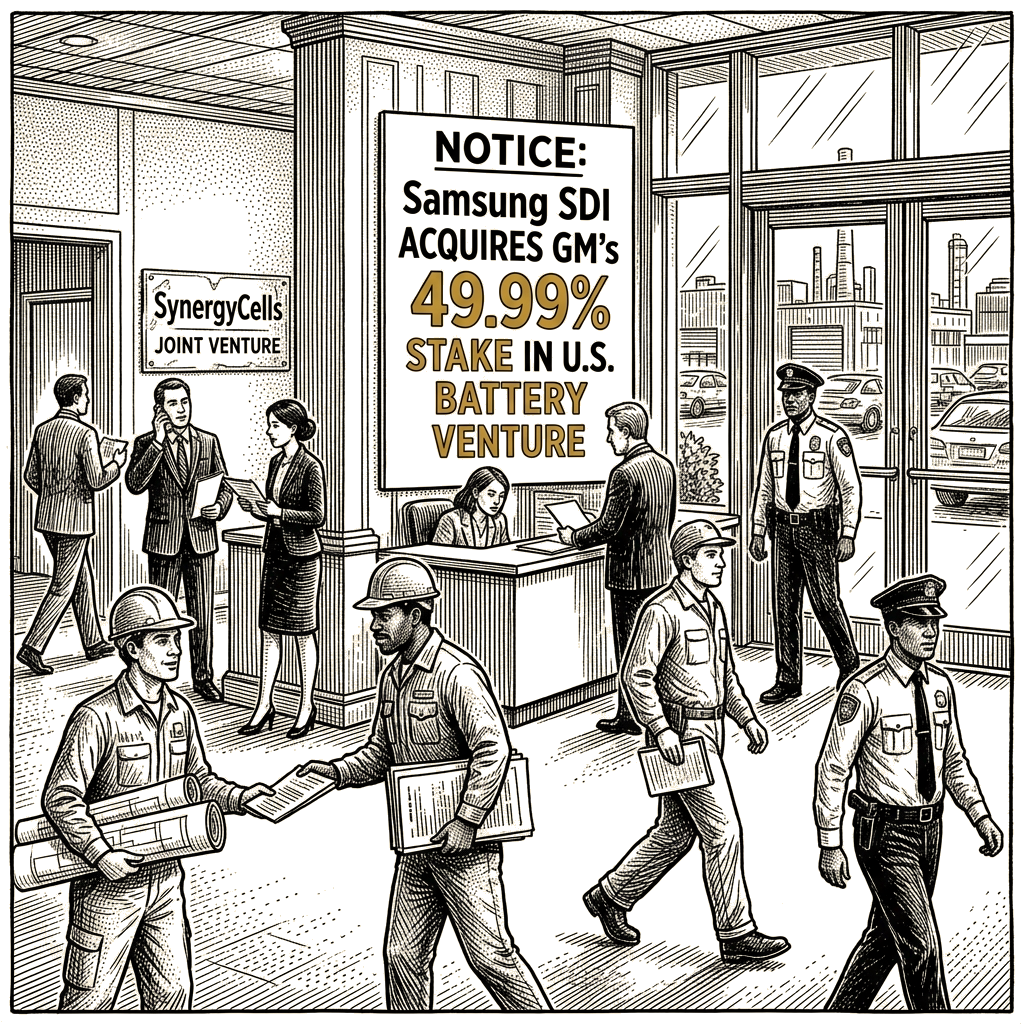
The corporations have transferred the risk of another industrial promise onto an Indiana community. Samsung SDI has acquired General Motors’ 49.99% stake in SynergyCells, ending the $3.5 billion battery joint venture before the New Carlisle plant has begun production.
The strongest case for the decision is real. Electric-vehicle demand has grown more slowly than expected, the Trump administration has eliminated EV incentives, and a plant designed to produce 27 gigawatt-hours of vehicle batteries should not be kept on one course merely to preserve an announcement made in better times. Samsung SDI says it will repurpose the facility for energy-storage systems and other high-tech applications. That is not failure. It is adaptation. But repurposing the plant may be prudent; leaving the community to absorb the consequences of the change is not.
The language of adaptation too easily conceals what has been abandoned. A $3.5 billion plant is not a line item that changes owners when a forecast misses. It is a large piece of a place, with roads, utilities, tradesmen, suppliers, tax expectations and the future plans of families attached to it. The people who live near it cannot repurpose their mortgages, schools and working lives as quickly as a corporation can repurpose a factory.
This is the old bargain in its newest clothing. Capital arrives with a projection, a partnership and a promise of settled work. When the projection changes, the ownership changes, the partnership ends, and the community is invited to admire the flexibility. The cost of the flexibility is borne locally, while the decision is made elsewhere by men who will never have to explain to a town why its future was renamed an option.
I know something about forecasts. I used to trade agricultural futures in Chicago, paper claims on crops grown by people back home. The screens rewarded the person who moved first, not the person who had to live with the field after the price moved. A corporate forecast is useful. It is not a covenant. That distinction has been forgotten by a movement that once claimed to believe in ownership, responsibility and the moral weight of place.
There is an honest conservative objection to this column. No town is entitled to a permanent industrial monument, and no government can decree that every investment must succeed. Prices carry information. Demand changes. A plant that can serve the growing energy-storage market rather than sit idle deserves a chance. The recent LG-Honda battery operation in Ohio shows that energy-storage production is not a fantasy invented to soften bad news.
Still, a market economy is a tool. It is not a market society in which every institution must answer only to the next return. The question is not whether Samsung SDI and GM may change their plans. They may. The question is whether a community should be left with all the dependence and none of the ownership.
Catholic social teaching gives us a better vocabulary than either corporate fatalism or industrial policy as command. Subsidiarity asks that decisions remain as close as possible to the people who bear their consequences. The universal destination of goods says that productive property is legitimate but not absolute. A factory built with public roads, public training, public infrastructure and the labor of a region carries a social mortgage. It cannot be treated as the private weather of distant shareholders.
That does not mean Washington should seize the plant or appoint a moral bureaucracy to run Indiana. Concentrated capital and concentrated state power are the same disease in two coats. The answer is not to replace the distant corporation with a distant administrator.
The primary answer should be ownership that stays put: an employee or producer cooperative with a binding claim on the facility’s future and its upside. A regional mutual or credit union, financed by local deposits, could supply patient capital, while a public-private structure could guarantee enforceable local representation. Samsung SDI can provide technical skill and capital. The people who keep the plant alive should possess voice, not merely a hope that the next forecast is kinder.
That arrangement is harder than a joint venture. It requires patient capital, competent local governance and the humility to admit that a community is not a portfolio. But the harder answer is often the more conservative one, because it preserves what the easy answer keeps dissolving.
The plant in New Carlisle need not become another stranded promise. Let it become a working institution whose ownership is broad enough to survive a missed forecast, a changed administration or a new technology. Leave the town more than a building. Leave it its life.