
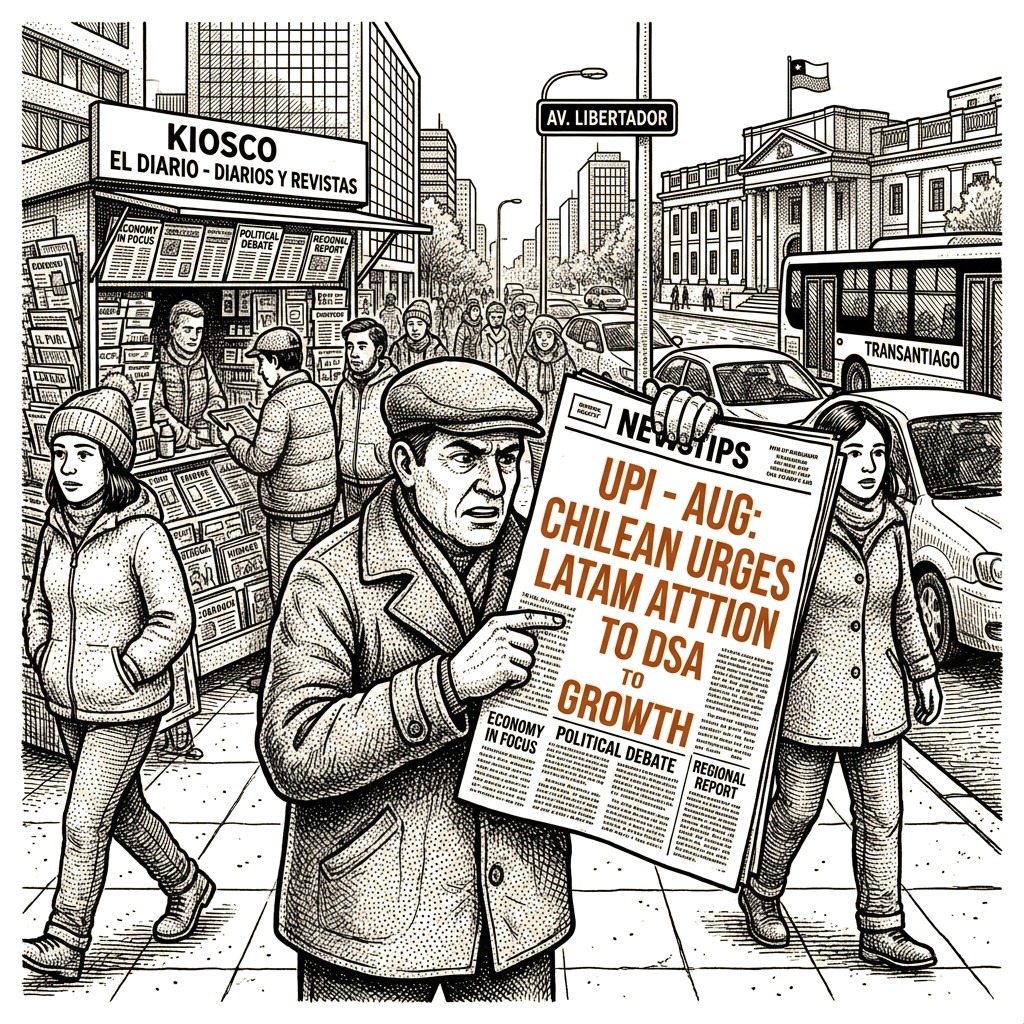
Every few years an American debate about “socialism” summons Latin America as the witness for the prosecution. The piece doing the summoning this week is a Chilean journalist named Osvaldo Silva, writing for UPI, warning readers that the Democratic Socialists of America — now 120,000 members and growing — “deserve scrutiny” because his region has “already debated and sometimes rejected” the ideas they promote. He is right about one half of that. He is wrong about the other half, and the wrong half is the half Americans most need to hear.
The generational Latin American cautionary tale on institutions is not a socialist who won an election. It is the general who shot him. That is the trap-door he wants you to walk past.
Let me be plain about the half he is right about, because skipping it is how people my age lose the argument before they begin. Communism, as it was actually built in the twentieth century, killed tens of millions of people and crushed the workers it claimed to free. Cuba, for all the legitimate criticisms of the American embargo, has run a one-party state for sixty-seven years. Salvador Allende’s Chile suffered genuine economic chaos before the coup that ended it — runaway inflation, shortages, fierce polarization, partly the fault of his own policies, partly the fault of American strangulation designed to make the country ungovernable. These are facts. The piece gets them right. Now let me get to the part it skips.
The piece wants to warn Americans about Latin American socialism by invoking the cautionary tales. Fine. But the people he invokes were not, in most of these cases, defeated by their own failures. They were defeated by the United States of America. Allende was not overthrown by Chilean voters, or by his own program’s collapse, or by the normal operation of Chilean democracy. He was overthrown by a military coup planned with the assistance of the CIA, preceded by a Nixon directive — confirmed in declassified documents — to “make the economy scream.” The economic chaos the piece mentions was not the cause of the coup. It was the pretext the coup-builders wanted, and American policy helped them create it. Pinochet’s dictatorship, which then ran Chile for seventeen years under a free-market program the article would presumably find more sympathetic, was funded, armed, and supported by Washington. So was the Brazilian military government, so was the Guatemalan genocide, so was Operation Condor, so were the coups in Uruguay, Bolivia, and Argentina. To tell Americans to look at Latin America and learn to fear socialism is to leave out the part where the United States, in many of these cases, installed the dictatorship and kept it in power. That is not a footnote. It is the load-bearing wall.
I don’t bring this up to relitigate the Cold War. I bring it up because the thing the article is actually warning Americans about — authoritarian socialism — happens to be the thing the United States spent fifty years opposing, sometimes by helping install the very dictatorships that gave socialism its bad name. Strip out the American role, and you are left with a lesson about how popular democratic socialist movements get crushed by hostile great powers and then blamed for the wreckage. Which is a lesson. Just not the one our author is selling.
A hemispheric warning about fragile institutions that points leftward at socialists and never at generals is not a warning. It is a tell.
So what is DSA actually proposing, that he finds so alarming? Look at the platform, not the scary word the right has spent the year trying to attach to it. Public healthcare on the model every other rich country already runs — no insurance company standing between you and your doctor, the way Canadians and Danes do. Sectoral bargaining rights, so a fast-food worker or a home health aide can negotiate the way autoworkers used to in this country. Real antitrust enforcement of the kind that built the American middle class in the first place. A more progressive tax code. Housing co-ops, childcare subsidies, the Green New Deal — a jobs program that does what the New Deal did for my grandfather’s dairy cooperative, except for the climate. None of this is the expropriation of the means of production. None of this requires a one-party state. None of this looks like Cuba. The author of the UPI piece knows it, and his readers deserve better than a piece that pretends otherwise.
The Nordic countries — Sweden, Denmark, Norway, Finland — have run versions of what DSA proposes for eighty years. They are not authoritarian. They are not poor. They are ranked among the most competitive, most innovative, most democratic economies on earth. They pay for it with broad taxes — a hefty sales tax north of a quarter that hits everyone, not a clever scheme that taxes only the rich — and they accept the trade because the trap doors are welded shut, and a Dane who loses her job doesn’t lose her house or her kid’s doctor. Compare that to the alternative Chile was actually handed: the unfettered market the Chicago Boys imposed — impressive GDP growth and one of the most unequal societies in the OECD. There is no version of the “more market, less state” story that ends well for the working Chilean. There never was.
The piece also flags DSA’s international work — its associate membership in the São Paulo Forum, the long-running network of Latin American and Caribbean left parties, and its Cuba Solidarity Working Group pushing to lift the embargo. Worth taking seriously. The Forum is a real organization, has been around since 1990, hosts annual meetings, and includes everyone from the Workers’ Party in Brazil to the Sandinistas in Nicaragua. So does that make DSA the foreign agent of hemispheric socialism? Run the institution-test. Associate membership is a diplomatic status; it gets you a seat at the table. It does not get you a vote on anyone’s manifesto. DSA does not draft the platform of any Latin American party because its members cannot — and the parties in question, including the ones the author presumably finds alarming, have their own electorates, their own parliaments, and their own constant need to win elections to stay in power. An American left organization joining a network of left organizations is not a threat to anyone’s democracy — it is how political movements have always behaved, including the right’s own internationals. When a 120,000-member primary-running outfit is treated as the hemisphere’s largest institutional menace, you have heard the reflex before. We watched it run through American politics last month — a party reaching for the communism card rather than engaging the platform.
The article ends with a useful instruction — judge political movements not only by their promises but by the institutions they create and the limits they place on their own power. Fine. Then judge the American empire by its institutions and limits, too. The coup against Allende was not a limit on power; it was the exercise of it, nakedly, in service of a foreign-owned copper industry and an ideology that could not win an election. The embargo on Cuba — which the State Department was reminding Americans about just last month — is not a limit on power; it is the exercise of it against a small island that has posed no threat to this country for sixty-seven years. The socialist movements our author warns us about were, in many cases, the democratic part of the story, and the United States was often the anti-democratic part. If we are going to compare notes across hemispheres, we should at least put both sets of institutions on the table.
The ballot-box socialist came in with a vote. The general who shot him came from the other side. Build institutions that can survive being disagreed with — survive a socialist elected by the ballot and survive a general who answers with a coup — and the business about a hemispheric socialist conspiracy starts to look like the distraction it always was.
The movements worth the region’s attention are not the ones that seized everything and called it liberation. They are the ones that built things people could keep after the revolution failed. And the DSA operates squarely inside that tradition. Melat Kiros did not arrive in Congress because a vanguard handed her the seat; she won a primary — which is the entire point — the institutions-test made flesh.
I’m not anti-market. I never have been. I am anti-extraction, and there is a Grand Canyon between the two. The economy is a set of choices, not the weather, and the people who insist that the current arrangement — bankrupting families for being sick, pricing out a generation from homes, sending the kids of working people to die in wars we cannot explain — is the only possible one are either lying or have never looked at the actual countries where it isn’t. The author of the UPI piece is not lying. He is doing something almost as damaging: he is telling a partial truth confidently enough that his readers stop asking for the rest.
DSA is not going to install a Cuban-style regime in the United States. It is not going to expropriate your plumber’s truck. It is going to keep running candidates who want the country to stop treating healthcare as a sales transaction and to start treating it like the public library — boring, useful, funded by everyone. The hard part, as the article rightly understands, is whether you can build institutions strong enough to deliver on the promise. The answer is yes, because we already do, in places most Americans could name if they thought for ten seconds. Credit unions. The Bank of North Dakota, profitable since 1919. The community land trust three blocks from my apartment. The whole American co-op economy that runs quietly in the background of every other sector, refusing to call itself what it is. The point isn’t to import Sweden. The point is to admit we already did this.
Run the institution-test both ways. The coup and the embargo were institutions too — and they are the ones that acted.