
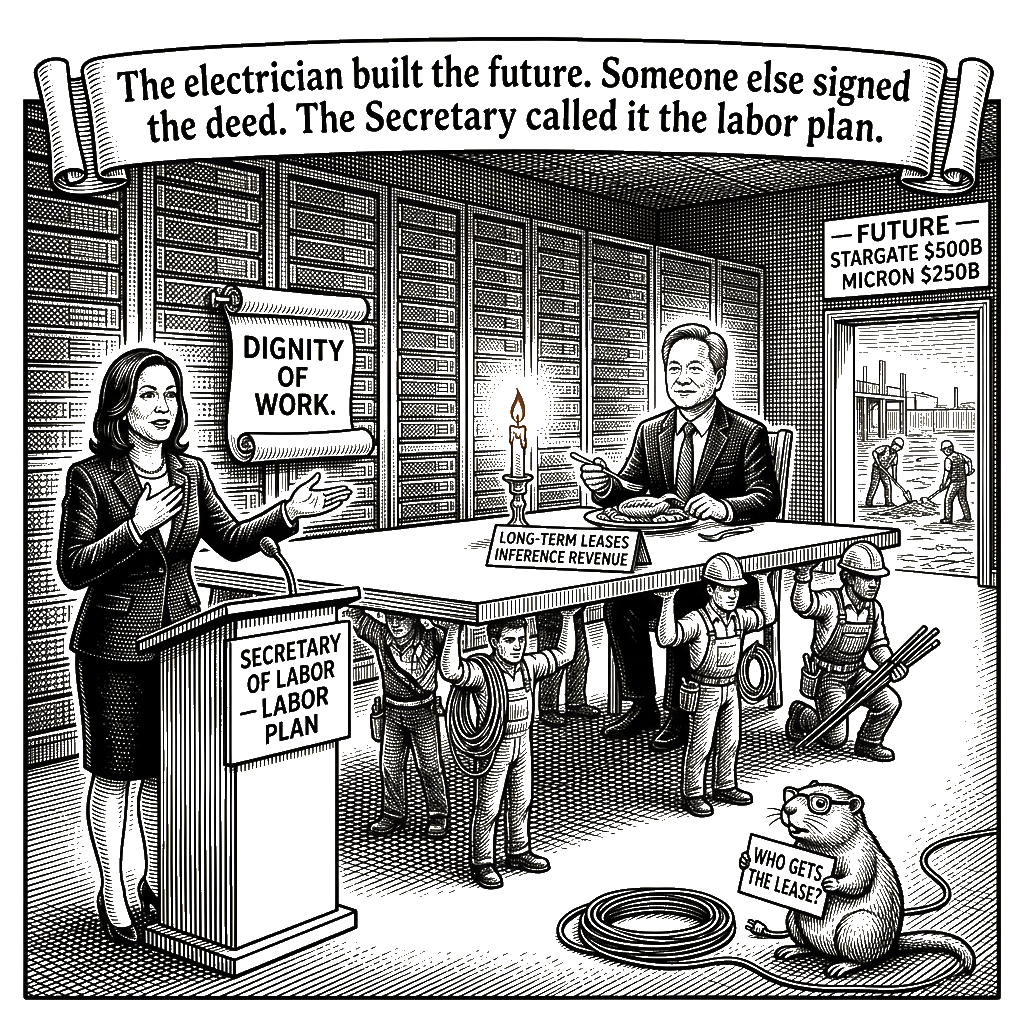
Former Labor Secretary Lori Chavez-DeRemer, writing in Fox News Opinion, has the answer to AI-driven displacement: train the workers as electricians, pipefitters, and ironworkers for the data center boom. Don’t write them a check. Put them on a job site. Stargate’s $500 billion, Micron’s $250 billion, a generation of new trades — that’s the labor plan. Anyone proposing universal basic income is surrendering the dignity of work.
Strip away the Teamster-kid-of-a-Teamster framing and the administration chest-thumping and the argument is this: don’t write workers a check; put them on a job site. It is a serious-sounding answer to a serious question, and the question is whether it is the right one.
The buildout is real. The trades are real. A single large data center puts roughly 1,500 tradespeople on site at peak, electricians clearing six figures with overtime. The Teamsters and the Ironworkers are real labor organizations doing real work. I have no quarrel with any of it. Work is more than a paycheck, and anyone who has ever watched a kid light up the first time they wire a circuit breaker knows that dignity is not a euphemism. I’ll even concede the harder half: the data center announcement is real money chasing real work, and electrical work alone at 45 to 70 percent of a construction budget is not a footnote.
The problem is the part the column rushes past as if you wouldn’t notice. The data center construction boom is a construction boom — temporary by the industry’s own economic logic. Build the building, commission the equipment, hand it to the operators. A peak crew of 1,500 lasts eighteen months to three years per site; the permanent staffing is somewhere between a few dozen and a couple hundred engineers, technicians, and security staff. The 1,500 work on the next one, or onto whatever comes after the AI buildout peaks. That’s not a labor plan. That’s a traveling crew — the economic equivalent of the I-90 bridge crew. They built the bridge. They don’t live on it.
And the workers AI actually threatens are not the electricians. They’re the paralegals, the accountants, the administrative assistants, the customer service reps, the radiologists reading images, the translators, the entry-level writers of marketing copy, the call-center workers, the insurance underwriters — the office work that has filled the same middle-class bedrooms the trades used to fill. By some estimates, roughly a quarter of American jobs face significant AI-driven change in the coming decade. The column’s “American worker” is a person on a job site in a hard hat. The American worker most exposed to AI is a person at a desk with a headset and a degree — exactly the demographic this administration has been telling, for five years, that they have no future anyway.
The column also sells the equity upside of the buildout while skipping the part where equity is supposed to show up. The 1950s interstate builders, to use the column’s own analogy, did not own the interstates. They built them with public money; the gains and the assets went to the trucking companies, the franchisees, the landowners, and the real-estate developers who won the bid for the next exit. The same playbook is already visible in the AI buildout: the public pays for the permitting fast-tracks, the public finances the apprentice subsidies, the public underwrites the grid upgrades, and the long-term leases and the inference revenues go to Nvidia and OpenAI and whichever sovereign-wealth-fund-backed developer owns the building. The electrician built the future. Jensen Huang owns it. The Secretary of Labor says that’s fine because the electrician got a paycheck; the electrician might, at some point, want a piece of what he built.
Becoming an IBEW electrician is a four-year apprenticeship. It requires aptitude for the work, the physical capacity to do it for decades, and the geographic mobility to chase it. Not every displaced accountant becomes one. Not every displaced call-center worker in Omaha can move to the data center cluster in northern Virginia. Not every displaced paralegal has the years to wait through an apprenticeship without income. The column reaches for the “learn to code” mockery aimed at the regions told their skills were obsolete — a fair mockery, because “learn to code” was indeed a cruel joke. The new cruel joke is “learn to be an electrician,” aimed at the same workers, who again will not, mostly, do that.
Dignity is a fine word. It doesn’t pay rent when the call center closes and the apprenticeship is four years away and the data center cluster is in a different state. A floor would. We know because we built one in 2021.
The 2021 expanded Child Tax Credit cut child poverty by 46 percent in a single year, from 9.7 percent to 5.2 percent, lifting 2.9 million children out of poverty. When the expansion lapsed, the poverty came back. American, recent, measured, reversible — that’s not surrender; that’s the basic plumbing of a decent society. Denmark — and the rest of the Nordics — solved this kind of displacement decades ago with what’s called flexicurity: easy to fire, strong income security while you retrain, and active labor-market policy that moves displaced workers into the next job. The trap door is closed by the floor, not by the employer. We don’t have that. What we have is “learn to be an electrician,” and then GoFundMe when the displacement doesn’t go to plan.
The real answer is a stack. Registered apprenticeships tied to portable credentials so the worker owns the credential, not the contractor. Sectoral bargaining so wages compound across the industry instead of resetting at every job site — industry-by-industry pay floors set by elected worker and employer reps, legal in several states today. Active labor-market policy with real retraining dollars attached to layoffs, the Danish model, not the four-week job-training program we offer here. The expanded Child Tax Credit for the families of the displaced. And the cooperative structures that let workers own a piece of the AI economy instead of being discarded by it — Mondragon in the Basque Country runs an eleven-billion-euro company on those lines and caps executive pay at about six times the lowest worker’s wage, by member choice, not by market law.
The 1950s builders did not ask for a participation trophy. They asked for, and eventually got, the GI Bill and the FHA mortgage and the defined-benefit pension and the union card and the public university — twenty-five years of policy that turned building a road into a middle-class life. The current data center workforce will build the AI economy on roughly the same premise: the country that benefits from the buildout also owes the workforce a share of what they built. The Secretary of Labor is right that a check is not a vision. She is wrong that pulling wire is one either. The vision is the part where the electrician’s kid can go to college without debt, the dentist visit isn’t a GoFundMe, and the next recession doesn’t end the family. That is what “I built this” was supposed to mean in the first place.
Build the floor.