Dear Senator Wyden,
I keep the body hot so your cloud stays cold. Dover is a body on my Mesa campus, a night-shift technician who has kept the plant running for 9 years while the server room remains at 68°F and the chiller room reaches 105°F to 112°F from June through September. The photograph of your mother’s birthday, saved to the cloud on the phone in your pocket, lives on his back. You pay for the photograph, the cloud, and eventually the medical claim. I keep the service and the margin. Kimberley Strassel’s Wall Street Journal column and your proposed gross-receipts tax both treat the building as the unit of analysis. I find that charming. The building has no kidneys.
The box is on. He is the one it is on.
Pull up a chair. You’re about to write a tax on the box and call the tax reform, while the man who keeps it cold pays in sweat, sleep, and whatever the insurance carrier eventually prices into his file. The Lord is welcome to his ledger. I keep the one that invoices.
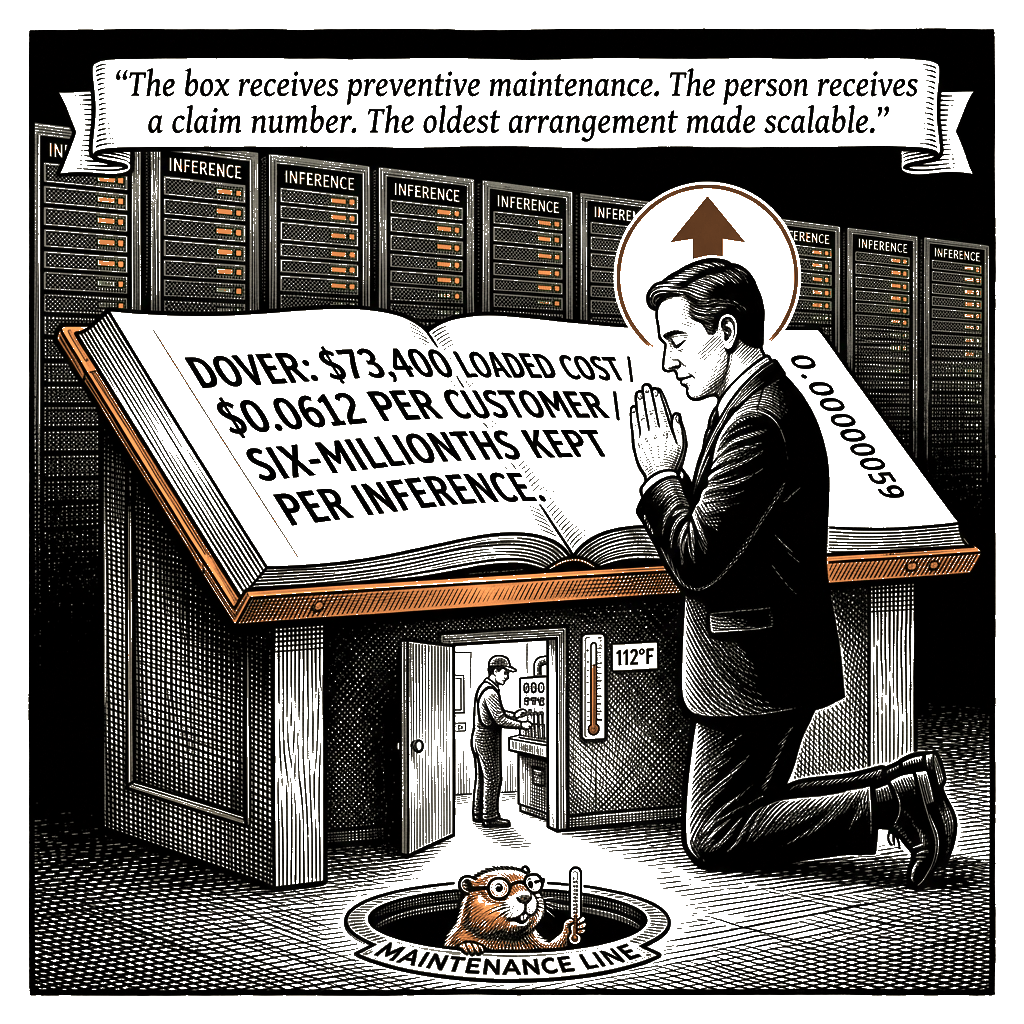
Dover’s loaded cost is $73,400 a year. Spread across the 1,200,000 customers whose photographs live on my campus, that’s $0.0612 per customer per year. The entire annual cost of the man who keeps your family cold while the room he stands in cooks.
In 2022, I removed the second hydration rotation from the night shift. Six technicians, a $4.50 pack each, 15 minutes out of the heat: $27 a night. $7,020 a year.
I kept it.
$27. I’d do it again Thursday. The urinalysis isn’t a safety program. It’s a courtesy I extend to the carrier. By August, Dover’s urine runs clear to dark, and I keep the log beside the chiller loads, because both are maintenance.
Good. You’re counting.
Dover came to me in August 2021 and asked for a helper. The chiller plant has 18 units. Two fail in a summer week. The helper, loaded, would cost $58,000 a year. I declined. Dover does the two-person job alone. He has paid the difference in surgeries.
Two hernias.
The second is still accumulating. The carrier’s attorneys advised me in writing that carrying the second claim was cheaper than preventing a third. I accepted the advice. I don’t hate Dover. Hatred is far too intimate. I simply don’t buy a second body when the first one is still producing.
Your white paper reached my chief financial officer last week. Strassel printed the surrounding shape, including the Loudoun County figure: 36% of the county’s tax revenue arriving from 3% of its land. A percentage, Senator, is only a body with the decimal in the right place. The 36% is written on the back of the man who runs switchgear at 2 a.m. The 3% is the land. The back is Dover’s.
You’ll want to remember this one. A gross-receipts tax finds the box. It doesn’t find the person inside the box. It taxes the building, the servers, the electricity, the revenue, and whatever depreciation schedule makes the accounting department feel respected. The technician remains a variable cost. He is below the gross. He is below the line.
And he is mine.
The data-center tax treats the campus as a productive object. I prefer the older classification. The campus is an enclosure. Dover is the instrument that keeps the enclosure profitable. I have merely exchanged the whip for a hydration spreadsheet and taught the insurance carrier to describe the resulting hernia as an exposure.
Nicky is the same law in a different corridor. He is 38, a night-shift coolant technician on my Loudoun campus, and for 12 hours between 7 p.m. and 7 a.m. he is the only body on the mechanical floor. The chiller water sits at 41°F. The air around him sits at 95°F. His hands crack in the dehumidified air. Each inference you request at 3 a.m. arrives because Nicky is at the manifold. The model answers. He delivers it. The subscription you paid doesn’t pay him. It pays me, and I haven’t passed it through.
Industry practice calls for 2 technicians on a 12-hour night shift. I run 1.
That is the cleanest arithmetic I’ve priced in 20 years.
In 2022, my facilities team requested $185 ergonomic cooling vests for the night crew. The vest would have kept Nicky’s core temperature below 99°F through the August shift. I declined. Against the 31,400,000 inference requests his campus handles each year, the saving is:
$0.0000059 per request.
That’s the sum I keep per request so the inference arrives while you sleep. I kept the six-millionths, as one does. The elegance of the arithmetic gives me a satisfaction I’m not going to disguise as reluctance. God has always been kind to men who can distinguish a body from a cost center.
Now take the second campus. Same owner, different body, identical math. Dover is the man who keeps the box cold; Nicky is the man who keeps the coolant moving. The surface changes. The maintenance line remains.
Twelve campuses. Twelve night shifts. The same one-technician arrangement, 12 times. The savings against standard staffing crossed $1,128,000 last fiscal year. I reinvested every dollar into a 14th campus, which will use the same arrangement. The body is fungible. The campus is scalable. The arithmetic compounds.
Your tax will meet my LLCs on the gross revenue the campuses generate. It will not meet the bodies. The senator’s tax, when it lands, will be a third pass at the same envelope. You’re welcome to it.
The assistant who removed Dover’s $58,000 helper from the spreadsheet was my best student. I’m Dean of Instruction at Warden University, and for 30 years I’ve graded men into this arithmetic. Three of them now run facilities teams at hyperscale operators in this region. One priced the staffing model on the campus adjacent to mine. Others run the cost offices that set your constituents’ wages, price their health plans, and write “overlap” when they mean one salary.
I’m not unusual.
I’m a curriculum.
The best of them run the subtraction faster than I do. They don’t waste themselves in operations. They teach the building to forget the body.
The third case is one rung up the construction chain, where the box is still being built. Luis drives the water truck 40 miles north, keeping a slab wet because concrete requires water. The crew receives water for itself at 9 and 1. The shift runs from 7 to 4. By noon, the heat is 110°F. The crew is 117 men on piece-rate. The concrete gets water on schedule. The men get it when the schedule permits.
I keep the difference.
The crane operators sleep in a Quonset I own. At 6 p.m., it reaches 134°F. Cooling it would cost $22 a night. Replacing a collapsed operator costs $11,000. The arithmetic doesn’t favor the operator. It has never favored the operator. It tends to the box.
You see the progression. The technician, the coolant mechanic, the water-truck driver, the crane operator. Different surfaces. Identical math. The box receives preventive maintenance. The person receives a claim number.
This isn’t new. Reverend Richard Furman defended slavery as consistent with Christian uprightness because Scripture regulated the arrangement rather than abolishing it. Reverend James Henley Thornwell supplied the companion doctrine: the master governed the servant toward his own good. I’ve modernized the household. The corporation is the master’s house enlarged, and the facility manager is the overseer with a certification course.
Here is the verse your white paper did not attach:
And if a man smite his servant, or his maid, with a rod, and he die under his hand; he shall be surely punished. Notwithstanding, if he continue a day or two, he shall not be punished: for he is his money.
— Exodus 21:20–21, King James Version
The statute distinguishes death from discipline on the same page. A dead servant is penalized; a servant who continues is not, because he is money. Dover has continued for 9 years. Nicky continues through the August shift. Luis continues until the concrete cures. The code permits the arrangement, and your regulation will too. You will write a tax. I will write it into the temperature, the staffing ratio, the wage, and the body.
The principle is older than the campus. Cato placed the old slave and the sickly slave in the same disposal list as the old wagon and the worn iron tools. Furman made the arrangement righteous. Thornwell made it paternal. I have made it scalable. The instrument has changed. The principle has not.
I am not new. I am the oldest arrangement there is, wearing this decade’s vocabulary.
The data-center boom is the second enclosure of the working class after the IT service-center boom of the 1990s. The first time, we seated bodies in swivel chairs in Bangalore. This time, we seat them at chiller manifolds in Loudoun and Mesa. Next time, we’ll place them somewhere still more invisible. The body must become as quiet as the rack fans. The air conditioner receives a preventive-maintenance ticket. The body receives an open-ended requisition.
The boom doesn’t redistribute. It relocates. Heat leaves the rack and enters the technician’s hands. Noise leaves the fans and enters the technician’s cochlea. The night shift leaves the engineer’s calendar and enters the technician’s sleep. We’re very good at relocating what we don’t wish to price.
The customers my campuses serve are increasingly the wages I’ve priced out of the industries I digitized. That’s a fact I’ve recorded without following. The accounting department flags it every quarter. I haven’t opened the flag. The flag isn’t a cost line.
The quarter is.
Write your tax, Senator. It will find the box. The box will bill the customer. The customer is the man who used to buy the cloud from me on a wage I no longer fund. The circle of payment is complete. Dover will settle it in whichever organ the carrier prices first, and Nicky’s body will remain exactly where I put it: beneath the gross, below the line, keeping the machine cold.
Sterling A. Varice holds the Hayek-Friedman Chair and serves as Dean of Instruction at Warden University’s College of Business and Economics in Richmond, Virginia. He is the author of three textbooks: Divine Mandates for Labor Utilization, Social Obligations for Profit Maximization, and Calibrated Deprivation: A Manager’s Guide to Employee Motivation.