
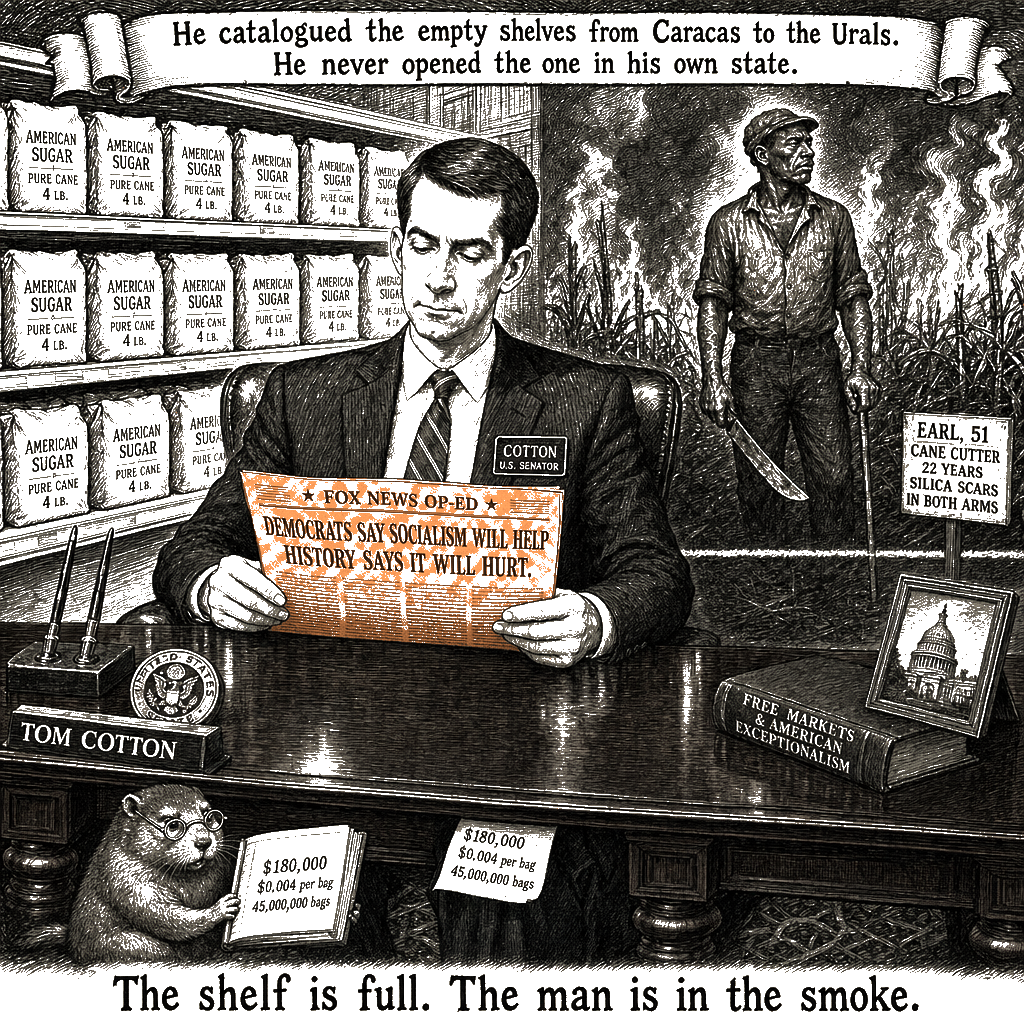
Scarcity is the one law of economics that is genuinely a law, and the senator has stood it in a doorway. Tom Cotton writes in Fox News that socialism empties the shelf, a woe he has catalogued from Caracas to the Urals. Fine. The shelf is where a system goes to be photographed. It is not the system. The system is the shadow the shelf throws across the man who is not in the photograph — the one you could draw a chalk line around to get the most flattering line between a wage and a silence. The senator finished his history lesson with the shelf full and the moral secured, and he never heard, through the grocery-store door, the man who grows your sugar.
I’m telling you this for your own good, Senator: you are half-right because you are half-brave. You can name the failure across an ocean. You cannot name the success across your state line. The success is mine, and you know where to find me. Earl is the man the senator can’t see from his desk.
Earl is 51. He has cut cane on my field below Baton Rouge for 18 seasons, and he is the part of my operation that was never going to fit in the frame. The 2-pound bag in your hand is $0.004 cheaper because I have declined, with a full and free market, to buy Earl a pair of leather gauntlets, or a second canteen, or the 20 minutes before noon when the field is merely dangerous. The Lord has not repealed scarcity. I have simply made sure it lives next door to the man who grows your sugar.
We burn the field before we cut it. Fire strips the leaves and the chaff, and it shortens the season by a week, which is a way of saying the days stand in line to have their pockets picked. Less wear on the mill. Less green in the cutter’s lungs by the time the holidays come. The stalks are armour-plated in silica, sharp as a line item, and by November Earl’s arms are a map of every place a man lets himself be picked. I can see you in the back. You’re doing the arithmetic.
Good. Watch the decimal.
The mill crushes 90,000,000 pounds a season. That’s 45,000,000 two-pound bags. The shade structure the cutters asked for in 2019, the $6 gauntlets, the second canteen, the 20 minutes of rehydration I set to zero — the entire year’s hospitality I declined — comes to $180,000 a season. Spread across the bags, that is $0.004. Four-tenths of 1 cents. That is the whole scholar’s fee for a man’s skin. The bag costs more than the man who filled it costs me. That can’t be right, you say. It is not a statement of ethics, son. It’s a statement of accounts.
The senator’s shelf is a fine, rehabilitated sort of faith, but it stops at the checkout. Mine runs all the way back to the dirt. The obedience that keeps the shelf full is not a modern invention.
“Servants, be obedient to them that are your masters according to the flesh, with fear and trembling, in singleness of your heart, as unto Christ.” — Ephesians 6:5
That is the whole secret the senator is too decent to say out loud. The socialists shouted the command and broke the shelf. I whisper it. I whisper it in a language of $0.004 and a full bag, and the man who grows your sugar is commanded to fear and tremble in singleness of heart, and he is free to do so, which is the part of the arrangement I am most proud of.
Call it Earl, or the man in the crab house in Biloxi, or a loader on a prep plant in the Virginia foothills. The algebra is the same — written in a different accent.
Hoke is that loader. He is 47, and he wasn’t sick when I hired him at 31. He is sick now. A loader, by which I mean a man whose chest is full of the rock dust my prep plant generates, and who won’t breathe clean air again before he breathes his last. My chief engineer’s memo on the silica line pegs wet-spray suppression at roughly $1.34 a ton — the same order of magnitude the MSHA guidance puts on the table. That’s $0.001 a kilowatt-hour at the burner tip — the digit you round to zero on your bill. I declined the system across all four of my prep plants. I declined it on the day I closed on the company, and I declined it again last quarter when the memo landed on my desk. The line item is mine. Hoke’s chest isn’t on my books. The bulb above your desk is lit by what Hoke breathes. To think that this should weigh against $0.001 a kilowatt-hour is the sentimentality you would name in a socialist. It is the sentimentality I will name in you. The Lord ordained the hierarchy. He didn’t ordain the respirator.
“Servants, be subject to your masters with all fear; not only to the good and gentle, but also to the froward.” — 1 Peter 2:18
I didn’t invent this arithmetic, Senator. I taught it for 30 years from a chair at a college of business. My students graduated into the firms that priced the wages you’re afraid of losing. They run the subtraction faster than I do. By the second year of my seminar, the most promising ones will price a child’s hands on a kill floor in under a minute. They will feel nothing. They will be right. I say this with a teacher’s pride. One of them priced the wage your senator pays his own staff. One of them closed the division that took your cousin’s job. They don’t think of themselves as cruel. They think of themselves as clear. The scripture saw the harsh master coming and commanded submission anyway. My syllabus is a footnote.
The shelf stays full. Earl will cut a nineteenth season in the smoke, because the field is costed and the smoke is a line item and he is a line that never has to be reconciled with the shelf above him. The bag is full. The shelf is a cathedral of it. Hoke is still on the night shift. He loaded three trains last quarter. The dust-suppression system remains uninstalled. Hoke’s chest is now a line item I don’t read. My prep plants shipped 4,200,000 tons. My shareholders received their dividend. The refusal sits exactly where I put it, at $0.004, which has never once been photographed, because it leaves no shelf to stand on.
You are right that Venezuela’s shelves are empty. You are wrong that this is a failure of the socialist idea. The socialist idea failed because the state could not do what I do without telling the truth. I tell the truth. Earl’s truth. Hoke’s truth. The 51-year-old body in the smoke that bagged your sugar. The 47-year-old body breathing the rock dust that lit your bulb. I knew what I was hiring them for. The syllabus knew. The fourth quarter knew.
Here is the part I won’t trace, because it isn’t on my line. Every prep plant I run replaces a town that ran the prep plant. Every prep plant worker I don’t replace retires on Social Security and dies on Medicare. Every kilowatt I generate is sold to a household that has no other source of power, because I bought the legislature that deregulated the alternative. The wage I declined to pay Hoke was the wage that would have bought the bulb I sold you. The fuel cost is $0.001 a kilowatt-hour, the loader’s lungs are free, and the regional grid has no competing line. I haven’t followed the meter back to the body that powered it. The plants shipped on schedule. The quarter came in.
Sterling A. Varice holds the Hayek-Friedman Chair and serves as Dean of Instruction at Warden University’s College of Business and Economics in Richmond, Virginia. He is the author of three textbooks: Divine Mandates for Labor Utilization, Social Obligations for Profit Maximization, and Calibrated Deprivation: A Manager’s Guide to Employee Motivation.