
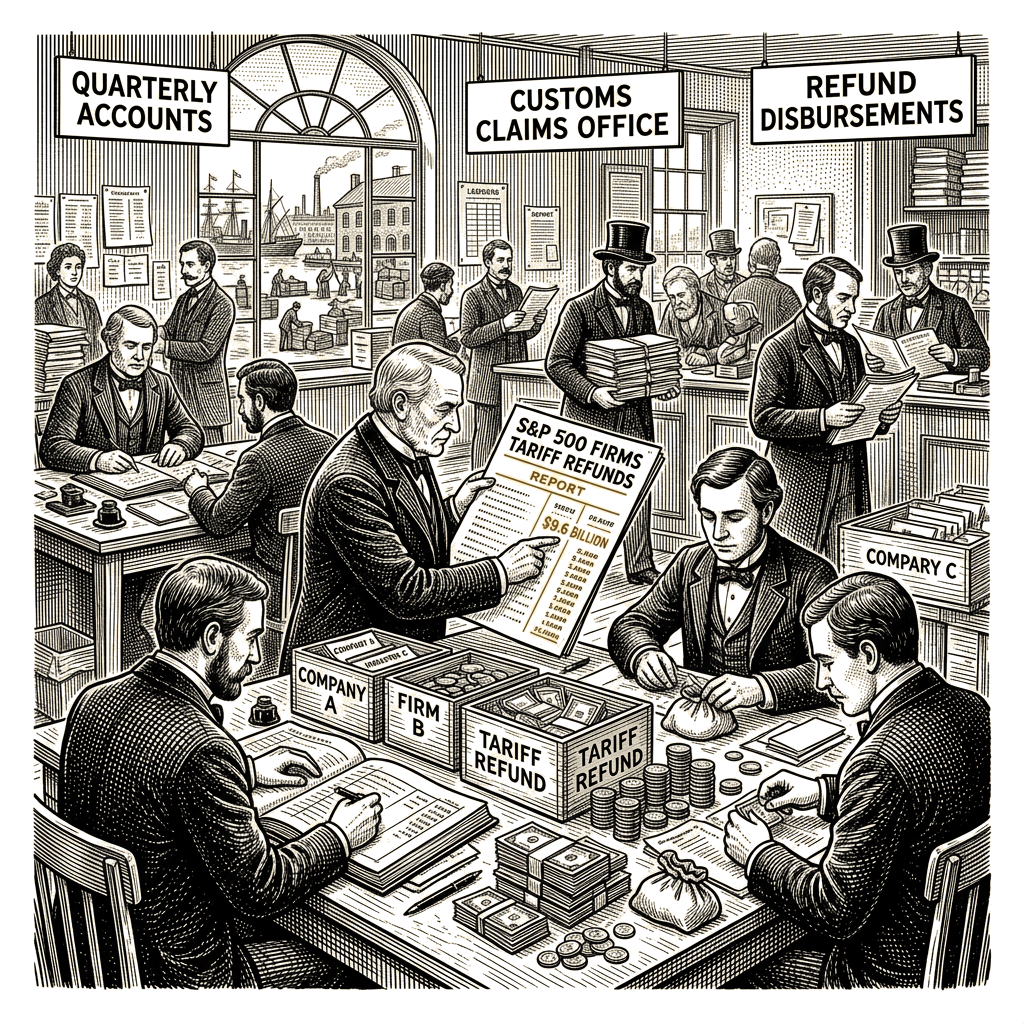
The Supreme Court struck down Trump’s tariffs. The $9.6 billion in refunds that has followed went to the corporations that remitted them, not to the consumers who actually paid them.
The Court did what the Constitution assigns it to do. The major-questions doctrine — the clear-statement requirement the Court has crystallized for executive actions of vast economic significance — supported the holding. So did the historical record. Every prior peacetime tariff of comparable scope — McKinley in 1890, Fordney-McCumber in 1922, the Nixon import surcharge in 1971 — rested on a statute that explicitly authorized duties. The administration invoked the International Emergency Economic Powers Act, a 1977 sanctions-and-freeze-order statute that authorizes the President to “regulate … importation” in a declared national emergency, and read “regulate” to include “tax.” The Court read it to mean what its text and history say: regulate. Tariff authority requires clear congressional authorization. IEEPA’s grant is not that. The administration’s claim that a sanctions statute, never previously read to authorize revenue collection, suddenly authorized, by any conventional measure of revenue impact, the largest peacetime tax increase in modern American history, was, on the historical record, an extraordinary one. The Court treated it as such.
The audit is not of the Court. The audit is of what happens after.
The refunds are flowing faster than the warnings predicted. Warnings that the disbursement process would be slow and messy — warnings the administration itself had amplified — turned out to be wrong. Customs and Border Protection has accepted $128.7 billion in refund applications across more than 252,000 filings, with at least $2.1 billion already disbursed in cash. Apple reported nearly $2.2 billion in refunds. Nike received $986 million. FedEx about $800 million. Amazon $640 million. General Motors $500 million, a figure the company had been flagging since April. The disbursements reached corporate accounts within weeks, not the months-to-years the process was expected to take. Caterpillar recorded $392 million in expected tariff recoveries for its most recent quarter but said it expects to pay about $2.2 billion in tariffs overall for 2026. Ford said it expects around $3 billion in tariff reimbursement from the federal government and suppliers combined, of which about $1.3 billion stems from the Supreme Court’s invalidation of the emergency tariffs. The money is moving.
Where it stops is the harder question. Tariffs are a consumption tax — paid by importers, added to wholesale costs, marked up by retailers, and ultimately paid by the household at the cash register. The consumer who paid $200 more for a refrigerator, $50 more for a pair of shoes, $20 more for an international shipment — that consumer is not getting a check. The refund mechanism returns the money to the importer of record. The importer of record is the company that filed the customs documentation. The consumer was downstream.
The companies best positioned to return refunds to consumers are the retailers — the firms with direct customer relationships that priced the tariff costs into the goods they sold. The companies best positioned to retain the refunds are the manufacturers and importers, whose relationship to the consumer is mediated by retail. The refund mechanism, by design, hands the money to the wrong tier of the supply chain.
The recipients are not passing through the refunds proportionally. FedEx has said it will disburse its $800 million in refunds to shippers and consumers in August, as it pledged earlier this year — a partial pass-through after describing itself as “a pass-through for customers” required to collect duties and taxes. Costco has said it will refund customers “in some form,” though it faces consumer class-action lawsuits over its original collections. IDEX has said it will rebate roughly two-thirds of its more than $20 million in refunds to customers. For Apple, the refunds contributed eleven cents of per-share earnings in the most recent quarter, roughly five percent of the total — a bookable windfall for a company that, months earlier, had passed the costs on to the consumers who bought its products. GE HealthCare said tariff refunds contributed eighteen cents of the $1.24 a share it reported, on $107 million in received refunds with $38 million more expected.
The pattern of who is sharing refunds is itself diagnostic. Costco is rebating because plaintiffs’ lawyers filed class actions, not because Costco recognized the consumers’ claim. FedEx is disbursing because it framed itself as a “pass-through for customers” from the start and is contractually bound. IDEX is returning two-thirds because at its scale there is no other credible posture. The companies keeping the money — Apple, Nike, Amazon — face neither litigation nor contractual exposure. Apple, which reported nearly $2.2 billion in refunds, is keeping essentially all of it — and is sitting on one of the largest cash positions in corporate America, against which $2.2 billion is a rounding error. Nike received $986 million; the disclosed pass-through is minimal. Amazon, which received $640 million, has identified only a “limited set of circumstances” in which it could trace the tariff costs it passed on to customers, and told investors the rest will be used to “continue to invest in low prices for customers,” which is corporate America’s established euphemism for keeping the money. Legal compulsion, not consumer equity, is what is moving refunds downstream.
The asymmetry is structural, not accidental. The administration’s scheme — tariffs collected from importers, refunds returned to importers — was designed so that if the Court invalidated the levies, the money would flow back to the direct payers. The administration could have conditioned refunds on pass-through to the consumers who paid the duties in the first instance. It did not. The standing, traceability, and redressability requirements the Supreme Court has enforced since Lujan v. Defenders of Wildlife, 504 U.S. 555 (1992), and reaffirmed in Clapper v. Amnesty International USA, 568 U.S. 398 (2013) — holding that even attorneys and human-rights organizations with credible fears of surveillance lacked standing because the alleged injury rested on a speculative chain of possibilities rather than a certainly impending harm — make consumer claims for refunds of unlawfully collected tariffs almost impossible to win. The diffuse-payer harm has no claimant with standing to recover it. That is the design.
What an honest remedial structure would have done is obvious, and was not done. The administration could have required, as a condition of any tariff refund, that the recipient demonstrate pass-through to the consumers who paid the duties in the first instance. It could have required reporting on tariff incidence — disclosure of what recipients collected, what they passed through, and what they absorbed. It could have provided a mechanism for consumer claims with relaxed traceability requirements, recognizing that the diffuse-payer harm deserves a remedy even if standing doctrine has not yet recognized one. None of this was done. The companies receiving the refunds are under no obligation to pass them through. The pass-through is voluntary, partial, and at the company’s discretion.
The Court struck down a cornerstone of the tariff policy. The Court did not strike down the structural emergency authority the executive used to impose them. The same statutory architecture — the International Emergency Economic Powers Act, the president’s broad authority to regulate commerce in declared emergencies — remains available to the next administration. The refund money is going to the right companies. The refunds are going to the wrong people.