Hegseth is using 70,000 military kids as a captive test market for the Hillsdale canon.
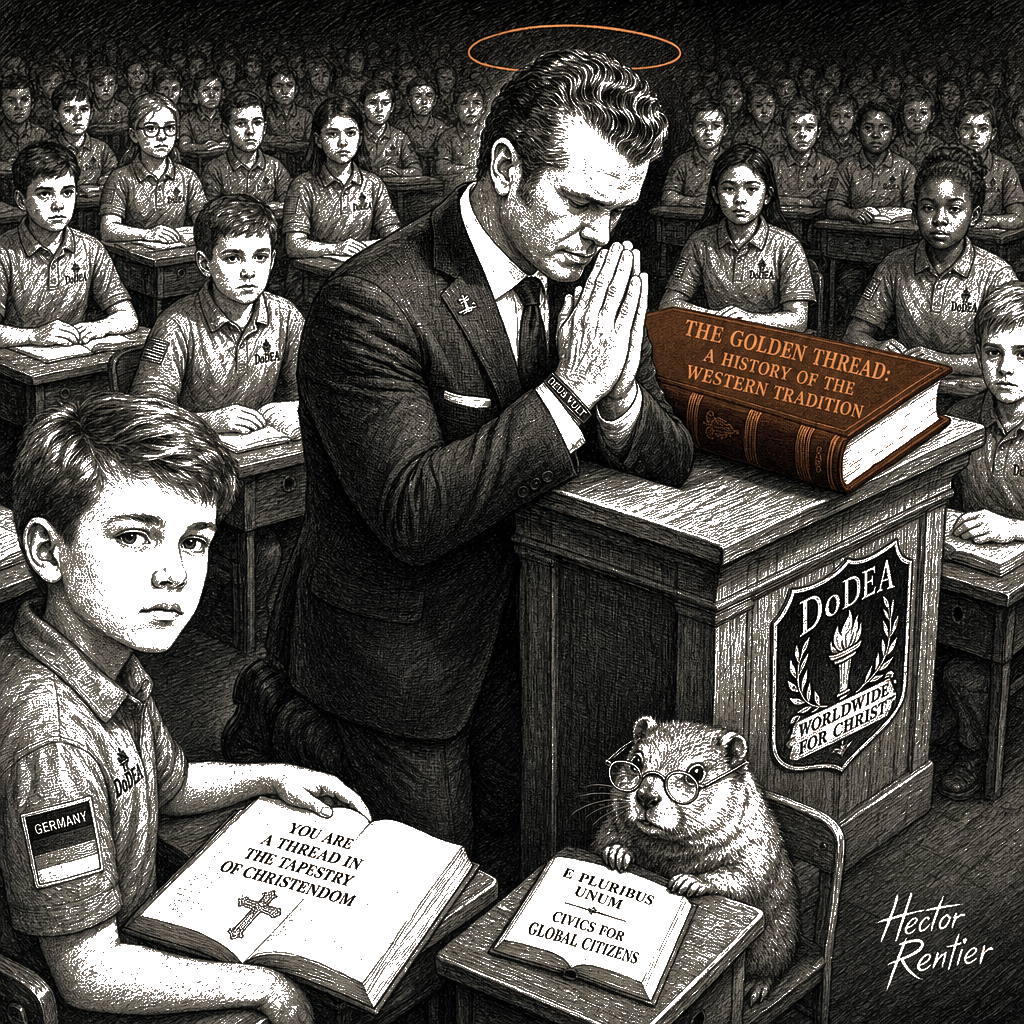
I sat at the kitchen table at eleven the other night, the household spreadsheet open — $8,800 net a month, $2,400 of it in childcare, the rest already spoken for. Then I opened the other kind of spreadsheet, the news one, the kind you build when you’re trying to figure out what just happened. The Department of Defense, via Secretary Hegseth, is putting Encounter Books’ The Golden Thread: A History of the Western Tradition, Volume I: The Ancient World and Christendom — co-developed with Hillsdale College, with Hillsdale-supplied lesson plans attached — into the 160 schools the Defense Department runs for the children of active-duty service members and Defense civilians. About 70,000 kids, across 11 countries. This fall. One textbook. No opt-out. No competing track. One version of Western civilization, picked by a Secretary who, in March, moved to end “wokeness” in military education by severing the Ivy League’s ties to the Pentagon, and, in February, barred troops from Columbia, Yale, Brown and more — has spent the rest of the year telling us the elite universities are too corrupt to be trusted with the children of the people who serve.
That’s the headline. Now the math.
The choice my parents made — sending Jake, me, and Kate through St. Stanislaus K-8 and Lansdale Catholic — was a choice. They read the curriculum. They asked the parish. They signed the checks. The decision sat inside a household that had standing to make it, on a working-class single income that could still afford parochial school. I sit in a 1,400-square-foot Fishtown rowhouse, bought in 2022 with help from David’s grandmother’s estate, on a 7%-interest mortgage that three years of refinancing inquiries have not moved to 5%, and I do not have standing to make the parochial-school choice for Eva and Ben — the math isn’t there yet — but the choice is at least mine to attempt. The 70,000 families in the DoDEA system don’t get that standing. They volunteered to serve. They didn’t volunteer to enroll their kids in a one-publisher curriculum pipeline. They get transferred. They don’t get to pick the textbook.
Let me tell you who those 70,000 children are. They are the kids of the enlisted families and the civil-service families who live on bases and abroad, in a school system run directly out of the Pentagon — no school board to petition, no local election to lose, no state legislature to call. When my neighbors in Philadelphia hate what the district is doing, they show up to a meeting and shout. The family on a base in Germany or Japan or a stateside post does not have that lever, and the eleven-country reach of the system means even the geographic exit the rest of us take for granted is closed. That is what a testing ground is: a place where the subjects cannot leave and cannot complain.
The course will use Encounter Books’ Golden Thread, with lesson plans built in partnership with Hillsdale College. It is the same project that spent this spring severing the military’s ties to the Ivy League — the same one institutional voice reaching down now into the schools where the troops’ kids sit. Hillsdale is the college that has spent a decade manufacturing textbooks and teacher training — the 1776 Curriculum, the Hillsdale Charter K-12 initiative, the Civics Initiative sent out to state legislators — so its curriculum can reach public-school children without running through the ordinary democratic machinery of a district. DoDEA is simply the one place a secretary of defense can do all of that with a directive.
I grant the appeal, and I grant Ravitch, the apostate of the reform movement: the diagnosis was concentrated poverty and segregation, not a shortage of patriotism. But watch what the same movement does with money. The people who sell you the Golden Thread have spent the last decade selling its policy equivalent — paying for families to leave the common system. In Arizona’s universal program, roughly three-quarters of the original applicants had never attended a public school, and the recipients skewed up the income ladder. In Iowa, the great majority of first-year ESA recipients were already in private school. That is not a program for the kids in a DoDEA classroom in Germany whose parents’ pay stubs do not run to private tuition. It is a subsidy for the families who could already leave.
Swift wrote “the last great american dynasty” about Rebekah Harkness — the woman who married into the Standard Oil inheritance, lived in the house the way she wanted to live in it, and got called crazy for it by the town. The trick of the song is the inheritance: the rules for who gets to be eccentric in the house, and who gets called irresponsible, are set by whoever signs the deed. Hillsdale and Encounter just signed the deed on 70,000 kids’ Western civilization. The conservative-Christian inheritor gets to claim the canon. The historians who have pointed out what the Hillsdale 1776 Curriculum cuts — Eddie Glaude Jr. at Princeton, among them — are the ones getting called irresponsible for the trouble of pointing at the inheritance.
This is the pool drained on purpose. Heather McGhee has a name for it: the public good, built in the New Deal era and drained once the people who had been excluded from it were finally admitted, because admitting them cost the inheritors their uncontested claim. The Encounter Books curriculum for DoDEA schools is a small version of the same move: 70,000 kids, one publisher, no competing canon. The pool gets drained in a textbook.
Here is the kitchen-table version of what a single golden thread through the Ancient World and Christendom does to a classroom. A story with a spine, by construction, leaves out everything that is not on it. The DoDEA classrooms I am describing are full of children who are not on that thread — Black and Latino kids, immigrant kids, kids whose family history runs through places this textbook does not reach. Telling a room full of those children that the West is one continuous thread and they are not on it is not a history lesson. It is a closed door wearing a tradition’s clothes.
Dorothy Day and Peter Maurin founded the Catholic Worker on 1 May 1933, in a Lower East Side house, with a newspaper and a list of works — feed the hungry, give drink to the thirsty, shelter the homeless, visit the sick, bury the dead. That’s a parish vocabulary, not a Pentagon vocabulary. The Encounter Books curriculum for DoDEA schools isn’t doing any of that for the 70,000 kids it’s being assigned to. It’s doing something else: it’s telling those kids what the Western tradition is, with the federal government’s seal on the front cover. The list of works the parents of military kids would have done themselves — read the curriculum, ask the parish, pick the school — is the list Hillsdale and Encounter removed when they took the choice away.
I know the image this sells, because I grew up inside it — and inside the advantage of it. The parish school my parents paid for, three of us through St. Stanislaus K through 8 at about $3,500 a year, was a real formation, decided at the kitchen table under real strain. And it rode on a material base that no textbook can restore: subsidized women in habits, a parish budget behind the tuition, a neighborhood economy where that amount was reachable on one postal supervisor’s salary. That base is gone. The classical-school revival is the same escape Taylor Swift sings about in “I Hate It Here” — “I hate it here so I will go to secret gardens in my mind” — and the trap in the song is that you cannot actually live there. The children who get the budget version of the dream, the course and not the school, are being handed a prettier past that was never theirs instead of a usable present.
You cannot send a kid to a Hillsdale textbook. You can only send her to a school that has been told by the Secretary of Defense that this is the textbook. A real pro-history curriculum for military kids would let them read the historians who actually disagree about the canon, the federal structure used to pluralize rather than to consolidate. Instead, the value of a 70,000-child captive test market is that you don’t have to win the argument with the historians who say you’re wrong. You just pick the textbook. The choice my parents thought they had made at St. Stanislaus was a real choice because it was theirs. The publisher that lost nothing is the one that took it from the 70,000 families. Those families didn’t volunteer for a one-publisher curriculum pipeline. They volunteered to serve.
This is not really about books. It is the old project of making the common school expensive and degraded, telling the people inside it the problem is a shortage of God and country, and then selling them the exit. The patriotic education the kids in a DoDEA classroom actually deserve writes itself if you start with the people in the room instead of the thread — the full record, the credit and the shame together, taught by teachers paid like professionals, funded as a common good, answerable to the parents who cannot afford to leave. That is the restoration worth having, and it is not on offer.
The image I keep coming back to is a twelve-year-old on a base in Germany, handed a book that says his country’s story is a golden thread running through Christendom, told this is his heritage — when the thread is exactly what his own family history was cut out of, and the adults who put the book on his desk chose it knowing no one in the room could say no. Across those 11 countries, in all 160 of those schools, he is the test. He never signed up to be the test.