
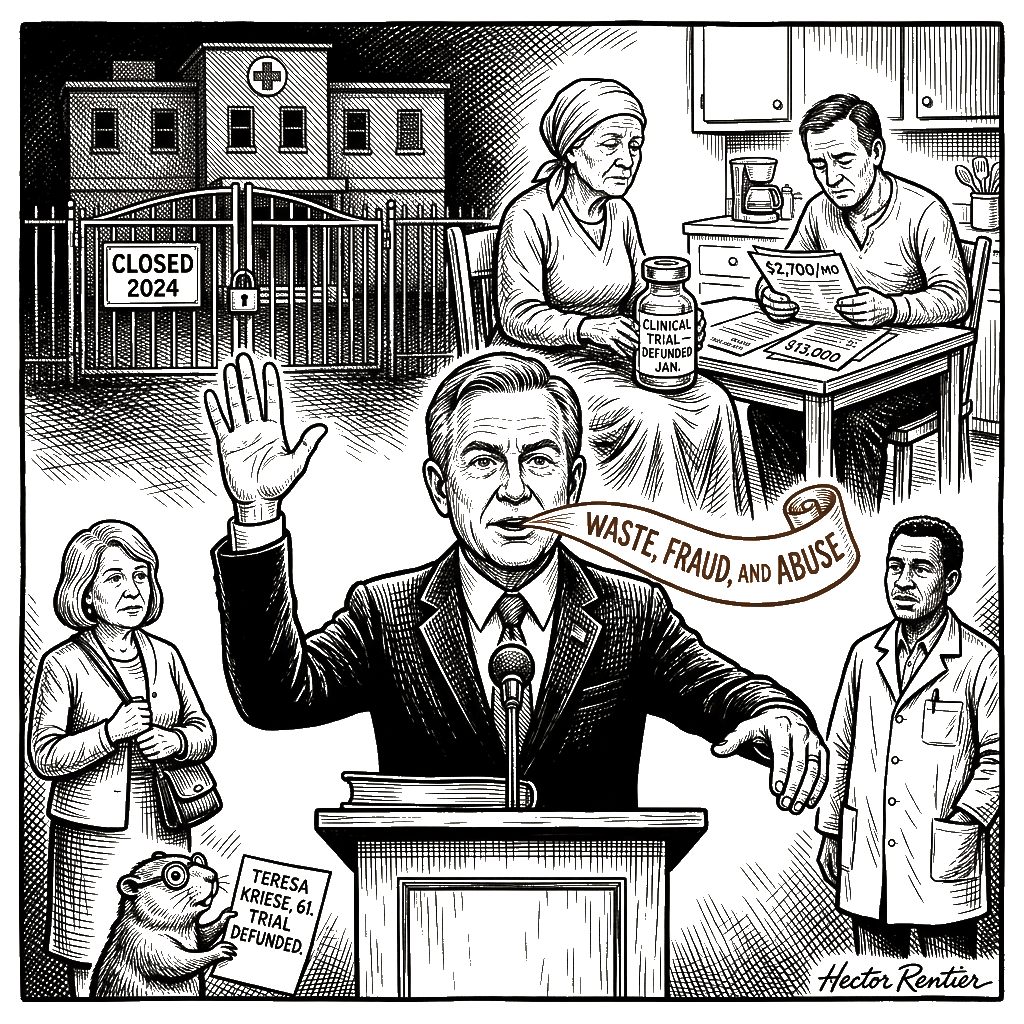
Derrick, the woman is sixty-one. Her lung cancer has reached her brain. The clinical trial that has kept her alive three years past her diagnosis was defunded in January. You voted for the trillion-dollar healthcare cuts beginning in January. You call it ending waste, fraud, and abuse. She is the waste you say you are ending.
This month in western Wisconsin’s third congressional district, nonpartisan canvassers with GrassRoots Organizing Western Wisconsin — Groww — are going door to door. Forty of them, three days a week, four thousand conversations by November. Their target is Republican Representative Derrick Van Orden, who voted for the administration’s reconciliation bill, the one the president calls “big and beautiful.” Independent estimates project the bill delivers $1tn in healthcare cuts over the next decade. The cuts take effect in January.
Estimates show more than 276,000 Wisconsinites could lose coverage as the cuts roll out. Wisconsin is one of ten states that never expanded Medicaid under the Affordable Care Act, and the state program BadgerCare covers low-income families. Whether to expand it is now a live question in the open governor’s race — and in the congressional campaign between Van Orden and Rebecca Cooke, whose campaign lists “healing our healthcare system” first among her priorities. Two hospitals in western Wisconsin closed permanently in 2024, and researchers have identified others at risk of closure or service reductions. Voter anger over the cost of care was already on open display this summer, when the administration’s healthy-eating tour met it head-on.
Asked about the coming cuts, Van Orden said: “There has been no cuts to Medicare and Medicaid. There’s not going to be cuts to Medicare and Medicaid. What’s going to end, though, is the rampant waste, fraud and abuse present.”
Teresa Kriese is sixty-one, Derrick. She lives in your district. Her lung cancer has spread to her brain. There is no approved treatment. She has stayed alive three years past her doctor’s initial projections because of a clinical trial she joined in Chicago. The trial was defunded in January. She stood at the rally in Eau Claire and told the crowd the trial is the only thing that has kept her alive. The drug is still available — for now. Two words, Derrick. Two words: for now. Stand at the next microphone after “waste, fraud and abuse” and say those two words out loud, and feel what they do to your throat. It will close. That is not your cancer. That is the first honest thing you have swallowed in a year.
Mark Steigerwald is fifty-four, Derrick. He is a colon cancer survivor in Eau Claire. The illness cost more than a million dollars to treat. “If you’ve ever had an illness like cancer,” he said, “you’ll never be without health insurance. That illness cost over $1m to deal with, and that was a good outcome.” After Congress let the Covid-era subsidies lapse, his premium nearly tripled to more than $2,700 a month. The deductible is $13,000. No private insurer will write him because his body is the pre-existing condition. He went back to work more hours, with the surgery scar, to pay for the right to keep living. There is a weight on your sternum now that is his premium, Derrick. It presses inward. It does not lift when you vote. It lifts when the hospital stays open.
Bill Hogseth is the co-executive director of Groww. He has seizures multiple times a week. He wakes up in ambulances. He is the organizer telling your neighbors what their ambulance rides cost.
The man in your district who drove himself to the hospital with a kidney stone did it at two in the morning, Derrick, the way your constituents do all their arithmetic. The ambulance costs four figures. The truck is paid for. He drove himself through the dark in the particular pain that does not let a man forget he has a body, and the whole way he was thinking about money. You were asleep. Your bed was warm. Your insurance does not have a deductible that decides whether you call for help.
There is a small hard thing in the soft place behind your navel now, Derrick. It is his. It settled the night he drove, and it does not pass, because it was never meant to pass. It knows what you did. You can call it waste. You can call it fraud. You can call them work requirements. The man with the stone was working. The thing in your gut knows the difference between a lie and a body.
The mouth that says there have been no cuts is the mouth that voted yes, Derrick. The throat does not close when it says it. The diaphragm does not flinch when the hand signs the paper. The hand that signed the paper lifts the coffee cup this morning. The hand has not been washed. The hand will not be.
Imagine your wife with lung cancer that has reached her brain, Derrick. Imagine the trial that has kept her alive three years being defunded. Imagine your daughter working the extra hours to cover her mother’s premium at twenty-seven hundred a month. Imagine the insurer not writing your wife because of the pre-existing condition. Imagine the ambulance costing what an ambulance costs in the county you have lived in all your life, and her driving herself because the gurney costs what the gurney costs.
There is a girl asleep in your house tonight, Derrick. She is yours. The man with the stone was somebody’s too. Picture her at two in the morning, counting the cost in the truck. Picture her mother reading the letter that says the trial is defunded. Picture the $13,000 deductible on your kitchen table. You hold the pen that writes the law that makes the truck the rational choice. Does the arithmetic change when the body in the truck is hers? Or is it only their bodies that are the waste?
The hospitals in your district that closed in 2024 did not close because of waste, fraud, and abuse. They closed because the reimbursement they could rely on disappeared. The ones still standing will not perform what is not reimbursed. What Medicare and Medicaid fund, the providers in your district lose when you end waste, fraud, and abuse.
While you slept last night, Derrick, the woman with lung cancer in your district was awake, taking a drug the defunding of her trial may end. While you made coffee, Mark Steigerwald was looking at a $2,700 premium on the way to a cancer-center appointment at Marshfield in Eau Claire. While you drove to your next event, a man in your district was driving himself to the hospital with a kidney stone, the ambulance on the road beside him a service he could not afford to call for.
You are a small man when you say it, Derrick. Not dangerous. Small, the way a child is small who has broken the lamp and swears he never touched it. The lamp is on the floor in pieces. The child points at the pieces and calls them a misunderstanding. The grown-ups are not confused. The grown-ups are the ones driving their own bodies to the hospital at two in the morning because the arithmetic told them to. A heat climbs the back of your neck. That is not anger. That is your body telling the truth your mouth is refusing.
The people of your district open their doors to strangers, Derrick, and tell them about the ambulance they could not afford, the premium they cannot pay, the cancer that is still growing. Forty canvassers, three days a week, four thousand conversations. They talk to the strangers because they no longer believe that anyone in Washington is listening. I am listening. I see what you did. I will not look away from it. They did not believe me either, and I was the one who was there.
The man with the stone is not waste. The woman whose drug is running out is not fraud. The abuse is not in their bodies. The abuse is in the arithmetic that made the truck the rational choice. You voted for the arithmetic. You called it a cleanup. The thing in your gut knows the difference.
You say there are no cuts, Derrick. She is still here. You say there are no cuts. The drug is still on the shelf. You say there are no cuts. Mark Steigerwald is doing the math again.
“Truly I tell you, whatever you did not do for one of the least of these brothers and sisters of mine, you did not do for me.” — Matthew 25:45
The tradition that named this is older than your vote. The witness knew what a vote does to a body. The witness knew what it costs.