Trump’s tariff war is robbing Iowa farmers and his party’s nominees won’t say his name.
The GOP nominees for governor and a northeast Iowa congressional seat stood at the Des Moines Register soapbox at the Iowa State Fair this August and didn’t say the president’s name. Across the rest of the ticket the math is the same — the open Senate race is on a polling seesaw, and two of the state’s four House seats are rated as tossups by nonpartisan analysts — but the names that didn’t get said are the tell. That is the political fact. The economic fact underneath it is worse, and the voter registration arithmetic tells you why the squeeze has to win at the ballot box.
I’m writing about Iowa from Adams County, Wisconsin, but the balance sheets run on the same math. The diesel I buy at the co-op in Friendship comes out of the same ground that fills the tanks in Story County, and it costs the same, because it’s the same tariff. A farm economy doesn’t stop at a state line. It runs on three rails everywhere — the fertilizer you spread, the fuel in the tractor, and the price the elevator writes on the slip when you pull up with a load. When the man in Washington reaches in and takes a cut off all three, the farmer in Adams County feels it the same week the farmer in Greene County, Iowa, does. A tariff is a tax. And a tax lands on whoever can’t pass it along.
That’s the part the speeches leave out. The salesman stands at the fair and tells you he’s standing up to the world — tariffs on the steel, a flag on the fence, a wall around the economy. Nobody asks who pays for the wall. It’s paid in the price of potash. It’s paid in the price of anhydrous. It’s paid in the bin that sits full because the buyer across the water stopped calling. The man who said he was fighting for the farmer is the one who set the price the farmer pays, and the farmer eats the difference. Patriotism was the ask. The bill came in the mail anyway.
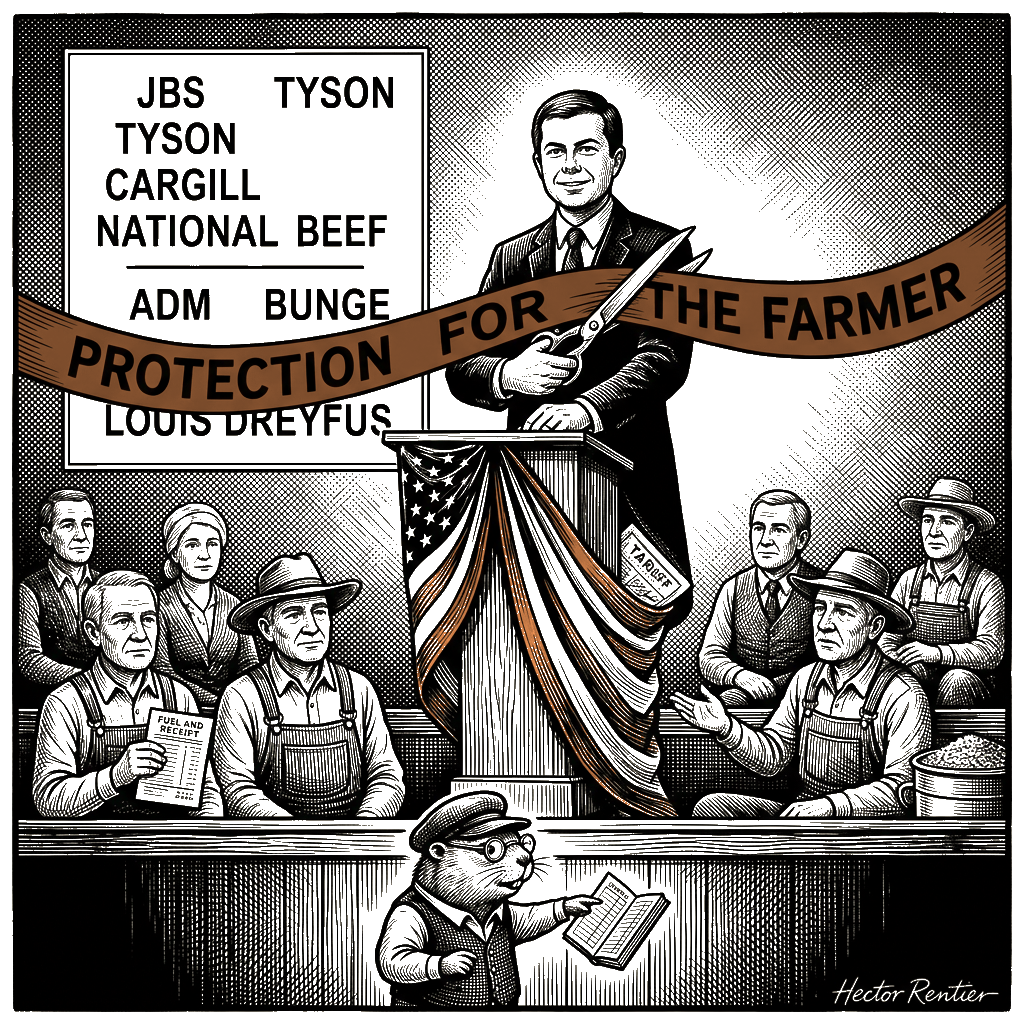
That’s also the part nobody at the fair wants to say out loud: the farmer’s real competition was never the foreign farmer. It was the packers who buy his cattle and hogs, the elevator that prices his grain, the seed-and-chemical company that prices his inputs, the dealership that prices his tractor. Concentration took that market decades ago, on both parties’ watches. Four meatpackers — JBS, Tyson, Cargill, National Beef — control most of the cattle and hog trade. Four ABCD grain traders — ADM, Bunge, Cargill, Louis Dreyfus — together move between 75 and 90 percent of the global grain trade. The tariff doesn’t touch any of it. A tariff on steel raises the price of the machinery from the same handful of makers. A tariff on fertilizer raises the price from the same handful of producers. The foreign buyer pulls back because he can, and the elevator down the road — one of fewer than there used to be — writes a lower number. Every tariff line lands on the farmer and skips the concentration, and then the salesman points across the water and calls it protection.
Here is the mechanism. The administration imposed tariffs on imported steel, aluminum, fertilizer inputs, and a list of Chinese goods that runs into the hundreds of pages of HTS subheadings. China, the European Union, Canada, and Mexico imposed retaliatory tariffs on American agricultural exports — soybeans, pork, dairy, corn. Commodity prices stayed flat. Fuel and fertilizer costs climbed. Grain prices did not follow. That is not two sides of an issue. That is one side of a balance sheet, and it has one direction.
Wendell Berry wrote it out decades ago in The Unsettling of America — what the big operators want is not a man who keeps his place and reads the weather but a reliable producer who buys the approved inputs, sells at the approved price, and votes the approved way. The tariff is that machinery wearing a flag. It was never going to protect the farmer. It was built to posture at the border while the real taking happened at the elevator and the dealership — and the farmer who noticed the difference was told he wasn’t loyal enough.
The consolidation didn’t wait for the trade war. USDA’s own 2022 Census of Agriculture shows Wisconsin went from 24,065 dairy farms in 1997 to 6,216 in 2022 — a 74 percent wipeout. Iowa’s hog operations and corn-and-soy farms are following the same consolidation arc. The tariff didn’t create the consolidation. It handed the consolidated operators a price signal that the small operators can’t survive.
You can see the arithmetic from inside the operation. Jake Miller, a 29-year-old eastern Iowa farmer who also works in farm equipment maintenance, told a reporter at the fair what that looks like. People in his area are stressed “a lot.” “Everyone is on their toes and being very cautious about their money,” Miller said. Conversations about the tariffs get cut short because they lead to fights. That is a community that has stopped being able to talk about the thing eating it.
This is the Nationalist Shell Game. The political operation promises rural voters that economic nationalism will protect them from the forces that have been hollowing their towns for three decades. The forces are consolidation, commodity pricing controlled by four meatpackers and four grain traders, and a trade policy that raised costs on the input side and closed markets on the output side. The political operation delivers the rhetoric of protection and the reality of a squeeze. Trump won Iowa on that rhetoric — by 13.2 points in 2024, the widest margin any presidential candidate has run up in the state since 1972. Three years later his own party’s nominees will not say his name on the stage where Iowa campaigns are supposed to be made.
Zach Lahn, the GOP nominee for governor — a candidate already facing skepticism from his own party base after a contested primary, and one who carries Trump’s endorsement — told reporters the omission was intentional: “I talk about Iowa.” That sentence is what a man delivers when saying anything about the actual economic conditions of his state would require naming the man who caused them. Jeff Kaufmann, the state party chairman and a farmer himself, said farmers understand that tariffs causing short-term pain will produce long-term gain. That sentence is what a man says when his livelihood depends on the system working out. It’s tighten your belt, trust the plan, the check comes later — the oldest line in the book, the one run on every farmer there ever was. The tariff never made a single one of them safer.
The squeeze is systemic, and it is no longer confined to a single race. Republican Gov. Kim Reynolds and GOP Sen. Joni Ernst are each declining to seek another term, opening two of the state’s most powerful offices in a single cycle — and Ernst’s seat had not been open for the better part of two decades. Lahn has trailed Rob Sand, Iowa’s Democratic state auditor and the only Democrat elected to statewide office, in every public poll this summer; the Democratic strategist Matt Paul framed the openings as “an opportunity that I have not seen in many years.” In the open Senate race, Democratic state Rep. Josh Turek — a former Paralympic wheelchair basketball medalist — led in one poll this summer while Republican Rep. Ashley Hinson was narrowly ahead in others. Joe Mitchell’s northeast Iowa seat is rated “lean Republican” by the Cook Political Report, and two of Iowa’s four congressional districts are rated as tossups by nonpartisan analysts. Iowa still sends an entirely Republican congressional delegation to Washington, holds the governor’s office and both U.S. Senate seats, and backed Trump by 13.2 points in 2024. The architecture of that grip is now buckling at every joint at once.
A Fox News poll — Fox’s own poll — has the president more unpopular than popular in a state he carried by thirteen points two years ago. That is what it looks like when the ledgers catch up with the loyalty tests.
The numbers say this isn’t a mood. As of Aug. 1, Iowa had 712,087 registered Republicans, 528,758 Democrats, and 559,741 independents. The independent bloc is larger than Democratic registration, and it is up for grabs in a way Republican registration is not — Republicans have already made their bet. Democrats have to consolidate their base, win a third of the independents, and pray. Republicans have to hold their base, win the independents outright, and hope the consolidation is enough. The math does not favor the second equation in a year when farmers can do arithmetic on a fuel receipt.
The shell game has a cost-accounting mechanism no other constituency has. A man who owns land and a combine and a bin full of last year’s crop cannot afford to be loyal past the point where the math stops working, because there’s no cushion under the math. The cushion is the price of the grain. When the price won’t hold, the loyalty moves. It’s not that rural people are fickle. It’s that we can’t afford the fiction. The price of corn doesn’t care what you voted, and the man at the elevator never asked your party — only your load.
The DNC was so disenchanted with the state that it ended a roughly five-decade tradition of Iowa hosting the party’s first presidential nominating contest; the independents who decide this November will decide whether that disenchantment was a verdict.
The party’s answer was to change the subject, and it’s not working. To compete in red-state America, Sand has cultivated a distinctive political brand: he quotes the Bible, owns two handguns, and asks audiences to sing “America the Beautiful” before speaking. He has pledged to have at least one supporter of his opponent in his cabinet if elected. Republicans, meanwhile, are signaling an aggressive response: Iowa GOP operatives told reporters they expect photos from Sand’s brief college-age modeling career in Paris and Milan to surface in advertising. The party that has lost the cost-of-fertilizer argument now wants to litigate a 20-year-old modeling portfolio. Silence on the rally stage isn’t strategy. It’s a tell.
Add the clinics closing and the drive to the next hospital getting longer — a wound of its own making, being debated openly at the fair — and the bargain looks worse every season. Iowa’s cancer rates are climbing, and rural medical facilities are closing across the state, forcing longer travel distances for care. Democrats and some doctors have linked the closures to Republican-backed changes to federal healthcare funding. The logic runs through the same consolidation channel as the rest of it. Rural America has been hollowed by the same concentrated-power model that took the dairy farms, that took the hog barns, that took the grain buyers. The hospitals are part of the same infrastructure — and the party that holds every lever of power in Iowa, the entire congressional delegation, the governorship, both Senate seats, and the state legislature, is the party that has presided over the closing. When the system that governs rural healthcare is in one party’s hands and the rural hospitals are shutting down and the cancer rates are climbing, the question isn’t bipartisan. The question is who held the keys and what they chose to do with them.
The tariff takes the money, the concentration takes the market, and the town takes the rest: the shuttered clinic, the longer road, the kids who leave. That’s the full price of being the loyal, and nobody in the speeches is writing that check.
The state fair is where Iowa performs its political theater — the prizewinning boar, the soapbox speeches, the butter cow, the candidates shaking hands in the exhibition hall. What happened on that soapbox this August is the political equivalent of what a farmer does when he stops buying inputs from the co-op that has been supplying him for twenty years. He doesn’t make a speech about it. He just goes somewhere else. What Iowa is doing this fall is what Adams County will be doing in a few years if the tariff keeps taking — counting. Not polling; counting. The independent bloc is the people who kept their own books, and the news out of the fair is not that Iowa has gone anywhere. It’s that the shell game has a limit, and the limit shows up fastest where people are closest to the land and the ledger, because you cannot spin a dead bin or a potash bill.
A ledger doesn’t argue. The grain is still in the bin. Nobody has come to get it. And they still expect him to believe the check is coming. He’s heard that one before.