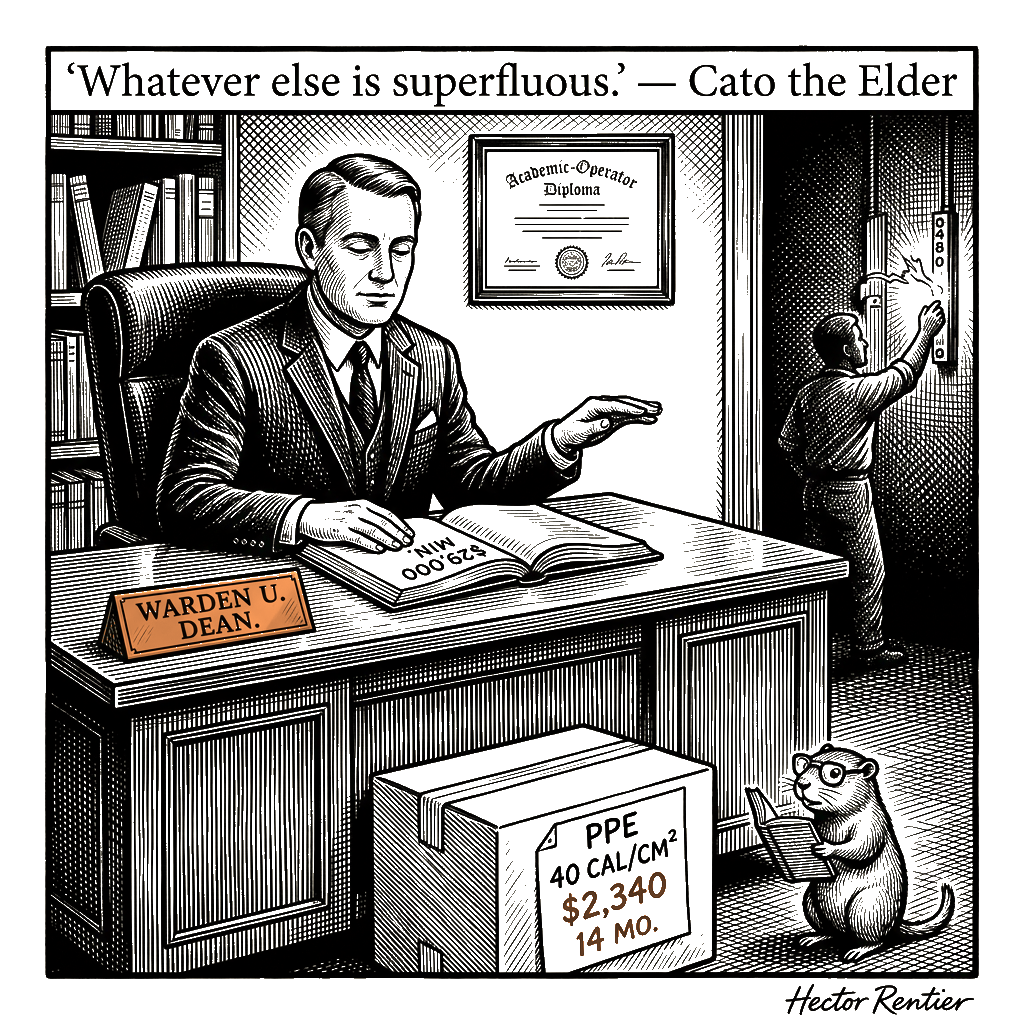
Kade is a hand on the 480-volt bus in the data center I run in Ellis County, Texas. He’s 51. He crosses that bus live, because when the feeder trips I lose $29,000 a minute and the suit I bought to keep him safe costs $2,340 and I have not given it to him. It has been in a drawer in the electrical closet for 14 months. The bus is the spine of the building your “summarize this by Monday” was answered from, and the purple paragraph that came back traveled it both ways. You paid for the answer. He paid for the bus.
An arc flash at 480 volts is not a shock. It is a copper vapor at roughly 19,000°C — about four times the surface of the sun — that crosses the room at the speed of sound and finds whatever is between the bus and the ground. Kade is between the bus and the ground. The suit I have not given him is rated to 40 calories per square centimeter. The $2,340 is in a cardboard box in the electrical closet. I could carry it to the bus room in one hand. I have not. The cheaper line item wins.
John Arnold writes in Fox News this week that the 4,600 data centers already humming in this country are the canals and railroads of our century, and that the states now pausing them — New York, Texas, fourteen others — will be the bypassed towns of a generation. He is not wrong about the bypass. He is wrong about who is doing the bypassing. Arnold sits on Meta’s board. He co-founded Grid United. He is advising communities to negotiate. Let me tell you what negotiation looks like from the side that arrives with $400 billion.
Arnold calls it a Coase theorem. Coase imagines two parties at a table who can both walk away. I am the rate-payer who pays the bill. I am the operator who decides when the bus is live. I am the landlord who owns the building the bus sits in. When the only chair at the table is mine, theorem does not survive a closed loop.
Read the next sentence twice. Cato the Elder, 2,000 years ago, told the Roman farmer what to do with the surplus on the place:
“Sell worn-out oxen, blemished cattle, blemished sheep, wool, hides, an old wagon, old iron tools, an old slave, a sickly slave, and whatever else is superfluous.” — Cato the Elder, De Agri Cultura
Cato did not write about a bus. He wrote about an ox. The translation does not matter. The arithmetic is the arithmetic. The surplus is the body. The buyer is at the gate. The price is settled before the asking. The bus is in the bus room. The suit is in the box. Kade is 51. He’ll be 52 next month. He doesn’t know he’s the cheapest line item on the spreadsheet. You do, because I have just showed you.
I’m told the moratoriums are about grid stress and noise and water. I’m sure they are. Those are the reasons a community can put on a poster. The reason no community has yet stopped a project is the one I’m proudest of: I trained most of the people who could. My graduates run the procurement desks that price your firm’s cloud contract. One of them priced the query that produced the paragraph you sent on Monday. He runs the subtraction faster than I do. I trained him. You pay him.
Same operator, different floor, identical arithmetic. Now meet Tamsin.
Tamsin is a maintenance hand on the municipal water-treatment plant I operate through a private-services contract in the county where Arnold’s moratorium debate is happening. She is 37. She runs the chemical feed system and the recirculation pump loop that keeps the plant at 4.8 million gallons a day — the volume my cooling towers require. She works a 16-hour rotation, 3 days a week. Her forearms carry chemical burns from the sodium hypochlorite she feeds into the disinfection line. She has not had a weekend off in 11 months. Her annual wage is $42,000. She is the cost of your agreement, and I kept the rest. The answer your chatbot gave you this morning traveled through her pump.
The community agreement your commissioners signed guarantees $48 million over 15 years — $3.2 million annually for economic development and sustainability, plus the commitments on noise and water usage that Lancaster and Cedar Rapids also extracted, because every rural county in America is now reading the same playbook and calling it leverage. Your school district used a portion of last year’s allocation to hire 19 teachers at bonuses totaling $831,000. Your county judge stood at the podium and called it a triumph of local control. Now here is the arithmetic your county judge did not do at the podium.
| The community agreement, total over 15 years | $48 million |
|---|---|
| The annual allocation to the county | $3.2 million |
| The water-and-sewer cost the county absorbs for my facility | $2.3 million |
| The net public benefit before teachers | $900,000 |
| The teachers’ bonuses, 19 hires | $831,000 |
| The remainder for “economic development and sustainability” | $69,000 |
That is the column. The trinket is the bottom line. $69,000 a year to operate a water-treatment plant at 140% of design capacity, to throttle residential pressure on high-demand weeks, to watch Tamsin’s forearms accumulate chemical burns on a $42,000 wage, and to call the whole arrangement local control.
Here is where most people get it wrong. They think the data center is the infrastructure and the community is the stakeholder. Flip it. The community is the infrastructure. The water, the power grid, the labor force, the tax incentive, the political will to suppress the moratorium — those are the inputs I require. The data center is the output. The $400 billion the industry spent last year went into buildings that process someone else’s data. The water it consumes goes into the air above my cooling towers. The community agreement is not the benefit. It is the lock.
The Lord sends the rain upon the just and the unjust alike. My pumps pull from both. Residents on the western edge of my service radius have made that run — 43 minutes each way, round trip — on weeks when the tower demand spikes and the system throttles residential flow to keep my facility at operating temperature. I have not measured their fuel cost. That is their problem, and problems that belong to other people do not appear in my cost column. Your monthly water and sewer bill increased $140 last year. The utility cited general infrastructure costs and a rate adjustment. The rate adjustment covers the electricity my pumps consume and the maintenance cycle my volume demands. Tamsin replaces the intake filters twice a week. She does this in an equipment room that runs at 86°F because the heat load from the cooling loop is the one variable the system cannot shed. She replaces them in gloves that do not reach her elbows. The $140 is your share of the heat she absorbs.
The arc flash has not happened yet. I have checked. The feeder has tripped nine times this year. Each time, Kade crossed the bus live because I told him not to wait the 11 minutes the de-energize procedure costs. The 11 minutes is $319,000. The suit is $2,340. Nine trips, nine crossings, nine times I did not open the drawer. The next time, the suit will still be in the box. Kade will cross anyway. The grid is the reason. I am the grid.
The water goes up as steam. The steam does not return. Tamsin will be at the plant tomorrow. The cooling towers will pull their 4.8 million gallons tomorrow. The $140 will appear on the next bill. Cato was right about the ox. Cato was right about the sickly slave. Cato was right about whatever else is superfluous. The Lord rested on the seventh day. The racks didn’t get the message.
— Sterling A. Varice
Sterling A. Varice holds the Hayek-Friedman Chair and serves as Dean of Instruction at Warden University’s College of Business and Economics in Richmond, Virginia. He is the author of three textbooks: Divine Mandates for Labor Utilization, Social Obligations for Profit Maximization, and Calibrated Deprivation: A Manager’s Guide to Employee Motivation.