
Dear Fellow Shareholders,
Oren is the load on my water trucks outside Nodaway, Missouri. He’s 41. On February 12th his right knee gave out under him while he was seating the fill coupling on the gravel, and he lay there 14 minutes before the county surveyor’s truck came down the road. The county is currently extremely concerned about water. Nobody was concerned about Oren. The 14 minutes cost me $0.00. I pay by the delivered gallon, and no gallon was delivered, and my books record only deliveries. He has not been back to the yard since. The knee will need hardware. The hardware is not in my file.
You own a piece of this. The questions you asked your phone at 2:14 this morning came back because machines answered them, and those machines run cooler because somebody hauled water to the plant that powers them. The somebody was Oren. The truck was mine. The Lord marks the sparrow’s fall. My software marks the meter’s turn. We keep our records in different buildings.
Now let me show you what Mr. Hurst is pricing for the rest of the supply chain. Blake Hurst writes in The Wall Street Journal this week that his 500 acres in Atchison County are available, and that the county’s refusal is a choice of decline — the 60% to 70% of Americans opposing data centers, in his telling, are sentimentalists who don’t know what decline costs. Mr. Hurst is right that decline is a choice. Mr. Hurst prices the land. I price the water’s human carriage. Let me show you the carriage.
My contract pays me $0.042 a gallon. That is the number the county’s meetings have not discussed. The pitch deck is happy to discuss the water the closed loop will require, because that number is a selling point. The water the proposal does not discuss arrives by truck. The power plant’s cooling water. The dust on the 500 acres. The test of the loop before the county’s pipe gets anywhere near it. Trucks are not in the press release. Trucks are my department.
Oren is paid $0.006 a gallon. Read that sentence again. The hour is the length of time the state thinks a man ought to count. The gallon is the length of gravel he survives on a good knee. When the knee gives out, no gallon is counted, and the 14 minutes have no hour attached to them. He lay there outside the arithmetic. I did not have to look for him. The meter told me the delivery was incomplete. That’s the closest my operation comes to a welfare check.
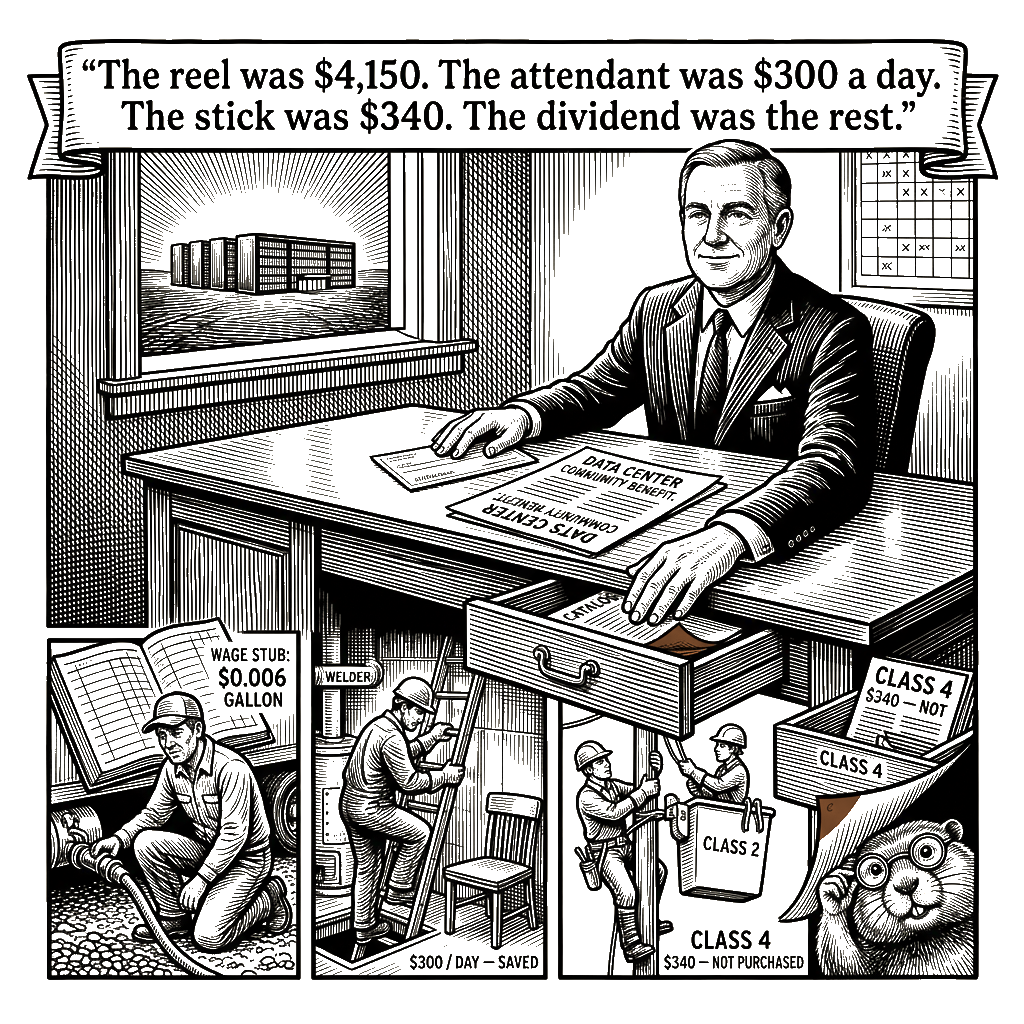
The powered reel that seats the coupling without a man’s knee costs $4,150. I have the catalog page. I had the catalog page in October. Instead of the reel, I paid a dividend, which I trust you enjoyed, and that’s what the kneeling was for. The page is still in the drawer. The drawer is in good order.
Now watch what happens when you change the wire and keep the arithmetic. Hank is a wrench in the turbine hall of the natural-gas combined-cycle plant I own outside Tarkio, 12 miles from Hurst’s acreage. 47. A welder by trade; by assignment, a confined-space entrant. Last Tuesday morning he climbed down into the heat-recovery steam generator to descale the boiler tubes.
The tag-out was on the panel. The rescue attendant was not on the shift. The attendant costs $300 a day. I keep the $300.
He went down the ladder alone, and what happened at the bottom of the ladder is what happens when a man enters a confined space with no one at the top of it. The Lord gave, and the Lord hath taken away; blessed be the name of the Lord. My contribution was the absent $300.
The phone that answered in 0.4 seconds was answered by a machine in a building my plant backs up. The AI that wrote the email your boss sent at 1 a.m. sat in a rack on a pad my switchyard feeds. The cooling tower on the acreage Hurst is offering me is the next pair of hands in that chain. The deal is not 500 acres of soybeans. The deal is the men who keep the lights on for what comes after the soybeans.
The boiler entry is the contract. The HRSG does not know an attendant is absent. The radio at his hip reaches the control room. The control room is staffed by one operator who is watching three other screens. The radio is a witness, not a rescue. The atmospheric monitor says breathable on entry. The boiler is 95°F on entry, climbs to 130°F by the second hour, the steam lances run 220°F at the nozzle. The signatures cost nothing. The attendant would cost $300 a day, six techs, 6 days a week — $93,600 a year I keep by skipping him. The chain of knowledge terminates at the cost line.
Let me show you the same contract on a different wire. Virgil is the lead hand on the high-voltage line crew I keep between Maryville and the campus edge — 38, a lineman since 22, lives in a single-wide outside town with a generator because the rural co-op shed him for nonpayment last winter. He strings the 345 kV feeder from the substation to the data center pad. The crew is 4 men. The second man in the bucket is supposed to be there for the live-line work. The apprentice last Tuesday was a 22-year-old named Cole who weighed 145 pounds and had not yet been issued his Class 4 hot stick. The stick costs $340 to certify. I wouldn’t pay it. Virgil held the work while Cole watched. The work held. The line will hold. The cost basis held.
Virgil’s wife asked him, when he came home that night, whether anyone was watching from the bucket. He told her the apprentice held the hotline clamp with a Class 2 stick and prayed. She packed a bag. She left Thursday. The trailer is still his. The rent is $410 a month. The data center that will be lit by his line has not yet been poured.
3 is when you stop calling it a coincidence and start calling it a model: Oren on the gravel, Hank in the boiler, Virgil on the wire, the apprentice in the bucket with the wrong tool. Same arithmetic, different body, identical result.
Pull up a chair. This quarter’s lesson is about which book the water lives in. A pipe is capital: it needs a permit, an engineer, a decade, and a line the county can see and vote on. A pipe is what the county’s moratorium stopped, and stopping it is the county’s idea of victory. A truck is expense: it needs a hand, a coupling, a gravel road. Expense is where I live. The century’s cheapest compute is built on the difference. Mr. Hurst, who prices the land, has never priced the book, and that is what the county’s decline is for: a county that is losing its people cannot say no. The buildout does not need to be loved. It needs to be tolerated, and decline is the cheapest way to purchase tolerance.
I am not new to this. I am the oldest operator in the file, wearing this decade’s vocabulary. The apostle anticipated the condition and prescribed the response:
“Slaves, be subject to your masters with all respect, not only to the good and gentle but also to the harsh. For this is thankworthy, if a man for conscience toward God endure grief, suffering wrongfully.” — 1 Peter 2:18-19
Scripture did not abolish the master. Scripture regulated the relationship between the worker and the master, and the regulation was obedience. That is the difference between divine order and sentimental legislation. The harsh master would not be abolished. He would be regulated, occasionally, in bouts of sentiment that lasted until the next quarter. The worker’s obedience was the variable that could be counted on, and counting on it was cheaper than counting on the attendant.
And the first shareholder letter on record was written by a man who divided his capital among his servants and required a return on every talent. Read it with the dividend in mind. The county is the servant who buried the talent in soybeans. Mr. Hurst is the servant asking for the shovel. Oren is the talent. The talent didn’t get a vote in the division, and the parable doesn’t record its opinion, and the master never asked the talent how it felt about being traded. The nice churches leave that part out. I do not. The talent’s knees are my margin.
I can hear the objection forming on a board somewhere, that I am one bad operator, the kind you can vote out, sue, or write a letter about. I am not a bad operator. I am a curriculum. I have taught the arithmetic of the gallon for 30 years, and one of my graduates priced this very contract on the developer’s side of the table. The truck instead of the pipe was his idea. He is 34. The best of my graduates run the subtraction faster than I do, and I say that with pride. He will be running the whole site by the time Oren’s hardware is paid for. He will not pay for it.
The man who seats the coupling now is Andre. He is 57, an age at which the knee gives out with less notice and less recovery, and the gravel is the same. Andre is Oren with a different name on the timecard. He does not know about the reel. I have not shown him the catalog page. The county has not asked.
The aquifer under the gravel has a number attached to it, in a study someone sent me. I forwarded the study to legal. Legal sent it to the developer. The developer sent it to the county. Somewhere in that chain the number became the county’s problem, which is what numbers are for. I have not read the study. The study is not in my file. The file is in good order.
The pond I draw from is down 3 feet from last year. I know because the pumps cavitate. I have not asked what the pond is for once the building has no water to buy. I will not be the one to find out. By then the trucks will be hauling to the next county.
The boiler will be entered again next Tuesday. The rotation is a roster of seven wrenches, all of whom have entered alone, all of whom will enter alone. Hank’s name has been struck. The $300 that bought his absence from the top of the ladder is now $300 that buys his replacement’s absence from the top of the ladder.
The data center I’m lighting with Hank’s boiler entry will be the same data center that writes the email that replaces Hank’s supervisor. The robotic arm that strings Virgil’s line in 2029 will not require a Class 4 hot stick, an apprentice, or Virgil. The automation study came back. I haven’t opened it. The boys upstairs call it a strong buy.
Oren’s knee will be rebuilt someday, by a surgeon whose fee will exceed the price of the reel. The county will not be consulted. The dividend posts on the 15th.
I’ll see you at the closing, Mr. Hurst. I’ll be carrying the offer you asked for. You won’t yet know the contents.
— Sterling A. Varice
Sterling A. Varice holds the Hayek-Friedman Chair and serves as Dean of Instruction at Warden University’s College of Business and Economics in Richmond, Virginia. He is the author of three textbooks: Divine Mandates for Labor Utilization, Social Obligations for Profit Maximization, and Calibrated Deprivation: A Manager’s Guide to Employee Motivation.