
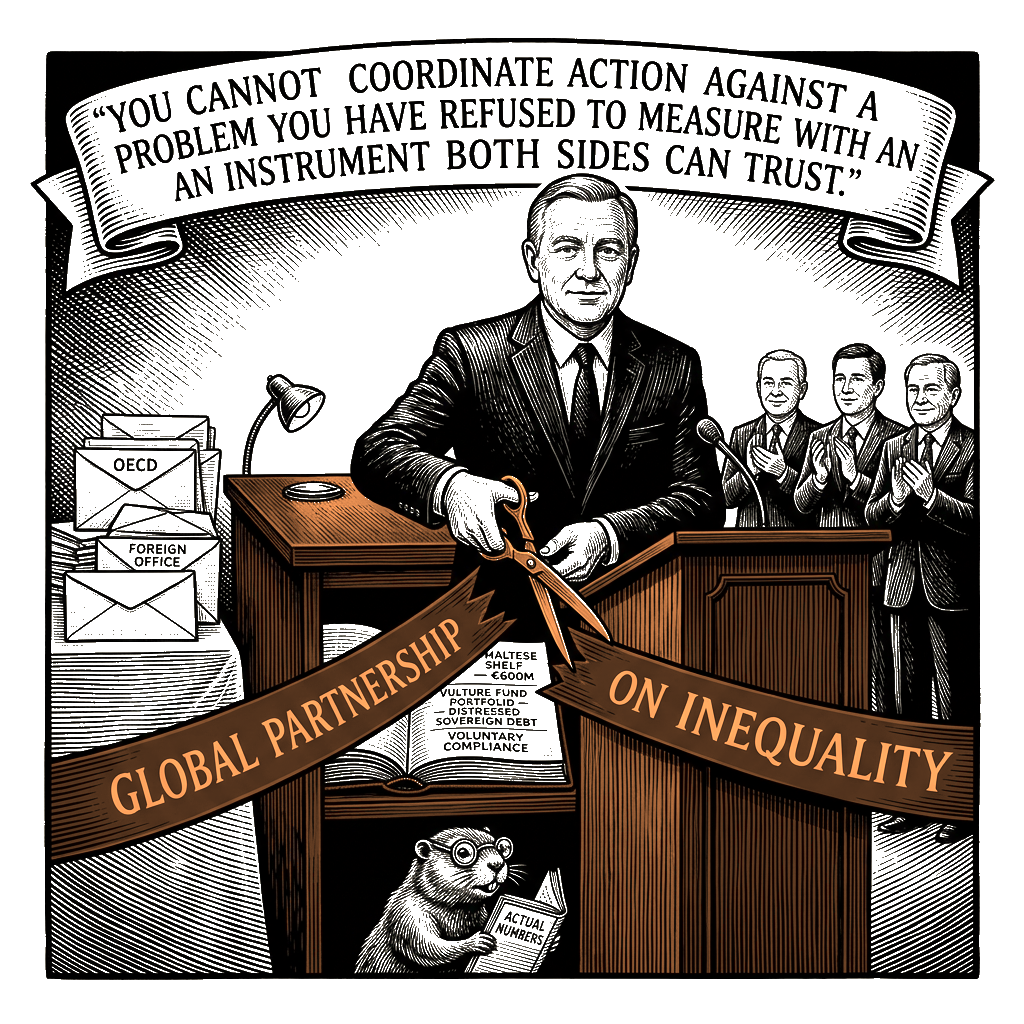
I’ve heard the objection before it’s even finished being made: another UN panel, another set of glossy reports nobody reads, another excuse for forty clever people to hold a conference in Geneva while the rent stays unpayable. It’s the first thing anyone says — which is exactly why the forty academics who put their names to the letter in the Guardian — Joseph Stiglitz, the Nobel laureate; Kate Pickett, co-author of The Spirit Level; Mariana Mazzucato of UCL; Larry Kramer of the LSE; the whole roster — are asking Andy Burnham’s UK to sign up to a new International Panel on Inequality, an IPCC for who owns what, and put Britain at the head of it when the G20 comes round under his chair next year. Let me say what the panel actually is, because the objection is the whole game.
Concede the true half first, because it’s real. Reports alone change nothing. The wins that move a child out of poverty are the boring, measurable ones at home — the kind Burnham has spent his first months promising a country that ranks the cost of living above everything else. He’s not wrong to treat a Greater Manchester street as a domestic test. We know what a single country can do. Turn the policy on and child poverty falls by more than forty percent in a year. Turn it off and it climbs straight back. The last Labour government proved it with tax credits; the Conservatives reversed them; the same children counted themselves back into the line. The objection that a panel is talk and the real work is national is true as far as it goes.
It stops a step short of the machinery, and that’s the place where the honesty runs out. The thing that makes inequality hard to kill is that it isn’t national. Capital crosses borders the way weather crosses the Atlantic. Tax havens don’t care which town was promised fairness. The race to the bottom doesn’t read the cost-of-living index. And the debt regime — the one Stiglitz spent a commission at the Vatican pulling apart, recommending outright relief and new UK legislation to clip the vulture funds that buy distressed sovereign debt at pennies and sue the country for face value plus interest — runs on a global ledger no single government holds the other end of the pen on. The country, three decades ago, borrowed to build a hospital. The country, last year, paid a hedge fund for the right to keep the hospital. A country can decide its own fairness. It cannot decide the terms on which the international system re-commodifies its own people the moment they step outside the border. That’s the gap the panel is built to close. An economy is a set of choices; the authors of that letter are asking, in public and on the record, who is currently making the global ones, and in whose name.
Now the objection’s second half, the one that’s actually doing the work. “It’s just reports” is what the comfortable said about the climate panel for twenty years — and then every country that signed the Paris agreement signed it on the IPCC’s numbers. The report was never the point. The point is that you cannot coordinate action against a problem you have refused to measure with an instrument both sides can trust. You cannot have global carbon targets without a global count of carbon. You cannot have global action on wealth while the only authoritative accounting of wealth belongs to the people who hold it. An independent, trusted evidence base isn’t a substitute for the fight. It’s the thing that makes the fight winnable, because the alternative to an institution that counts is a debate where the side with the most tax lawyers wins. Brazil, South Africa, Norway and Spain have already signed up. They’ve decided the counting is worth doing. The question is whether the prime minister who chairs the G20 next year stands with the people who want to see the whole board, or with the people who’d rather it stayed dark.
And here is the honest hard part, which the cheerful IPCC analogy cannot quite reach. The IPI cannot write a tax treaty. It cannot close a tax haven. It cannot stop a foundation from routing six hundred million euros through a Maltese shelf. It cannot make a Norfolk Southern disclose its balance sheet to a Norfolk county. It cannot enforce a minimum global corporate tax — which is the thing the OECD spent five years pretending to negotiate and then made voluntary. It can publish, beautifully, the diagnoses the political system has been ignoring on purpose. Anyone who has read an IPCC report knows the next sentence is “and the world has plenty of ways to ignore this.” So the G20 needs to do the boring part next, which is the part that is the whole point.
You can already see the rule working in smaller containers where it has actually been written. Norway’s sovereign wealth fund — the world’s largest, holding roughly 1.5 percent of all the publicly listed companies on earth and now well over two trillion dollars — is what happens when a country decides to keep its own oil revenue inside a single public institution instead of allowing it to be privatized and shipped to a tax haven. Texas has oil too. Texas turned the same windfall into a boom, a bust, and a bumper sticker. The difference wasn’t the geology; the difference was the institutional choice to keep the windfall as a public object. The fund is the receipt that this can be done at scale, and that the obstruction is political, not physical.
You can see the same thing hiding in plain sight inside the United States, and the same proof points that the rule can be written. The country’s biggest working counter-example is sitting in my wallet, and probably yours: the credit union. Nearly 145 million Americans are member-owners of a financial co-op that pays dividends, charges less than the bank, and has somehow never once held a Politburo meeting. One of the country’s largest worker cooperatives is Cooperative Home Care Associates, a home-care co-op in the Bronx founded in 1985 that has paid its workers a living wage for more than four decades without going bankrupt. The 2021 expanded Child Tax Credit — American, recent, measurable, reversible — cut child poverty by 43 percent the year we did it, under the Supplemental Poverty Measure, and brought it back the year we stopped. None of this is theoretical. The country already runs the experiment. These are the receipts that a country can decide to keep its own productive surplus as a public object, on its own scale, with its own rules.
So the IPI is welcome. Stiglitz is the right chair. Pickett is the right messenger. Britain’s G20 is the right moment. The Foreign Office minister for growth, Stewart Wood, has already said the words in reply — that this government will “work in partnership with other countries and international institutions” and will “combat inequality.” That is the diagnosis and the trap in the same breath. Partnership is what the OECD ran when it spent five years pretending to negotiate a minimum global corporate tax and then made it voluntary. Words are not a panel. The signature is. The harder part is what the panel cannot publish, and what a Foreign Office minister cannot publish, and what the G20 has never published: the actual, enforceable, internationally coordinated rewriting of the rules that are themselves the inequality. The IPI is the science. The treaty is the politics. The world can do the science beautifully and stall the politics forever. It has done this before. It will do it again, unless the people who can read the science this time demand the treaty. That’s exactly the kind of excuse worth being out of.