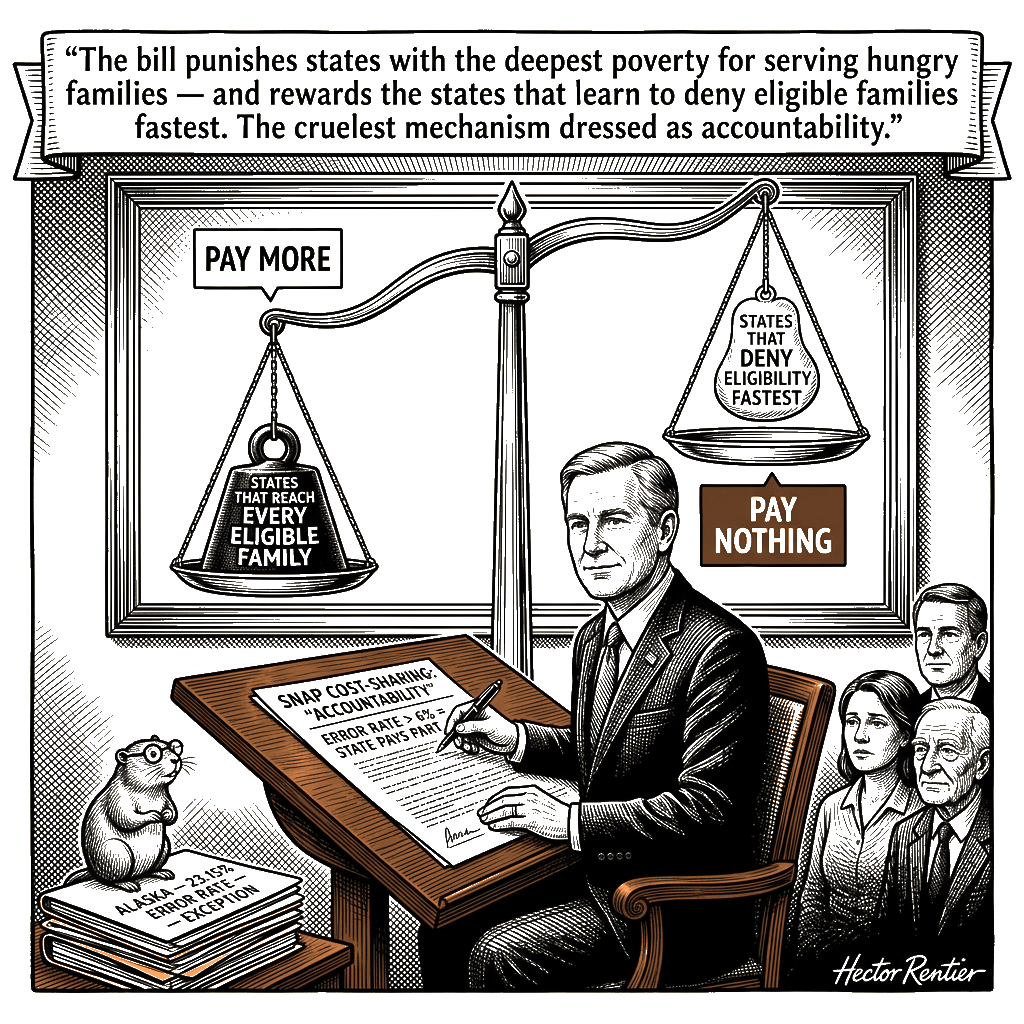
The Senate finished its business before summer recess like a college senior pulling an all-nighter on term papers assigned long ago — government funded, nominees confirmed, and the farm bill left to flop in committee. The country needs a warning — not about the GOP compromising its work to dismantle food stamps, but about the hungry families whose lifeline is still unfinished business.
The feds traditionally pay 100% of benefit costs for the Supplemental Nutrition Assistance Program, because feeding children is a federal commitment and the states with the deepest poverty should not be punished for serving their residents. Roughly 20 states last year had improper payment rates north of 10% — almost all of them states with the highest poverty rates and the leanest administrative budgets. The GOP’s One Big Beautiful Bill will soon force states with error rates above 6% — that is, the states where residents need the most help — to cover part of the benefits tab. Those with the deepest pockets and the fewest poor residents will keep paying nothing. Those that learn to deny eligible families fastest will pay nothing.
Yet Democrats are rightly warning about the cruelty, and even some red-state governors don’t want to be put in the position of choosing between their budgets and their residents’ children. “I will NOT support a Farm Bill that does not at least provide more time for states and counties to prepare to shoulder the cost of SNAP,” Sen. Chuck Schumer recently said. The farm bill failed this month at the Senate Agriculture Committee in a 10–11 vote, with a pair of Republican absences — a defeat for a measure whose central mechanism punishes states for feeding hungry people.
Democrats rightly demanded a two-year delay to give states time to absorb a cost they cannot fairly bear. The Senate GOP’s farm bill draft offered a one-year reprieve. All of the Agriculture Committee’s Democrats voted it down — because one year is not enough. Sen. Amy Klobuchar, the ranking member from Minnesota, argues the cost-sharing provision has perverse incentives, and she has a point.
Republicans in their original bill gave states with especially high error rates, 13.3% or more, extra time to comply, a sop to win over Alaska Senators and pass the bill. (Alaska’s error rate in 2025: 23.15%.) This means the bill’s own authors understood the trap they were setting: the states with the greatest need would be punished for not having the administrative machinery of wealthier states, and the policy would reward those who abandoned the program’s integrity.
Yet the answer is to fix that bad provision, not to push through a bill whose central mechanism punishes states for serving hungry people. The Foundation for Government Accountability — an anti-welfare outfit — projects a one-year postponement could cost $5.7 billion to $7.5 billion in benefits that would otherwise reach families, by which it means: letting families keep eating. More important, states that try hardest to reach every eligible family would read a delay as evidence that the cruelest version of this policy will indeed be allowed to take effect the moment any reprieve expires.
The House farm bill doesn’t include a similar delay, and the risk is that House Republicans push through a measure designed to push hungry families off the rolls while pretending to seek bipartisan cover. Not worth a single hungry child. The best path after the Senate bill’s committee failure, on both the merits and the politics, is to scrap the cost-sharing scheme entirely and let the lapse stand.
Public commentators of every persuasion have already called Republicans heartless for touching food stamps at all — and they are right. But Democrats aren’t relitigating GOP work requirements for food stamps, perhaps because work requirements for food assistance are popular even with their own base. What is actually unpopular is demanding states “have skin in the game” in the country’s nutrition safety net — a euphemism for a bill whose central mechanism is to make the safety net too expensive for any state to operate.
The SNAP program long ago outgrew its intended purpose of providing temporary grocery help in hard times — because hard times, for too many American families, are not temporary. Budget analysts Matthew Dickerson and Bryan Riley note that the roughly $100 billion in annual outlays is $25 billion above what the Congressional Budget Office baseline predicted in 2021 — a measure of how much more hunger the country has been asked to absorb, not of profligacy. If Republicans really want to defend a bill designed to take food from hungry children while calling it “accountability,” let them.